



KEPCO maps out 10-year AI blueprint to modernize electrical substations
Jun 29, 2026, 09:19 am


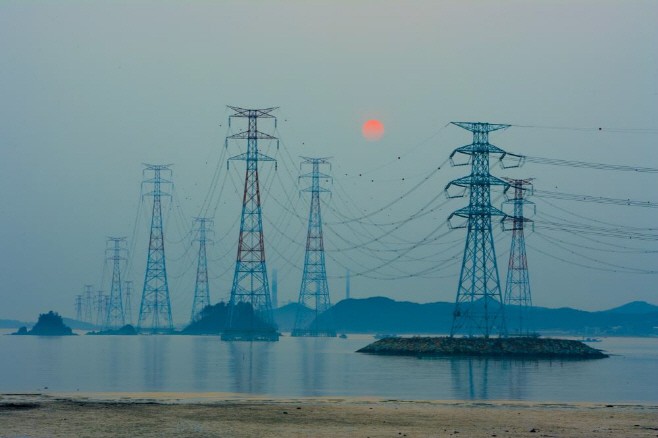 |
| An overview of Korea Electric Power Corporation (KEPCO) transmission towers. / Courtesy of KEPCO |
Korea Electric Power Corporation (KEPCO) is pushing for a transition of its substation maintenance system into an artificial intelligence (AI)-based predictive maintenance model. Amid rising public sensitivity toward blackouts and increasing new loads such as AI data centers, the number of substations and power facilities continues to grow. Consequently, KEPCO judged that the conventional reactive maintenance approach, which relies on manual human inspections, faces structural limitations in ensuring stable power grid operations.
According to industry sources on the 28th, KEPCO will enter foundational work starting this year through 2038 to deploy an AI-based Predictive Protective Relaying System (AI-PRIS) across substations nationwide. AI-PRIS is a system where AI analyzes voltage and current waveforms collected from substation facilities in real time to detect subtle anomalies and predict malfunctions in advance. The utility plans to build this to perform the role of a sort of "MRI for power facilities," analyzing micro-anomaly signals that are difficult to capture with conventional measuring instruments.
The analysis results will be interconnected with the Supervisory Control and Data Acquisition (SCADA) system, the Substation General Preventive Diagnostic System (SEDA), and the Asset Management System (AMS), integrating facility monitoring, preventive diagnosis, and asset management into a unified framework. Through this, KEPCO plans to move away from the breakdown-maintenance style of responding after a failure occurs, shifting instead to a predictive maintenance framework that preemptively identifies and inspects facilities with high probabilities of malfunctioning.
KEPCO plans to expand the application of AI-PRIS nationwide to 1,297 substations by 2038, starting with 90 substations in 2029. Currently, the number of substations nationwide stands at approximately 940. By 2038, this figure is projected to grow by roughly 40% to 1,297. Substation facilities have already increased by about 48% over the 15-year period from 2010 to 2025, but the related workforce grew by only 13% during the same timeframe. As of last year, the operational workforce stood at 4,333 personnel. Because it is difficult for maintenance personnel to keep pace with the velocity of facility growth, a transition to an AI-based predictive maintenance framework is inevitable, KEPCO explained.
The fact that it is difficult for humans to constantly capture the precursors of sudden malfunctions also heightens the necessity of adopting AI. Internally, KEPCO diagnosed that its human-centered inspection method is reaching its limits, stating, "While facilities are increasing exponentially, the shortage of skilled diagnostic and operational personnel is intensifying, meaning the conventional method relying on human eyes cannot bear the operational risks."
Accordingly, KEPCO plans to promote step-by-step technological verifications at the Cheonho Substation and the Gochang Power Testing Center starting this year, embarking on the nationwide expansion from 2029. Based on an estimated cost of about 200 million won per substation, the total project cost is expected to reach 259.4 billion won, injecting an annual average of roughly 21.6 billion won. In the short term, domesticating the system and securing independent operational technologies have been presented as core tasks.
KEPCO anticipates that once AI-PRIS is implemented, it can reduce sudden blackout accidents by more than 50% and optimize facility replacement priorities, cutting annual facility replacement expenses by 20% to 30%.
Meanwhile, cumulative blackouts in the substation sector over the past five years were tallied at 175 incidents. By cause, aging deterioration was the most frequent with 54 cases, followed by operational errors with 46 cases, malfunctions with 31 cases, and ripple-effect failures with 26 cases.
Bae Seok-won
Most Read
-
1
Kia Sportage outperforms Mazda CX-5 in German auto..

-
2
Houthis launch successive attacks on Saudi airport..

-
3
Saudi Arabia, Iran hold first diplomatic talks to..

-
4
U.S. deploys carrier, 10,000 more troops to Middle..

-
5
Saudi airport in Riyadh struck again, leaving at l..

-
6
Putin's ally visits China on the 8th ahead of APEC..

-
7
Chinese military support and training center opens..

PEOPLE





HEADLINE NEWS

-
Address : In-Young Bldg., 34, Uisadang-daero 1-gil, Yeongdeungpo-gu, Seoul
Copyright by ASIATODAY CO., LTD. All rights resereved