



[Exclusive] K-Shipbuilders secure more U.S. Navy MRO requests
Jun 29, 2026, 09:12 am


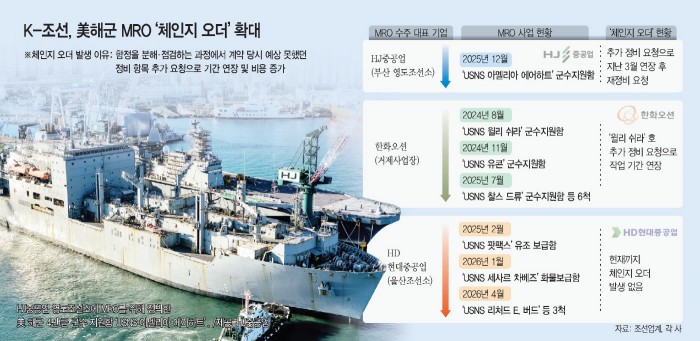 |
The U.S. Navy naval vessel maintenance, repair, and overhaul (MRO) project being performed by HJ Shipbuilding and Construction has been confirmed to be running longer than initially anticipated. This is not a mere delay in delivery, but a result of the U.S. Navy consecutively requesting additional work during the overhaul process, thereby expanding the scope of the contract. Industry insiders evaluated that these additional maintenance requests from the U.S. military, so-called "Change Orders," are appearing across the entire shipbuilding industry engaged in MRO businesses.
According to the shipbuilding industry on the 28th, HJ Shipbuilding has been carrying out maintenance at its Yeongdo Shipyard in Busan after securing the MRO project for the U.S. Navy logistics support ship "USNS Amelia Earhart" in December last year.
Initially, the industry anticipated that the Amelia Earhart would complete its maintenance and depart around March, but it is understood that operations are continuing to this day. According to HJ Shipbuilding, the Amelia Earhart has already executed one Change Order. An additional maintenance project that was not part of the contract scope during the bidding process late last year was extended through renegotiations around March, and the delivery deadline was reportedly set for the end of this month. However, as consecutive Change Orders overlapped, it has been confirmed that even a June delivery has become difficult.
An official from HJ Shipbuilding explained, "While we were proceeding with the work according to the initial contract scope, the U.S. military kept making additional requests saying, 'Since it's already up on the dry dock, please maintain this as well,' which has made the operation period longer than expected."
The official added, "It is not simply that the schedule has been pushed back, but rather a situation where the contract scope itself is expanding as additional work continues to arise."
Such a case is not unique to HJ Shipbuilding. Hanwha Ocean experienced a similar situation. Hanwha Ocean explained that during its MRO project for the U.S. Navy logistics support ship "Wally Schirra," performed in August 2024 as the first in the domestic shipbuilding industry, additional work requests from the U.S. military continued during the maintenance process, stretching the operation period longer than initially planned and leading to a delivery after seven months.
An official from Hanwha Ocean explained, "Even during the MRO project for the U.S. Navy logistics support ship Wally Schirra, which was the first executed by the domestic shipbuilding industry, additional work requests from the U.S. military continued during the maintenance process," adding, "When additional maintenance needs are discovered while inspecting a vessel, adjusting the contract scope alongside the work schedule is a common occurrence in the MRO business."
The industry views this as the "Change Order" procedure unique to MRO businesses. An official from HD Hyundai Heavy Industries explained, "Because MRO requires actually dismantling a vessel and inspecting the interior, it is not rare to discover maintenance items that were unexpected at the time of the contract," adding, "When a client requests additional work, the man-hours and work volume increase, triggering a 'Change Order' where the resulting costs and schedules are renegotiated."
The official went on to say, "Such Change Orders are a common occurrence in the global MRO market," adding, "The fact that additional maintenance continuously arises also means that the client trusts the technical prowess and quality of the respective shipyard, thereby broadening the scope of work."
In fact, the U.S. Navy has recently been expanding overseas MRO utilizing shipyards in allied nations to enhance naval vessel operational efficiency. Domestic shipbuilders, upon discovering unexpected defects during the process of placing a vessel into dry dock and inspecting the hull, machinery, and electrical or electronic equipment, are executing additional maintenance through consultations with the U.S. military.
The shipbuilding industry views that these additional orders will act positively not just for simple maintenance, but also for securing follow-up projects. An industry insider said, "From the U.S. military's perspective, it is far more efficient to complete all necessary maintenance at once rather than placing an already dry-docked vessel back in again," concluding, "Entrusting additional maintenance also implies that they have recognized the quality of work at the respective shipyard."
Han Dae-ui
Most Read
-
1
Kia Sportage outperforms Mazda CX-5 in German auto..

-
2
Houthis launch successive attacks on Saudi airport..

-
3
Saudi Arabia, Iran hold first diplomatic talks to..

-
4
U.S. deploys carrier, 10,000 more troops to Middle..

-
5
Saudi airport in Riyadh struck again, leaving at l..

-
6
Putin's ally visits China on the 8th ahead of APEC..

-
7
Chinese military support and training center opens..

PEOPLE






HEADLINE NEWS

-
Address : In-Young Bldg., 34, Uisadang-daero 1-gil, Yeongdeungpo-gu, Seoul
Copyright by ASIATODAY CO., LTD. All rights resereved