



Europe's heatwave breaks records, with worse forecasted next year
Jun 26, 2026, 05:01 pm


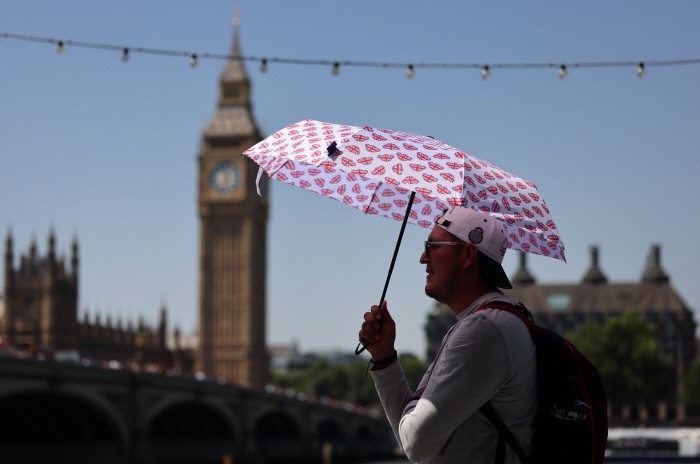 |
| As the UK Met Office issued a red extreme heat warning on the 25th (local time) amid a persisting heatwave, a tourist uses an umbrella to shield herself from the sun in London. / Courtesy of EPA Yonhap |
Regarding the extreme heatwave sweeping Western Europe, experts raised analyses that it would have been impossible without climate change, warning that if the pace of global warming does not slow down, even this summer could be felt as a "cool year" in the future.
Reuters reported on the 25th (local time), citing a study by World Weather Attribution (WWA), a global group of climate scientists, that this week's heatwave in Europe was about 3.5 degrees Celsius hotter than the same period 50 years ago in 1976, and that the likelihood of tropical nights like the current ones has increased 100-fold compared to 20 years ago.
The WWA stated, "This heatwave is the most severe recorded in the study region," adding, "It was virtually impossible without human-induced climate change."
Indeed, the UK recorded its highest-ever June temperature on this day, leading to power supply disruptions and the closure of schools and cultural facilities.
In the case of France, nighttime temperatures in some regions stayed above 20 degrees Celsius for more than a week, and on certain days, the lowest temperature neared almost 30 degrees Celsius.
The WWA anticipated that this heatwave would have severe impacts on health, just as the European heatwave in the summer of 2022 resulted in more than 60,000 deaths. They also predicted that tropical nights would become more intense.
In particular, as Europe is the fastest-warming continent in the world, the intensity and frequency of heatwaves are projected to become increasingly severe.
Claire Barnes, a researcher at Imperial College London in the UK, noted, "We are not doing enough to slow the pace of global warming," adding, "Consequently, peak temperature records will be broken much more frequently in the future."
The WWA also warned that this European heatwave will appear more frequently and with greater intensity in the future, and even the current summer could look like a "relatively cool year" in the future.
Experts pointed out that greenhouse gas reductions and urban-level adaptation policies are urgently needed.
Urban adaptation policies refer to expanding green spaces and providing shade, operating public cooling centers, and improving building insulation and ventilation.
On the other hand, it was analyzed that the current El Niño phenomenon did not exert an influence on this European heatwave.
Park Jin-sook
Most Read
-
1
Trump shares map on social media labeling Strait o..

-
2
Kia Sportage outperforms Mazda CX-5 in German auto..

-
3
Houthis launch successive attacks on Saudi airport..

-
4
U.S. deploys carrier, 10,000 more troops to Middle..

-
5
Trump rejects Iran's offer to open Strait of Hormu..

-
6
N. Korea conducts first swarm attack drill with dr..

-
7
U.S.-China summit falls short on substance as Trum..

PEOPLE






HEADLINE NEWS
- Seoul dismisses Ukraine's claim of 'S. Korean support for Russia' as "inaccurate and inappropriate"
- S. Korea, Japan race to develop nuclear-powered submarines
- Henri Kagan, Kenso Soai win Nobel Prize in Chemistry for uncovering how mol..
- Vance says Alaska LNG cooperation will move forward with Seoul's current or..

-
Address : In-Young Bldg., 34, Uisadang-daero 1-gil, Yeongdeungpo-gu, Seoul
Copyright by ASIATODAY CO., LTD. All rights resereved