



Micron beats earnings, flags major memory shortage into 2027
Jun 26, 2026, 09:24 am


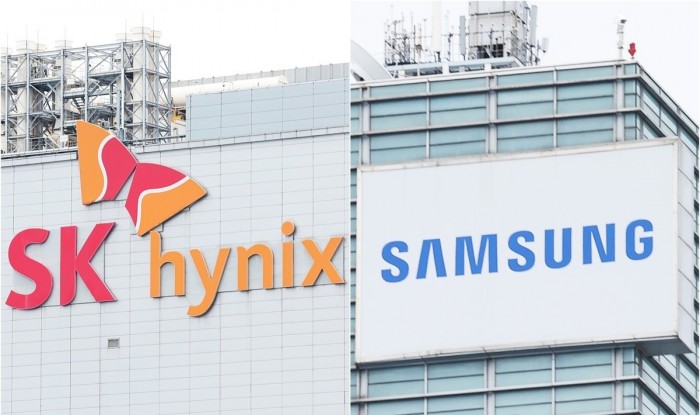 |
| SK Hynix and Samsung Electronics. / Courtesy of Yonhap News |
Micron Technology, the largest memory semiconductor company in the United States, delivered a market-beating "earnings surprise" and forecast that the AI memory supply shortage will persist. Micron has also completely sold out its High Bandwidth Memory (HBM) inventory.
Following this development, projections suggest that memory market leaders SK Hynix and Samsung Electronics will continue to post robust financial results. In particular, SK Hynix is poised to fuel an aggressive capacity expansion, as the company announced it will deploy approximately 45 trillion won—to be raised through U.S. American Depositary Receipts (ADRs)—into facility investments. Capitalizing on these favorable tailwinds, Samsung Electronics is also expected to mount a chase to seize market leadership, spearheaded by its next-generation HBM4.
On the 24th (local time), Micron CEO Sanjay Mehrotra stated during the fiscal third quarter (March–May) earnings call that "AI-driven demand increases will sustain the (memory) supply shortage well into 2027 and beyond," adding, "It is difficult to predict when memory supply will be able to catch up with demand."
On this day, Micron reported an all-time quarterly high revenue of $41.46 billion. This milestone was largely driven by the company completely selling out its HBM inventory through fixed-price contracts for this year.
CEO Mehrotra presented a fourth-quarter revenue guidance of around $50 billion—even higher than the current performance—explaining, "The fourth-quarter outlook, which is stronger than the third-quarter results, reflects the strategic value of memory in the AI era." He further emphasized, "Multi-year Strategic Customer Agreements (SCAs) will enhance the sustainability and predictability of Micron's solid financial performance."
Market observers evaluate that these results have substantially dispelled the "AI bubble" narrative that stemmed from fears of a memory market slowdown. Consequently, expectations are mounting for SK Hynix and Samsung Electronics ahead of their earnings releases next month. Holding market shares of 58% and 21% respectively as of the first quarter, these two companies effectively control the global HBM market.
Particularly for SK Hynix, which commands the majority share, the potential to reap massive benefits remains high. SK Hynix Chairman Chey Tae-won has projected that the memory supply shortage will continue until 2030, and the company is designing large-scale capital expenditures to expand production capacity. It has also unveiled plans to list ADRs on the 10 of next month to raise 45.45 trillion won, utilizing the proceeds to fund the first fabrication plant (Fab) at the Yongin Semiconductor Cluster and the P&T7 advanced packaging fab in Cheongju.
An industry insider noted, "Similar to Micron, SK Hynix will continue to experience sold-out memory inventory," adding, "They will continuously pursue facility investments, and even then, they might feel it falls short of demand."
Samsung Electronics is also concentrating its capabilities on restoring its HBM competitiveness. Having already achieved a world-first mass production shipment of HBM4 last February, the company broke through $1 billion in revenue just four months later. Samsung Electronics is reportedly pivoting its resources entirely toward HBM4, excluding the production required to meet existing HBM3E demand. Industry insiders explain that this reflects the company's strong determination to drive up its market share and reclaim leadership.
Some analysts forecast that full-scale competition will unfold as the AI memory market enters a phase of structural growth. This implies that the memory boom is not a temporary phenomenon but will endure for a prolonged period. An industry insider commented, "The battle for dominance in the memory market will continue," adding, "For the time being, the traditional down-cycles of the past are unlikely to apply."
Choi In-gyu
Most Read
-
1
Kia Sportage outperforms Mazda CX-5 in German auto..

-
2
Houthis launch successive attacks on Saudi airport..

-
3
Saudi Arabia, Iran hold first diplomatic talks to..

-
4
U.S. deploys carrier, 10,000 more troops to Middle..

-
5
Saudi airport in Riyadh struck again, leaving at l..

-
6
Putin's ally visits China on the 8th ahead of APEC..

-
7
Chinese military support and training center opens..

PEOPLE




HEADLINE NEWS

-
Address : In-Young Bldg., 34, Uisadang-daero 1-gil, Yeongdeungpo-gu, Seoul
Copyright by ASIATODAY CO., LTD. All rights resereved