



[Exclusive] Police boost victim safety measures, but court-ordered detentions for stalkers fall
Jun 26, 2026, 09:08 am


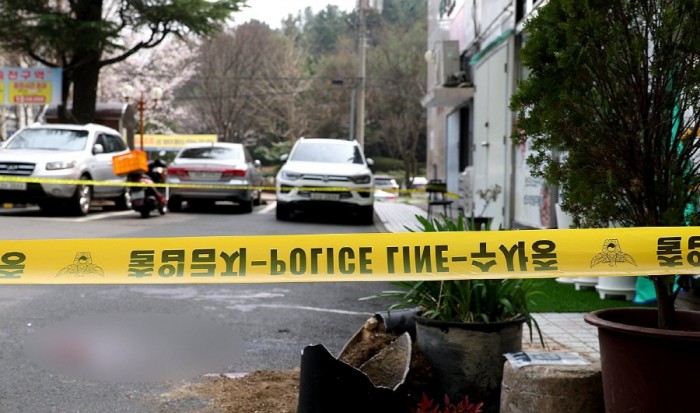 |
| A stabbing occurred at a parking lot near an apartment complex in Seongsan-gu, Changwon, leaving a woman in her 20s hospitalized in cardiac arrest and a man in his 30s severely injured. Photo shows the scene of the crime. / Courtesy of Yonhap News |
While police protection measures for victims of relational crimes, such as stalking and dating violence, have increased, the approval rate for physical isolation measures—detaining perpetrators in holding cells or detention centers—has conversely declined. Experts point out that although the distribution of protective equipment for victims and the tracking of reporting histories are expanding, the effectiveness of separating high-risk perpetrators from victims remains a critical challenge.
According to the National Police Agency on the 25th, the police implemented a plan to reinforce the stalking response and management system, integrating a comprehensive review of reporting histories, victim-perpetrator relationships, and recidivism risks during the handling of 112 emergency calls for stalking, with heads of each police station directly supervising the process.
Through the reinforced management system, the rate of victim protection measures relative to 112 reports for relational crimes rose by 1.8 percentage points, from 9.2% to 11.0%. The monthly average of victim protection measures grew by 50.9%, from 2,872 to 4,333 cases, while monthly average 112 emergency calls also increased by 26.1%, from 31,369 to 39,556 cases.
However, perpetrator control measures showed varying trends by type. Applications for Provisional Measure No. 3-2, which involves attaching location-tracking electronic devices, surged by 153.9% from 26 to 66 cases, with the court approval rate ticking up slightly from 34.6% to 36.4%. Conversely, applications for detention under Provisional Measure No. 4 rose by 26.0% from 100 to 126 cases, but the approval rate dropped from 39.0% to 29.4%.
Provisional Measure No. 4 is a measure to detain stalking perpetrators in a police holding cell or a detention center. Unlike restraining orders or no-contact orders, it can physically separate the perpetrator from the victim, making it a core protective tool for high-risk cases. However, concerns are being raised that a lower approval rate could make on-scene officers more hesitant to secure custody of suspects, even when repeated reports or violations of restraining orders are confirmed.
The recent stalking murder in Namyangju is another example that clearly exposed the limitations of information sharing among related agencies and the access barrier system. At the time, the victim was issued a smartwatch and the perpetrator was wearing an electronic ankle bracelet, but that specific ankle bracelet had been attached due to a separate sex crime. The lack of real-time linkage between the Ministry of Justice's electronic supervision data and the police's victim protection equipment was also pointed out as a flaw.
The perpetrator at the time was reportedly subject to Provisional Measures No. 1, 2, and 3. However, Provisional Measure No. 3-2—the attachment of a location-tracking electronic device that could trigger an alarm when approaching a victim—was not implemented. Applications for an arrest warrant or Provisional Measure No. 4 to detain the perpetrator in a holding cell or detention center were not swiftly pursued either, and the crime occurred in the interim. This indicates that even with restraining orders and victim protection equipment in place, there were limits to preemptively blocking the perpetrator's approach.
An official from the National Police Agency stated, "The police are actively applying for protection measures in high-risk cases," and added, "However, a significant number of cases are dismissed during the prosecution and court stages. As the courts apply strict standards to judge the requirements, there are limitations to practically blocking perpetrators from approaching."
Lee Woong-hyek, a professor of police science at Konkuk University, noted, "Even if detaining a perpetrator is necessary, since it is a measure that restricts physical freedom, clear criteria for risk assessment and follow-up control mechanisms must be established together." He added, "The necessity for detention should be evaluated based on objective indicators such as repeated reports, restraining order violations, and the severity of threats, and a system is needed where the prosecution and court stages evaluate both the risk to the victim and the basic rights of the perpetrator together."
Seol So-young
Most Read
-
1
Trump demands rates fall below 1% as Fed hikes for..

-
2
Celltrion seeks rheumatoid arthritis indication ex..

-
3
Chinese e-commerce giants AliExpress, Temu and She..

-
4
Trump warns countries not helping U.S. must pay re..

-
5
Turkish Airlines named main club partner of Liverp..

-
6
China expels No. 2 military official Zhang Youxia..

-
7
Houthi rebels release video claiming downing of Sa..

PEOPLE







-
Address : In-Young Bldg., 34, Uisadang-daero 1-gil, Yeongdeungpo-gu, Seoul
Copyright by ASIATODAY CO., LTD. All rights resereved