



Japan’s PM sets special budget framework for AI and chips
Jun 25, 2026, 11:15 am


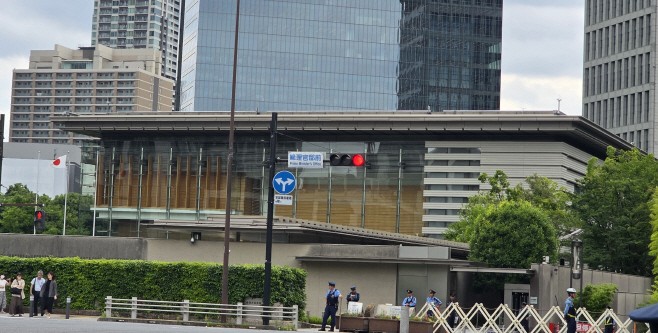 |
| Japanese Prime Minister Sanae Takaichi will establish a separate budget framework to intensively support growth sectors including artificial intelligence (AI), semiconductors, and shipbuilding in the compilation of the fiscal 2027 budget. The photo shows the Prime Minister's Official Residence in Japan. / Reported by Choi Young-jae, Tokyo Correspondent |
Japanese Prime Minister Sanae Takaichi will establish a separate budget framework to intensively support growth sectors including artificial intelligence (AI), semiconductors, and shipbuilding in the compilation of the fiscal 2027 budget. Under this method, the government will waive the ceiling on budgetary requests that ministries must adhere to when submitting proposals to the Ministry of Finance, allowing them instead to secure the necessary funds based on multi-year plans.
The Yomiuri Shimbun reported on the 24th, citing multiple Japanese government sources, that Prime Minister Takaichi plans to announce this policy during a joint meeting of the Growth Strategy Council and the Council on Economic and Fiscal Policy held later today. The new budget framework is named the "Strong and Prosperous Japan" investment framework. It is expected to serve as a core mechanism to reflect the "responsible and proactive fiscal policy" that Takaichi has consistently championed throughout her administration.
The initial budget for fiscal 2027 marks the first budget compiled entirely under the Takaichi cabinet. The Prime Minister has previously expressed her intent to break away from the government practice of relying heavily on supplementary budgets, maintaining a stance that standard policies should, in principle, be incorporated into the initial budget. The Japanese government had previously allocated 18.3 trillion yen to the general account in the fiscal 2025 supplementary budget.
This special framework focuses primarily on investing in "17 strategic fields," including AI, semiconductors, and shipbuilding. It will also link up with the "Regional Future Strategy" aimed at regional revitalization. The government intends to target policies with a strong potential to induce private capital expenditures and boost the potential growth rate for this special framework. Rather than forcing ministries to divide and fit their projects within existing budget ceilings, the structure allows them to additionally allocate funds for projects aligned with the national growth strategy within an entirely separate framework.
 |
| The new special framework introduced by Prime Minister Takaichi for the compilation of the fiscal 2027 budget focuses primarily on investing in 17 strategic fields, including AI, semiconductors, and shipbuilding. / Courtesy of Getty Images Bank |
Strategy industry budget compiled under PM leadership without ceilings
In Japan's budget compilation, ministries have traditionally requested funds within the Ministry of Finance's budgetary request guidelines, the so-called ceiling, every year. However, this upper limit will not apply to the special framework. The initiative aims to lower inter-ministerial barriers and strategically allocate funds under the direct involvement of the Prime Minister. Regarding the scale of the special framework, Prime Minister Takaichi is reportedly set to present a policy at the meeting to secure a sufficient and necessary scale while achieving fiscal sustainability.
The special framework budget is based on multi-year plans. The government calculates that by providing long-term budgetary directions, it can enhance predictability for businesses and accelerate private investments. Underlying this approach is the judgment that in sectors requiring large-scale capital expenditures and long-term research and development—such as AI data centers, advanced semiconductors, shipbuilding, space, and critical minerals—multi-year support is far more effective for corporate investment decisions than single-year budgeting.
The economic security sector will also be managed separately. The government is pushing for a plan to manage expenditures of critical importance to economic security, such as securing a stable supply of critical minerals, distinct from the special account. This method involves issuing bridging bonds with clear redemption sources and ensuring a sufficient budgetary scale for crisis management investments within the economic security domain, even within the special account. It signifies a national commitment to backstop the supply chains of core materials through state finances amid China's rare earth export controls and the U.S.-China tech hegemony rivalry.
Prime Minister Takaichi also plans to overhaul the fund system established for executing multi-year policies. The administration is considering extending the current standard that limits the period for injecting capital from the budget into funds to roughly three years in principle. The government intends to reflect these policies in the Basic Policy on Economic and Fiscal Management and Reform, the so-called Honebuto Policy, to be formulated in July.
This budget reform offers significant implications for South Korea. Japan's decision to manage strategic industries like AI, semiconductors, shipbuilding, and critical minerals through a separate investment framework rather than making them compete for general budget allocations demonstrates that industrial policy in the era of economic security is leading to structural fiscal overhauls. Experts point out that as global competition intensifies in South Korea's mainstay industries, such as semiconductors, batteries, shipbuilding, and defense, the nation also needs a fiscal management approach that bridges mid-to-long-term investment plans with private capital expenditures, moving beyond single-year, budget-centric support.
Choi Young-jae
Most Read
-
1
Trump shares map on social media labeling Strait o..

-
2
Kia Sportage outperforms Mazda CX-5 in German auto..

-
3
Houthis launch successive attacks on Saudi airport..

-
4
U.S. deploys carrier, 10,000 more troops to Middle..

-
5
Trump rejects Iran's offer to open Strait of Hormu..

-
6
N. Korea conducts first swarm attack drill with dr..

-
7
U.S.-China summit falls short on substance as Trum..

PEOPLE





HEADLINE NEWS
- Seoul dismisses Ukraine's claim of 'S. Korean support for Russia' as "inaccurate and inappropriate"
- S. Korea, Japan race to develop nuclear-powered submarines
- Henri Kagan, Kenso Soai win Nobel Prize in Chemistry for uncovering how mol..
- Vance says Alaska LNG cooperation will move forward with Seoul's current or..

-
Address : In-Young Bldg., 34, Uisadang-daero 1-gil, Yeongdeungpo-gu, Seoul
Copyright by ASIATODAY CO., LTD. All rights resereved