



Fake weather news spikes every summer, but gov't takes backseat
Jun 25, 2026, 09:50 am


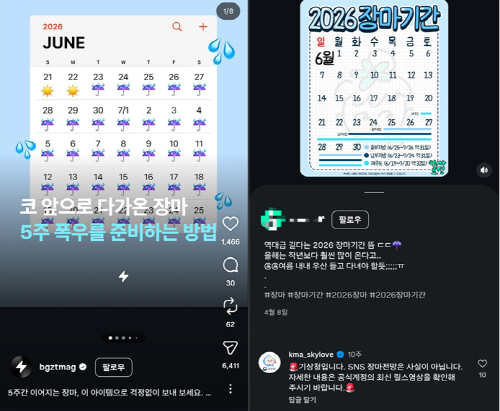 |
| A post from the official social media account of second-hand e-commerce platform Bungaejangter (left) alongside a request for correction made by the Korea Meteorological Administration regarding false information. / Capture from Instagram |
"Weather myths," which consistently resurface ahead of every rainy season, are making their rounds once again this year. Confusion among citizens is mounting, particularly as some commercial businesses and retailers weaponize this misinformation for marketing tactics. Critics point out that government monitoring is failing to keep pace with the velocity of online dissemination, leaving authorities locked in a largely passive response.
According to the Korea Meteorological Administration (KMA) on the 24th, the agency is currently monitoring monsoon-related misinformation spreading across social media platforms such as Instagram and X (formerly Twitter). The false posts typically claim that the monsoon season will begin on either the 23rd or 25th of this month and that rainfall will persist non-stop for an entire month. Some have even compiled a calendar of the upcoming month's weather, presenting it as if it were an official "monsoon calendar." A more significant issue is that major retail and e-commerce players are exploiting this false information to drive sales of rainy-season merchandise. On June 2, second-hand e-commerce platform Bungaejangter uploaded a monsoon calendar to its official social media account to promote dehumidifiers, rain boots, and outerwear available on its platform. The promotional post included the phrase: "A five-week monsoon season ahead—worry less with these items." Three weeks later, the post remains online, having accumulated over 6,400 shares.
All such information regarding this year's monsoon season, including the widely circulated calendars, has proven to be entirely false. Due to the inherent limitations of scientific forecasting, the KMA ceased issuing long-term monsoon outlooks in 2009, meaning official monsoon periods are now determined strictly ex-post-facto. The false claims pegging the start dates to June 23–25 appear to be mistakenly based on historical averages from 1991 to 2020. On average, South Korea's rainy season begins on June 23 in southern regions and June 25 in central regions. However, these dates fluctuate heavily year by year and vary by region. For instance, in the central region, a delayed monsoon began on July 3 in 2021, whereas it commenced as early as June 19 in 2025. Furthermore, there is typically a gap of about one week between the onset of the monsoon in Jeju and the central regions.
The government's current case-by-case monitoring approach is turning out to be nothing more than a stopgap measure given the nature of online spaces. The KMA currently relies on requesting individual posters to correct their content via comments or notifying users that the information is inaccurate. Yet, even posts where the KMA's official account has directly left warning comments remain active without being deleted, as the requests lack legal enforcement. Consequently, the misinformation continues to be newly posted and shared across the web.
In response, the KMA is preparing guidelines and subordinate legislation to enable the imposition of fines or administrative penalties. This serves as a follow-up measure to KMA Administrator Lee Mi-sun's pledge during a press conference on the 28th of last month to crack down on weather-related fake news. While the current Weather Act stipulates that it is illegal for private entities to issue weather forecasts—excluding the KMA, the military, and legally authorized private forecasters—there have been no actual enforcement cases due to the absence of detailed criteria defining what constitutes a "forecast." However, the formation of a review committee to oversee this process has reportedly not yet been finalized.
Attention is also turning to whether the amendment to the Act on Promotion of Information and Communications Network Utilization and Information Protection—the so-called "Anti-Fake News Act," set to take effect on July 7—could serve as a viable deterrent. Under the new law, if information regarding the public interest is proven false and its commercial purpose, such as product advertising, is clear, the government can initiate reviews and impose sanctions. An official from the Korea Communications Commission explained, "Starting July 7, if content carries falsehood, intent, and purpose that results in societal harm, it will be classified as fabricated misinformation. If a consumer makes a purchase decision based on such false data, it can certainly be deemed a form of harm." The official added, "The KMA or the business entity itself must directly file a report or request a review." Conversely, a KMA official stated, "We are not currently considering policy collaborations with other agencies."
Kim Hong-chan
Most Read
-
1
Trump demands rates fall below 1% as Fed hikes for..

-
2
Celltrion seeks rheumatoid arthritis indication ex..

-
3
Chinese e-commerce giants AliExpress, Temu and She..

-
4
Trump warns countries not helping U.S. must pay re..

-
5
Turkish Airlines named main club partner of Liverp..

-
6
China expels No. 2 military official Zhang Youxia..

-
7
Houthi rebels release video claiming downing of Sa..

PEOPLE







-
Address : In-Young Bldg., 34, Uisadang-daero 1-gil, Yeongdeungpo-gu, Seoul
Copyright by ASIATODAY CO., LTD. All rights resereved