



Pakistan steps up on world stage via U.S.-Iran mediation
Jun 24, 2026, 01:20 pm


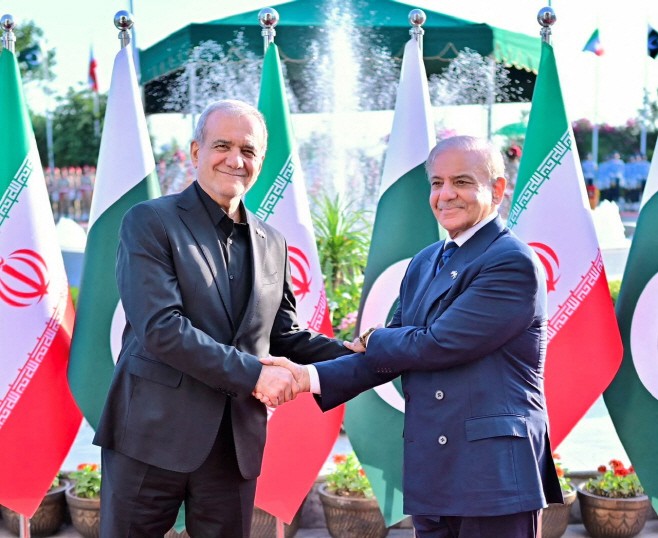 |
| Pakistani Prime Minister Shehbaz Sharif (right) welcomes Iranian President Masoud Pezeshkian at the Prime Minister's Official Residence in Islamabad on June 23 (local time). President Pezeshkian's visit comes in the immediate aftermath of a war-termination peace agreement brokered between Iran and the United States through Pakistan's diplomatic mediation. / Courtesy of Reuters-Yonhap News |
Pakistan is under global klieg lights as observers watch whether the nation can leverage its broad international acclaim for mediating the U.S.-Iran peace talks into a lifeline for its chronically distressed economy.
Pakistani Prime Minister Shehbaz Sharif and Chief of Army Staff General Asim Munir joined the high-stakes negotiations between Iran and the United States held over the weekend in Bürgenstock, Switzerland, Reuters reported on June 24 (local time). Their presence marked the culmination of months of intense behind-the-scenes diplomatic maneuvering by Islamabad.
Upon spotting General Munir at the venue, U.S. Vice President J.D. Vance embraced him warmly, asking, "How are you doing, my friend?" Both the American and Iranian delegations, alongside several world leaders, expressed deep gratitude to Pakistan. Had the talks collapsed, a prolonged blockade of the Strait of Hormuz could have choked global oil supplies and sent shockwaves through the world economy.
With Islamabad's geopolitical stock soaring after the breakthrough, analysts say the nation of 250 million now has a rare window to convert this diplomatic goodwill into tangible economic windfalls to break its decades-long boom-and-bust cycle. "A country that anchors domestic stability and contributes to global security naturally transforms into a far more credible investment destination," said Khurram Schehzad, an adviser to the Pakistani finance ministry.
Analysts are already mapping out concrete scenarios for where this newfound confidence might flow. Alex Vatanka, director of the Iran Program at the Middle East Institute in Washington, noted that Pakistan has unlocked "immense potential to become an integrated member of the broader Middle East," which could eventually yield regional economic cooperation stretching into the defense sector. Former Finance Minister Miftah Ismail projected that lifting sanctions on Iran could pave the way for cross-border trade via the Balochistan border.
However, skepticism runs deep, fueled by historical precedents where similar geopolitical jackpots evaporated. Following the 9/11 attacks and the subsequent U.S. invasion of Afghanistan in 2001, Pakistan leveraged its frontline cooperation with Washington to secure debt rescheduling from over a dozen nations and regain access to the IMF and multilateral lenders. Yet, structural weaknesses prevented Islamabad from capitalizing on those windfalls.
Even so, some experts point to a fundamental difference this time around. Economic commentator Khurram Husain observed that while 2001 marked "the beginning of a long, destructive war where Pakistan had to shoulder frontline risks," today Islamabad is operating as a "mediator." Pakistan's current diplomatic leverage stems from being simultaneously useful to opposing power blocs, including the U.S., Iran, the Gulf states, Türkiye, and China.
Despite the optimism, Ismail cautioned that while Islamabad's diplomatic stature has risen, its underlying vulnerabilities—exorbitant structural costs, sluggish exports, and crushing foreign debt repayments that keep the nation shackled to the IMF—remain fundamentally untouched. "Our own house is in such a mess that foreign powers cannot rescue us unless we help ourselves," Ismail warned. "Nothing about this war changes that baseline, and we will remain dependent on the IMF."
Consequently, experts urge policymakers to steer away from hunting short-term liquidity injections and focus instead on structural economic restructuring. Asim Ijaz Khwaja, director of the Center for International Development at Harvard University, suggested Pakistan should reject quick-fix financial concessions that do not enhance productivity. Instead, he argued, Islamabad must demand academic exchanges, scholarships, preferential market access for its textile and IT sectors, technology transfers, and green investment frameworks. Atif Mian, a professor at Princeton University, echoed this view, warning against treating diplomacy merely as a pipeline for central bank deposits, debt rollovers, or IMF-style bailouts. He emphasized that the true dividend lies in a "transition to peace" built on regional trade, energy corridors with Iran, and integration with the Gulf and Türkiye.
Western interest is already tangible. Hamish Falconer, the UK Minister for the Middle East, visited Pakistan last week to extend London's gratitude for its mediation role. He told Reuters that the UK sees "immense room to deepen trade relations" with Pakistan. Diplomats from two other Western nations confirmed they are exploring stronger economic ties with Islamabad in the wake of its peace-making efforts.
Yet, warnings persist that no amount of external economic perks can fix Pakistan's internal fault lines. Adeel Malik, a professor of development economics at Oxford University, warned that without sweeping structural reforms, the nation risks "imploding from within over the coming decades." He pointed to deep-seated resentment brewing among the youth and a shrinking middle class against the ruling elite. "The current arrangement has extended the political lifespan of the ruling elite, but it has left the country socially and economically more unstable," Malik observed. If the applause won on the global stage fails to spark domestic reform, this "peace dividend" may vanish into thin air before Pakistan can ever grasp it, much like the aftermath of 9/11.
Jeong Ri-na
Most Read
-
1
Trump shares map on social media labeling Strait o..

-
2
Kia Sportage outperforms Mazda CX-5 in German auto..

-
3
Houthis launch successive attacks on Saudi airport..

-
4
U.S. deploys carrier, 10,000 more troops to Middle..

-
5
Trump rejects Iran's offer to open Strait of Hormu..

-
6
N. Korea conducts first swarm attack drill with dr..

-
7
U.S.-China summit falls short on substance as Trum..

PEOPLE






HEADLINE NEWS
- Seoul dismisses Ukraine's claim of 'S. Korean support for Russia' as "inaccurate and inappropriate"
- S. Korea, Japan race to develop nuclear-powered submarines
- Henri Kagan, Kenso Soai win Nobel Prize in Chemistry for uncovering how mol..
- Vance says Alaska LNG cooperation will move forward with Seoul's current or..

-
Address : In-Young Bldg., 34, Uisadang-daero 1-gil, Yeongdeungpo-gu, Seoul
Copyright by ASIATODAY CO., LTD. All rights resereved