



U.S., Iran clash over inspections of Iranian nuclear facilities
Jun 24, 2026, 11:56 am


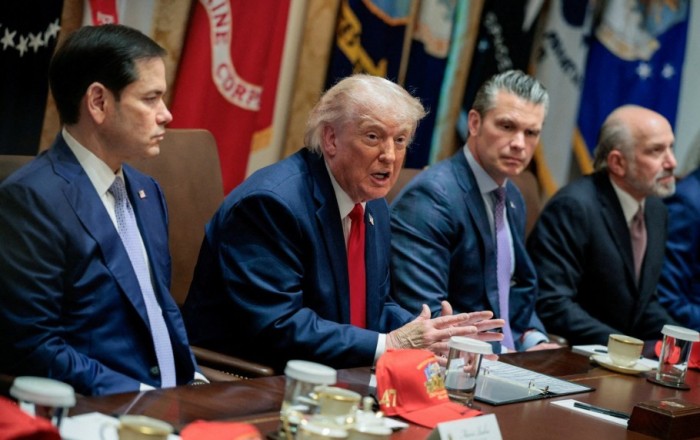 |
| U.S. President Donald Trump speaks during a cabinet meeting held in the Cabinet Room at the White House in Washington, D.C., on June 27 (local time). Pictured from left are Secretary of State Marco Rubio, President Trump, Secretary of Defense Pete Hegseth, and Secretary of Commerce Howard Lutnick. / Courtesy of Reuters-Yonhap |
The United States and Iran are locked in a dispute over whether to grant international inspectors access to Iranian nuclear sites, the Associated Press reported on June 23 (local time), exposing a deep rift between the two nations' official stances.
"There is currently no scheduled visit for International Atomic Energy Agency (IAEA) inspectors to examine the nuclear facilities targeted by U.S. airstrikes last year," Iranian Foreign Ministry spokesperson Esmaeil Baghaei told reporters. "Whether these inspections will resume hinges entirely on the progress and eventual outcome of upcoming war-termination negotiations."
The statement directly contradicts remarks made just a day prior by Vice President J.D. Vance, the lead U.S. negotiator, who claimed that Tehran had agreed to allow IAEA inspectors back into the country.
U.S. President Donald Trump immediately fired back, asserting that an agreement on nuclear inspections was the baseline prerequisite for the talks. He argued that if Iran had refused to comply with the inspections, the negotiations themselves could not have proceeded.
"Iran has fully and completely agreed to the highest level of nuclear inspections, indefinitely into the future," Trump stated in a post on Truth Social.
He further claimed the agreement would "ensure nuclear transparency," adding that "if Iran did not agree to this, there would have been no further negotiations."
Speaking to reporters later at Reading Regional Airport in Pennsylvania, Trump maintained that IAEA inspectors would be deployed to Iranian nuclear sites at an appropriate time. Dismissing Tehran's claims that no visits were planned, Trump warned, "They are wrong. If not, I will cancel the meetings right now."
The IAEA also remains at odds with Iran regarding the true nature of Tehran's nuclear program.
While Iran has consistently maintained that its nuclear program is strictly intended for peaceful purposes and that it has never pursued nuclear weapons, the IAEA has repeatedly pointed out that Iran possesses highly enriched uranium that could be weaponized for an atomic bomb.
Experts warn that Iran, which currently holds a stockpile of uranium enriched up to 60% purity, could rapidly reach the 90% weapons-grade threshold if it secures additional enrichment facilities.
The volume currently held by Iran is theoretically sufficient to manufacture roughly ten nuclear bombs.
Park Jin-sook
Most Read
-
1
Trump shares map on social media labeling Strait o..

-
2
Kia Sportage outperforms Mazda CX-5 in German auto..

-
3
Houthis launch successive attacks on Saudi airport..

-
4
U.S. deploys carrier, 10,000 more troops to Middle..

-
5
Trump rejects Iran's offer to open Strait of Hormu..

-
6
N. Korea conducts first swarm attack drill with dr..

-
7
U.S.-China summit falls short on substance as Trum..

PEOPLE






HEADLINE NEWS
- Seoul dismisses Ukraine's claim of 'S. Korean support for Russia' as "inaccurate and inappropriate"
- S. Korea, Japan race to develop nuclear-powered submarines
- Henri Kagan, Kenso Soai win Nobel Prize in Chemistry for uncovering how mol..
- Vance says Alaska LNG cooperation will move forward with Seoul's current or..

-
Address : In-Young Bldg., 34, Uisadang-daero 1-gil, Yeongdeungpo-gu, Seoul
Copyright by ASIATODAY CO., LTD. All rights resereved