



U.S. Senate approves resolution restricting Trump's military action on Iran
Jun 24, 2026, 10:27 am


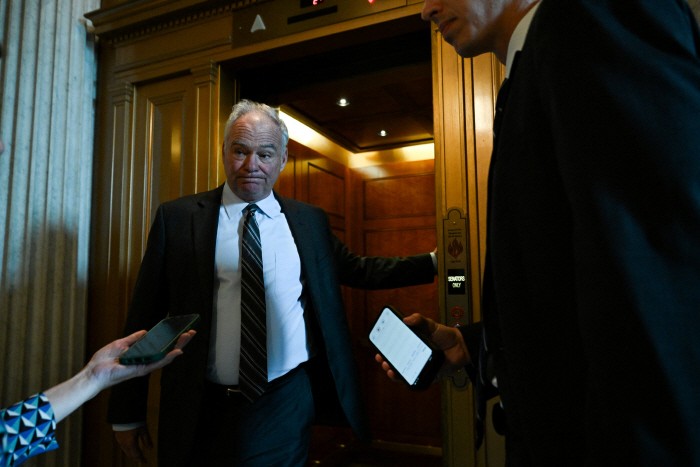 |
| US Senator Tim Kaine (D-VA) answers questions from reporters at the Capitol in Washington, D.C., on June 23 (local time), after the US Senate passed a resolution directing the removal of US Armed Forces from hostilities against Iran. / Courtesy of Reuters Yonhap |
The US Senate has passed a war powers resolution aimed at restricting President Donald Trump from resuming military action against Iran.
During a plenary session on June 23 (local time), the Senate approved the resolution in a 50–48 vote, as reported by outlets including The Washington Post and The Wall Street Journal.
Republican Senators Mitch McConnell and Dave McCormick were absent from the vote. However, four Republicans—Susan Collins, Bill Cassidy, Lisa Murkowski, and Rand Paul—broke ranks with their party to vote in favor of the resolution. Conversely, Senator John Fetterman was the sole Democrat to cast a dissenting vote.
While previous iterations of the resolution had repeatedly collapsed due to Republican opposition, the measure finally cleared the Senate on its 10th attempt. The House of Representatives had also passed an identical resolution earlier this month.
The vote comes on the heels of the United States and Iran signing a formal memorandum of understanding (MOU) last week to end hostilities, with both nations entering the implementation phase. Some Republican lawmakers have staunchly opposed the deal, pointing out that the MOU includes lifting sanctions on Iranian crude oil and establishing an Iranian reconstruction fund valued at 300 billion dollars.
Democratic Senator Tim Kaine, who spearheaded the resolution, maintained that passing the measure was imperative despite the recent peace agreement. Pointing to President Trump's recent remarks that the US would strike back if Iran fails to rein in its proxy forces in Lebanon, Kaine emphasized the necessity of preemptively blocking military action without congressional approval.
The White House and Republican leadership argued that because the resolution bypasses the presidential signature process, it lacks legal binding force under past Supreme Court precedents. On the other hand, Democrats countered that the measure holds legal weight under the War Powers Act of 1973 and demanded that the administration comply with it.
Legal experts noted that the administration is highly likely to ignore the resolution by citing constitutional authority, predicting that actual legal enforcement will face steep hurdles.
Nevertheless, analysts view the vote as politically significant, given that a Republican-leaning Senate chose to signal internal dissent against the administration's unilateral military operations.
Lee Jung-eun
Most Read
-
1
Trump shares map on social media labeling Strait o..

-
2
Kia Sportage outperforms Mazda CX-5 in German auto..

-
3
Houthis launch successive attacks on Saudi airport..

-
4
U.S. deploys carrier, 10,000 more troops to Middle..

-
5
Trump rejects Iran's offer to open Strait of Hormu..

-
6
N. Korea conducts first swarm attack drill with dr..

-
7
U.S.-China summit falls short on substance as Trum..

PEOPLE






HEADLINE NEWS
- Seoul dismisses Ukraine's claim of 'S. Korean support for Russia' as "inaccurate and inappropriate"
- S. Korea, Japan race to develop nuclear-powered submarines
- Henri Kagan, Kenso Soai win Nobel Prize in Chemistry for uncovering how mol..
- Vance says Alaska LNG cooperation will move forward with Seoul's current or..

-
Address : In-Young Bldg., 34, Uisadang-daero 1-gil, Yeongdeungpo-gu, Seoul
Copyright by ASIATODAY CO., LTD. All rights resereved