



Turkistan drives Kazakhstan’s baby boom as multiple births approach 2,000 through April
Jun 24, 2026, 10:00 am


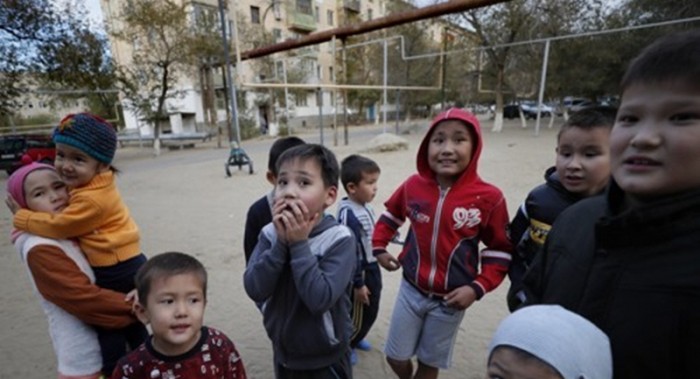 |
| Children spend their free time at a park within a residential complex in Baikonur, Kazakhstan. / Courtesy of EPA, Yonhap |
Kazakhstan logged nearly 2,000 twin and triplet births in the first four months of this year, with a heavy concentration of these multiple births reported in Turkistan, a high-fertility southern region.
Citing data from the Bureau of National Statistics, state-run news agency Kazinform reported on June 23 that a total of 99,400 newborns were delivered between January and April. Among them were 1,926 pairs of twins and 54 sets of triplets, while no quadruplets or higher-order multiple births were recorded.
By region, the southern city of Turkistan recorded the highest number of twins at 263 pairs, followed by Almaty City with 245 pairs and Almaty Region with 175 pairs. For triplet births, Turkistan, Atyrau, and Shymkent tied for the top spot, each registering three sets.
Regions with higher counts of twins and triplets consistently exhibited relatively robust birth rates overall. Standing out among them is Turkistan, which maintains the highest fertility metrics nationwide.
During the January–April window, Turkistan’s crude birth rate reached 19.75 births per 1,000 people, leading the country. Shymkent followed closely at 19.39, with Mangystau placing third at 19.28.
This demographic momentum is part of a sustained pattern rather than a temporary spike. As of 2024, Turkistan’s total fertility rate (TFR) stood at 4.25 children per woman, comfortably outpacing the national average of 2.80.
Turkistan similarly held the nation's highest fertility rate last year, cementing its position as Kazakhstan’s premier demographic engine.
Demographers point to Turkistan’s youthful population structure and deeply rooted family values to explain these elevated birth rates.
As a core southern hub where ethnic Kazakh and Uzbek communities coexist, the region retains a strong conservative cultural fabric that places a premium on traditional lifestyles, viewing large, multi-generational families in a highly positive light.
The average age of childbirth for Kazakhstani women stands at 29.9 years, while the average age at first birth is 25.3 years. Women in the southern regions are known to marry and start families noticeably earlier than the national average.
While Kazakhstan’s overall total fertility rate stays above the population replacement level of 2.1, its trajectory has softened recently. The national TFR fell to 2.57 last year, marking a fourth consecutive annual decline.
Total live births are shrinking across the country. Approximately 335,000 babies were born in Kazakhstan last year, representing a year-on-year drop of roughly 8 to 10% and hitting an 11-year low.
In response, the Kazakhstani government continues to incentivize childbearing through a suite of welfare policies for large families, including childbirth and childcare subsidies alongside housing support.
Kim Min-kyu
Most Read
-
1
Trump shares map on social media labeling Strait o..

-
2
Kia Sportage outperforms Mazda CX-5 in German auto..

-
3
Houthis launch successive attacks on Saudi airport..

-
4
U.S. deploys carrier, 10,000 more troops to Middle..

-
5
Trump rejects Iran's offer to open Strait of Hormu..

-
6
N. Korea conducts first swarm attack drill with dr..

-
7
U.S.-China summit falls short on substance as Trum..

PEOPLE






HEADLINE NEWS
- Seoul dismisses Ukraine's claim of 'S. Korean support for Russia' as "inaccurate and inappropriate"
- S. Korea, Japan race to develop nuclear-powered submarines
- Henri Kagan, Kenso Soai win Nobel Prize in Chemistry for uncovering how mol..
- Vance says Alaska LNG cooperation will move forward with Seoul's current or..

-
Address : In-Young Bldg., 34, Uisadang-daero 1-gil, Yeongdeungpo-gu, Seoul
Copyright by ASIATODAY CO., LTD. All rights resereved