



China announces policy packages for cars to boost domestic demand
Jun 24, 2026, 09:49 am


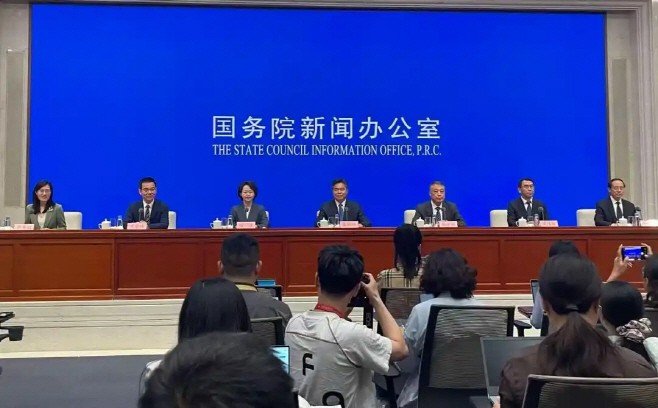 |
| Officials from nine Chinese government agencies, including the Ministry of Commerce, announce the "List of Pilot Cities for Automotive Distribution and Consumption Reform" on June 23, a move aimed at boosting sluggish domestic demand. / Courtesy of Xinhua News Agency |
China is moving beyond its recent string of rhetoric to "reinvigorate domestic demand" and has rolled out a sweeping package of consumer incentives, including measures targeting car sales, to break out of a persistent domestic economic slump that shows no signs of clearing up. According to reports on June 23 from the state-run Xinhua News Agency and China Central Television (CCTV), nine government agencies, led by the Ministry of Commerce, held a joint press conference to unveil the "List of Pilot Cities for Automotive Distribution and Consumption Reform." A total of 40 cities nationwide were selected. Under this initiative, these hubs will anchor targeted reforms and innovation focusing on smart connected vehicles, automobile leasing, and used car distribution.
Regarding the initiative, authorities directed that "each pilot city must tailor its approach to its local industrial strengths, market traits, resource endowments, geographic advantages, and functional positioning to eliminate irrational restrictions on automotive distribution and consumption, strengthen support via land and capital, streamline approvals, and nurture new models of automotive consumption."
In tandem, the central ministries, including the Ministry of Commerce, disclosed measures to foster the automotive aftermarket. Authorities explained that they plan to develop the car customization sector by refining vehicle modification regulations, establishing national standards, improving the auto parts certification system, and training specialized technical talent.
Separately, the Ministry of Industry and Information Technology and the Ministry of Public Security announced a measure to streamline the electronic registration process for domestically produced compact passenger cars, allowing buyers to complete the purchase, tax payment, and license plate issuance all on the same day. The two ministries project that this policy will benefit more than 20 million vehicle buyers annually.
The Chinese economy has been struggling significantly due to a protracted domestic slump that emerged as a chronic issue years ago. In particular, car sales—widely seen as a barometer of domestic consumption—have been contracting far worse than expected.
In fact, data released this month by the China Passenger Car Association showed that China's passenger vehicle sales fell 22.1% year-on-year to 1.51 million units in May. Cumulative sales from January to May also dropped 19.5% from a year earlier to 7.09 million units.
Even the new energy vehicle (NEV) sector, where dozens of brands have been locked in a cutthroat price war, saw sales slip 7.5% year-on-year last month to 950,000 units, marking a five-month consecutive decline. In short, the market has run out of options, which explains why the Ministry of Commerce and other agencies stepped in with these automotive stimulus measures. The conviction that stimulating car sales is the most effective lever to boost broader domestic consumption clearly drove this decision.
Hong Soon-do
Most Read
-
1
Trump shares map on social media labeling Strait o..

-
2
Kia Sportage outperforms Mazda CX-5 in German auto..

-
3
Houthis launch successive attacks on Saudi airport..

-
4
U.S. deploys carrier, 10,000 more troops to Middle..

-
5
Trump rejects Iran's offer to open Strait of Hormu..

-
6
N. Korea conducts first swarm attack drill with dr..

-
7
U.S.-China summit falls short on substance as Trum..

PEOPLE






HEADLINE NEWS
- Seoul dismisses Ukraine's claim of 'S. Korean support for Russia' as "inaccurate and inappropriate"
- S. Korea, Japan race to develop nuclear-powered submarines
- Henri Kagan, Kenso Soai win Nobel Prize in Chemistry for uncovering how mol..
- Vance says Alaska LNG cooperation will move forward with Seoul's current or..

-
Address : In-Young Bldg., 34, Uisadang-daero 1-gil, Yeongdeungpo-gu, Seoul
Copyright by ASIATODAY CO., LTD. All rights resereved