



Israel worries over ties with U.S. following Washington's signed MOU with Iran
Jun 23, 2026, 11:03 am


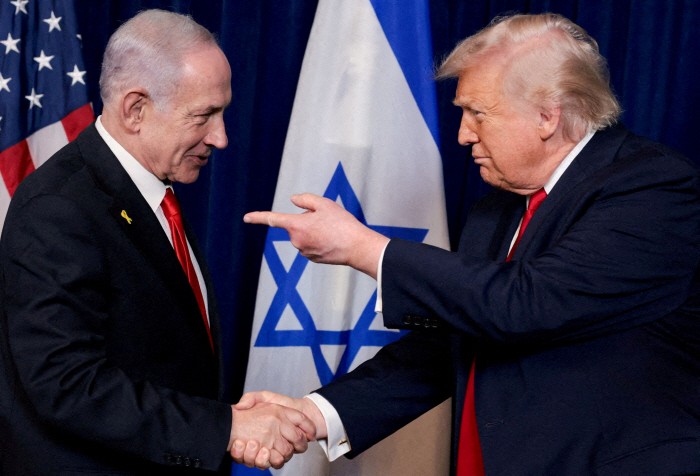 |
| On December 29, 2025 (local time), U.S. President Donald Trump (right) and Israeli Prime Minister Benjamin Netanyahu shake hands and gesture during a press conference following their meeting at the Mar-a-Lago Club in Palm Beach, Florida. / Yonhap News via Reuters |
As criticism mounts that Israel is putting the U.S.-Iran end-of-war agreement at risk by insisting on maintaining its military presence in Lebanon, allies of U.S. President Donald Trump have stepped forward to defend him amid intensifying concerns over a rift in the U.S.-Israel alliance.
The relationship between the United States and Israel has undergone a turbulent shift, moving from a period of rock-solid trust immediately following their joint strikes on Iran to open friction between President Trump and Israeli Prime Minister Benjamin Netanyahu over strategies to conclude the war.
According to a Reuters report on June 22 (local time), the Israeli political establishment, including Prime Minister Netanyahu, as well as the broader public, view the end-of-war Memorandum of Understanding (MOU) signed between Washington and Tehran as a move that strengthens Iran—Israel's primary adversary. There is also widespread concern that the agreement could restrict Israel's capacity to counter threats from Hezbollah, Iran's proxy network in Lebanon.
Reuters reported that as public opinion polls in the U.S. reflect growing negative sentiment toward Israel, and with President Trump—historically Israel's most staunch ally—seemingly distancing himself, observers within Israel are warning that the U.S.-Israel alliance, the bedrock of the nation's security strategy, is facing a crisis.
Addressing these anxieties at a foreign policy conference in Jerusalem, the U.S. Ambassador to Israel, Mike Huckabee, acknowledged that the level of apprehension regarding the bilateral relationship within Israel is substantial. However, he emphasized that "the bond between the United States and Israel remains unbreakable."
Mark Levin, a prominent Fox News commentator and long-time supporter of Donald Trump who recently broke ranks with the president over his opposition to the Iran deal, also came to Trump's defense. Levin praised the president for his historical, unwavering support for freedom, religious values, and Judaism.
Beyond the specific terminology of the MOU, Israeli observers are focusing heavily on the pressure being applied by President Trump to secure a ceasefire with Hezbollah in Lebanon, as well as the sharp rhetoric he has directed at Netanyahu for resisting these demands.
In recent weeks, President Trump has intensely criticized Netanyahu over Israel's airstrikes in Lebanon and has publicly floated a proposal to replace Israeli forces stationed in Lebanon with Syrian troops.
U.S. Vice President J.D. Vance similarly offered a critique of Israel, yet remarked that "at this moment, President Trump is the only world leader truly friendly toward Israel."
The emergence of such criticism from within the U.S. Republican Party, which has traditionally maintained a staunchly pro-Israel stance, is placing a heavy strategic burden on Israel. Consequently, voices within Israel are increasingly calling for self-reflection and urging the nation to prepare for a future that may lack unconditional American backing, while pushing to bolster independent military and technological capabilities.
Lee Jung-eun
Most Read
-
1
Trump shares map on social media labeling Strait o..

-
2
Kia Sportage outperforms Mazda CX-5 in German auto..

-
3
Houthis launch successive attacks on Saudi airport..

-
4
U.S. deploys carrier, 10,000 more troops to Middle..

-
5
Trump rejects Iran's offer to open Strait of Hormu..

-
6
N. Korea conducts first swarm attack drill with dr..

-
7
U.S.-China summit falls short on substance as Trum..

PEOPLE






HEADLINE NEWS
- Seoul dismisses Ukraine's claim of 'S. Korean support for Russia' as "inaccurate and inappropriate"
- S. Korea, Japan race to develop nuclear-powered submarines
- Henri Kagan, Kenso Soai win Nobel Prize in Chemistry for uncovering how mol..
- Vance says Alaska LNG cooperation will move forward with Seoul's current or..

-
Address : In-Young Bldg., 34, Uisadang-daero 1-gil, Yeongdeungpo-gu, Seoul
Copyright by ASIATODAY CO., LTD. All rights resereved