



Japan to scrap paper customs forms by 2030, speeding up entry for tourists
Jun 23, 2026, 10:29 am


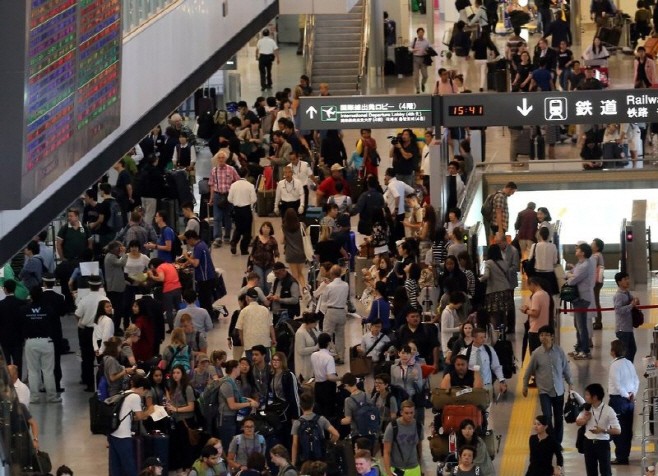 |
| The arrivals gate at Japan's Narita International Airport is crowded with foreign travelers. / Courtesy of Yonhap News |
The Japanese government will completely digitalize airport customs procedures by 2030. In alignment with its tourism-driven national goal of boosting annual foreign arrivals to 60 million, the plan focuses on slashing wait times that occur at the customs declaration stage following immigration clearance.
The Yomiuri Shimbun reported on June 22 that the Japanese government will include the complete digitalization of airport customs in its upcoming "Customs Medium-to-Long-Term Vision 2030." Currently, all arrivals in Japan—including returning Japanese nationals as well as foreign tourists—are required to submit a "Declaration of Accompanied Articles and Unaccompanied Articles." Although an electronic declaration system utilizing smartphones is already in place, paper forms still account for nearly half of all submissions, acting as a primary bottleneck for queues in the customs area.
To resolve this issue, the Japanese government plans to significantly expand the deployment of electronic declaration terminals across airports. For instances where customs duties are incurred, the government will expand cashless payment options to streamline the collection process. The ultimate objective is to implement a walk-through system, allowing travelers to clear customs without having to stop at a service counter.
Significant impact expected for South Korean visitors
This measure is anticipated to have a direct, tangible impact on South Korean travelers. According to the Japan National Tourism Organization, foreign arrivals to Japan reached 3,597,500 in January, with South Koreans making up the largest share by country or region at 1,176,000. Given the geographical proximity and the abundance of low-cost carrier routes, South Korea represents a market with a high proportion of short-term visits and repeat travelers. Consequently, reducing airport customs wait times will deliver a highly noticeable benefit for weekend travelers, families, and those utilizing regional airports.
The driving force behind Japan's urgency to digitalize customs is the explosive surge in inbound tourism. Annual foreign arrivals to Japan hit a historic high of 42,683,600 in 2025. With the government maintaining its target of 60 million visitors by 2030, leaving airport entry procedures as a bottleneck would inevitably constrain the expansion of tourism spending and the revitalization of regional airports. Thus, the digitalization of customs operations is viewed not merely as an administrative convenience, but as a critical infrastructure upgrade to expand inbound capacity.
However, the digitalization effort is not designed solely for traveler convenience; the Japanese government is simultaneously pushing for enhanced inspections of air cargo. According to the Yomiuri, the government aims to establish dedicated Air Cargo Inspection Centers at major hubs including Narita International Airport and Kansai International Airport by the early 2030s. The plan also includes expanding X-ray screening—which is currently conducted only on a select portion of small parcels—to cover all small-scale cargo shipments.
This tightening of cargo security comes in response to a surge in small import shipments driven by the boom in global e-commerce. The number of import cargo clearances in Japan skyrocketed nearly fivefold, rising from approximately 50 million cases in 2019 to 230 million cases in 2025. As international online shopping and overseas parcels surged, customs authorities faced an escalating burden in intercepting narcotics, counterfeit goods, restricted items, and hazardous materials. Ultimately, the Japanese government intends to restructure its system to fast-track inbound travelers while significantly reinforcing its enforcement and screening capabilities in the cargo sector.
Choi Young-jae
Most Read
-
1
Trump shares map on social media labeling Strait o..

-
2
Kia Sportage outperforms Mazda CX-5 in German auto..

-
3
Houthis launch successive attacks on Saudi airport..

-
4
U.S. deploys carrier, 10,000 more troops to Middle..

-
5
Trump rejects Iran's offer to open Strait of Hormu..

-
6
N. Korea conducts first swarm attack drill with dr..

-
7
U.S.-China summit falls short on substance as Trum..

PEOPLE






HEADLINE NEWS
- Seoul dismisses Ukraine's claim of 'S. Korean support for Russia' as "inaccurate and inappropriate"
- S. Korea, Japan race to develop nuclear-powered submarines
- Henri Kagan, Kenso Soai win Nobel Prize in Chemistry for uncovering how mol..
- Vance says Alaska LNG cooperation will move forward with Seoul's current or..

-
Address : In-Young Bldg., 34, Uisadang-daero 1-gil, Yeongdeungpo-gu, Seoul
Copyright by ASIATODAY CO., LTD. All rights resereved