



SK hynix designs 'AI Company' blueprint, sparking interest in affiliate restructuring
Jun 23, 2026, 09:34 am


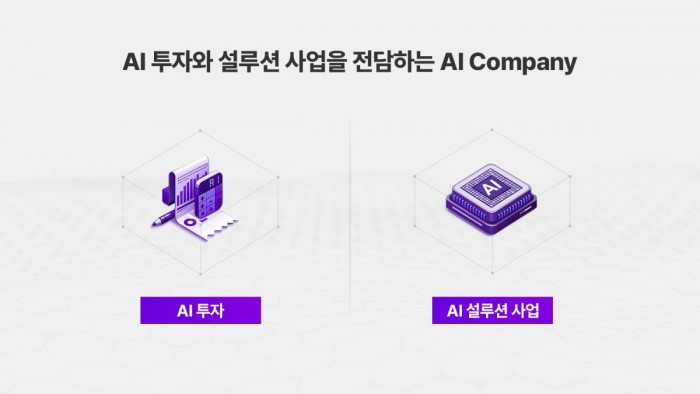 |
| An illustration explaining SK hynix's vision of 'AI Company.' / Courtesy of SK hynix |
Attention is drawing to whether the blueprint of the newly established "AI Company" by SK hynix will successfully untangle the overlapping businesses among the group's affiliates. Currently, the US-based AI Company serves as the linchpin of SK Group's artificial intelligence (AI) business—a domain previously driven by SK Square and SK Telecom. Industry watchers observe that the direction of this consolidation will become clearer following the upcoming reshuffle of organization and executives in the second half of the year, which comes after SK hynix—which recently dethroned Samsung Electronics to claim the top spot in market capitalization—lists its American Depositary Receipts (ADRs).
According to industry sources on June 22, the US-registered AI Company, established last February, is currently charting its future business trajectory. Since SK has positioned the new entity as the dedicated powerhouse for its AI business, the company is reportedly channeling its focus into investments for building AI data centers and related infrastructure. While its exact business pipeline is still taking shape, the process is expected to pick up significant momentum following SK hynix’s ADR listing.
The critical crux lies in streamlining the functions that overlap with other affiliates, such as SK Square and SK Telecom. These affiliates have already been actively pursuing projects that fall under the new AI Company’s mandate. Most notably, SK Square has been functioning as an investment vehicle encompassing both semiconductors and AI. For instance, TGC Square, an overseas investment arm established by SK Square in Singapore back in 2023, has been actively investing in promising AI startups.
Co-funded by SK hynix, Shinhan Investment & Securities, and LIG Nex1, TGC Square operates on a relatively modest scale with around 100 billion won in assets under management. However, its core objective virtually mirrors that of the new AI Company. In fact, over the past two years, TGC Square has consistently injected funds into AI firms in the US and Japan, including Hammerspace and Linkus.
Confronted with this overlap, some industry insiders project that SK Square might build a collaborative structure by injecting capital directly into the AI Company. "At this juncture, coordinating the roles among affiliates seems necessary, and they will likely undergo that very process," an industry insider noted. "Given that the AI Company is set to orchestrate the group's overarching investment strategies, they might adopt a method where investment funds are executed jointly through this single entity."
SK Telecom (SKT) faces a similar situation, with a substantial portion of its portfolio overlapping with the AI Company. SKT has been aggressively expanding its footprint, recently partnering with Nvidia to construct a gigawatt (GW)-class AI factory, and joining forces with Japan’s NTT and Taiwan’s Chunghwa Telecom to launch a 500-million-dollar IOWN fund. Backed by solid investments in AI data center-related firms such as Penguin Solutions ($200 million) and Lambda ($20 million), SKT’s AI-related segment posted 131.4 billion won in the first quarter—a stellar 89.3% surge compared to the same period last year. Experts agree that this segment also requires a clear division of labor.
Some analysts suggest that the group's executive reshuffle in the second half of the year will serve as the bellwether for the restructuring. Executive appointments within the group traditionally reflect the stark realities and the weight of the challenges confronting each affiliate. In short, identifying who takes the helm at which post will offer a vital gauge to measure the group's shifting priorities.
"With the entire group pivoting heavily toward AI, the boundaries of each domain will likely be redrawn," another industry source remarked. "While the specific responsibilities delegated to each unit will differ slightly, the group is highly unlikely to leave these overlapping functions unchecked. The initial contours should become visible in the upcoming organizational restructuring."
Choi In-gyu
Most Read
-
1
Kia Sportage outperforms Mazda CX-5 in German auto..

-
2
Houthis launch successive attacks on Saudi airport..

-
3
Saudi Arabia, Iran hold first diplomatic talks to..

-
4
U.S. deploys carrier, 10,000 more troops to Middle..

-
5
Saudi airport in Riyadh struck again, leaving at l..

-
6
Putin's ally visits China on the 8th ahead of APEC..

-
7
Chinese military support and training center opens..

PEOPLE






HEADLINE NEWS

-
Address : In-Young Bldg., 34, Uisadang-daero 1-gil, Yeongdeungpo-gu, Seoul
Copyright by ASIATODAY CO., LTD. All rights resereved