



Asia's drug market expands despite record-high seizures
Jun 22, 2026, 02:42 pm


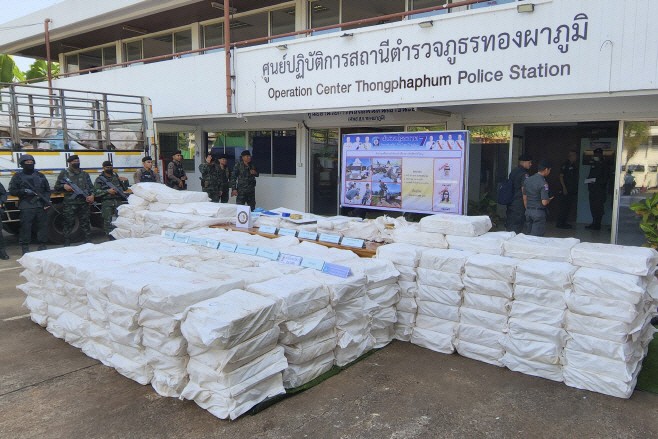 |
| Methamphetamine seized by Thai authorities in December 2023. / Photo by AP via Yonhap News |
A United Nations report released on June 22 revealed that despite record-high seizures of synthetic drugs in East and Southeast Asia last year, prices have actually dropped and supplies are stronger than ever.
According to a report titled "Synthetic Drugs in East and Southeast Asia: Latest Developments and Challenges 2026," published by the United Nations Office on Drugs and Crime (UNODC) and reported by Singaporean media outlet CNA, methamphetamine seizures in 2025 reached 349 tonnes, a 48% increase from the previous year. This figure is more than five times the amount seized a decade ago. Ketamine seizures also soared by 185% in a single year, reaching 52.5 tonnes.
While the seizure metrics might suggest that law enforcement crackdowns have been effective, experts interpret the data in the exact opposite light. They argue that an increase in the volume of drugs confiscated indicates that the overall quantity of drugs circulating in the market has grown substantially. Nualnoi Treerat, director of the Institute of Asian Studies at Chulalongkorn University, pointed out, "Authorities are seizing more drugs, but trafficking networks are manufacturing even more."
If crackdowns had successfully choked off the supply, prices should have risen; however, methamphetamine prices across key Southeast Asian markets are conversely falling. In Myanmar, the retail price dropped from $6 per gram to $5.55 per gram, making it the cheapest market in the region. Thailand experienced the sharpest decline, with prices plummeting from $20 to $13.50 per gram within a year. Indonesia also saw prices plunge by more than 40%, falling from $134 to $79 per gram. Richard Horsey, a senior adviser on Myanmar for the International Crisis Group (ICG), noted, "This means that the amount of drugs being seized is just a drop in the ocean."
The supply remains relentless because the primary hubs for drug manufacturing are located in areas outside the reach of state authority. The vast majority of the seized volume was concentrated in Southeast Asia, with Thailand alone confiscating over 159 tonnes of methamphetamine last year, accounting for nearly half of the total seized across East and Southeast Asia.
However, the actual source of this massive outflow lies elsewhere: Shan State in Myanmar, where armed groups and organized crime have been deeply entrenched for decades. Horsey highlighted that "Myanmar is the heart of transnational organized crime in Southeast Asia."
Criminal syndicates controlling these strongholds have evolved beyond simply selling narcotics. The most notable shift highlighted in the report is the emergence of a unified 'criminal economy' that seamlessly links drug manufacturing with scam compounds, money laundering networks, and cybercrime operations. Business structures featuring vertical integration, money laundering, franchising, and IT support have firmly established themselves, rendering drug trafficking merely one revenue stream within a highly diversified criminal ecosystem.
Operating like corporate enterprises, these drug cartels are expanding their distribution channels in search of higher-value destinations, and South Korea has entered their crosshairs. Inshik Sim, a lead analyst at the UNODC Regional Office for Southeast Asia and the Pacific who co-authored the report, warned that while drug demand was traditionally low in Japan and South Korea, it has been expanding rapidly of late, with trafficking syndicates targeting the two high-priced nations as 'premium markets.'
In fact, methamphetamine seizures smuggled into South Korea via air travelers nearly doubled in a single year, rising from 106 kilograms in 2024 to 199 kilograms last year. Sim remarked, "South Korea has long considered itself relatively safe from drug issues, but it is now realizing that the expanding supply originating from Southeast Asia is having a significant impact at home." This underscores the reality that while crackdowns in Southeast Asia fail to contain the market, the repercussions are rippling all the way to the Korean Peninsula.
Jeong Ri-na
Most Read
-
1
Trump shares map on social media labeling Strait o..

-
2
Kia Sportage outperforms Mazda CX-5 in German auto..

-
3
Houthis launch successive attacks on Saudi airport..

-
4
U.S. deploys carrier, 10,000 more troops to Middle..

-
5
Trump rejects Iran's offer to open Strait of Hormu..

-
6
N. Korea conducts first swarm attack drill with dr..

-
7
U.S.-China summit falls short on substance as Trum..

PEOPLE






HEADLINE NEWS
- Seoul dismisses Ukraine's claim of 'S. Korean support for Russia' as "inaccurate and inappropriate"
- S. Korea, Japan race to develop nuclear-powered submarines
- Henri Kagan, Kenso Soai win Nobel Prize in Chemistry for uncovering how mol..
- Vance says Alaska LNG cooperation will move forward with Seoul's current or..

-
Address : In-Young Bldg., 34, Uisadang-daero 1-gil, Yeongdeungpo-gu, Seoul
Copyright by ASIATODAY CO., LTD. All rights resereved