



GO, Japan's largest taxi app, to invest IPO proceeds in autonomous taxis
Jun 22, 2026, 10:42 am


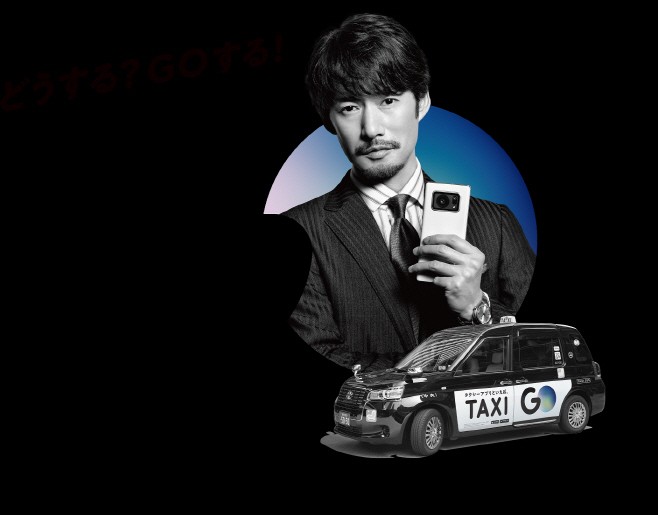 |
| GO, Japan's largest taxi-hailing app and the country's equivalent to Kakao T, will invest the capital raised through its initial public offering (IPO) into autonomous taxi services. / Screenshot from the official GO website |
GO, Japan's largest taxi-hailing app and the country's equivalent to Kakao T, plans to invest the capital raised through its initial public offering (IPO) into autonomous taxi services. With a surging number of foreign tourists visiting Japan and the era of robotaxis looming on the horizon, the battle for dominance in the Japanese taxi-hailing market is intensifying.
The Yomiuri Shimbun reported on June 20 that competition among Japanese ride-hailing apps connecting passengers via smartphones is heating up, driven by the influx of international visitors and the commercialization of self-driving taxis.
Much like Korea's Kakao T, GO is Japan's largest dispatch service, linking passengers with taxis via a smartphone app. Launched in 2020 through the merger of multiple ride-hailing applications, GO expanded its service area across all 47 prefectures of Japan by 2025. Its network now boasts a fleet of more than 80,000 dispatchable vehicles.
On June 16, GO made its debut on the Growth Market of the Tokyo Stock Exchange. Based on its closing price on the first day, the company's market capitalization reached approximately 205 billion yen, making it Japan's largest IPO of the year. GO intends to channel the raised funds into investments related to autonomous vehicle dispatch services. During an IPO press conference, GO President Hiroshi Nakajima stated, "We will continue to push forward to ensure our dominant position in Japan remains unshaken."
The immediate catalyst driving this taxi app rivalry is the growth of tourism in Japan. According to GO, the adoption rate of taxi-hailing apps in Japan stands below 30%, contrasting sharply with rates of 70% to 90% in the United States and South Korea. As more foreign tourists accustomed to hailing taxis via applications arrive in Japan, operators are expanding strategic partnerships to capture this demand.
In April, US-based Uber Technologies partnered with S.RIDE, a taxi app affiliated with the Sony Group. This alliance allows inbound tourists to use their domestic Uber apps to hail Japanese taxis contracted under S.RIDE. Similarly, S.RIDE teamed up with Chinese ride-hailing giant DiDi in January to capture foreign tourist demand in the Kansai and Kyushu regions.
Another reason ride-hailing companies are accelerating their efforts is the advent of autonomous taxis. Once robotaxis become mainstream, the vast majority of passenger hailing and vehicle assignments will likely be processed through apps. GO is currently pushing for the real-world implementation of autonomous taxis in collaboration with a firm backed by Toyota Motor and other partners. Uber has also announced a partnership with Nissan Motor.
Taxi-hailing apps offer the convenience of pinpointing pickup locations directly on a map, making it easy to call a vehicle to unfamiliar addresses or side streets. However, users must pay a dispatch fee on top of the standard taxi fare. As the Japanese taxi industry grapples with an aging workforce and labor shortages, ride-hailing operators have entered a fierce race to simultaneously capture inbound tourist demand and secure an early foothold in the future robotaxi market.
Choi Young-jae
Most Read
-
1
Trump shares map on social media labeling Strait o..

-
2
Kia Sportage outperforms Mazda CX-5 in German auto..

-
3
Houthis launch successive attacks on Saudi airport..

-
4
U.S. deploys carrier, 10,000 more troops to Middle..

-
5
Trump rejects Iran's offer to open Strait of Hormu..

-
6
N. Korea conducts first swarm attack drill with dr..

-
7
U.S.-China summit falls short on substance as Trum..

PEOPLE






HEADLINE NEWS
- Seoul dismisses Ukraine's claim of 'S. Korean support for Russia' as "inaccurate and inappropriate"
- S. Korea, Japan race to develop nuclear-powered submarines
- Henri Kagan, Kenso Soai win Nobel Prize in Chemistry for uncovering how mol..
- Vance says Alaska LNG cooperation will move forward with Seoul's current or..

-
Address : In-Young Bldg., 34, Uisadang-daero 1-gil, Yeongdeungpo-gu, Seoul
Copyright by ASIATODAY CO., LTD. All rights resereved