



Unprecedented 'Super El Niño' to disrupt Asia's food chains
Jun 21, 2026, 03:31 pm


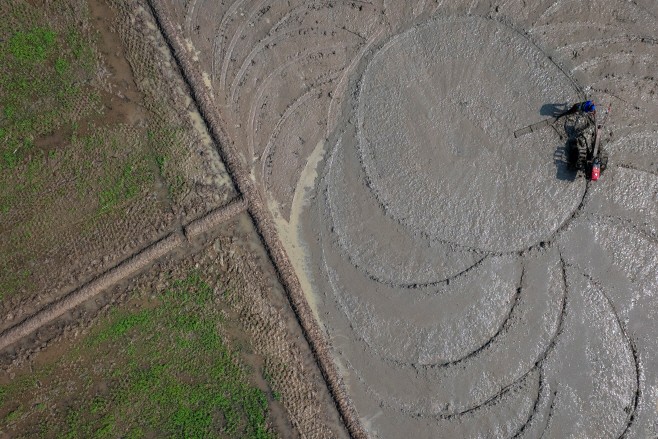 |
| An image taken by a drone on the 3rd, local time, shows paddy fields in Cirebon, West Java, Indonesia. The Indonesian government has advised farmers to immediately replant their crops, in response to the possibility of a prolonged dry season linked to El Niño, Reuters and Yonhap News reported. |
Sea surface temperatures in the Pacific have soared 2.5 degrees Celsius above average, and as a "super El Niño"—widely expected to be the strongest in decades—begins to form, concerns are mounting over an impending food crisis in Asia.
According to reports from Reuters, the South China Morning Post (SCMP), and other sources on the 21st, local time, the development of El Niño began earlier this month in the Pacific, accompanied by a rise in sea surface temperatures to 2.5 degrees Celsius above normal. The Australian Bureau of Meteorology announced on the 16th that this year's El Niño "could peak at the highest level observed since 1950," while US meteorological authorities estimated a two-thirds chance of it becoming a "very strong" event. UN Secretary-General António Guterres warned on the 2nd that this year's El Niño "will hit harder, spread further, and cross borders at a terrifying speed."
El Niño is a climate phenomenon that redistributes heat and moisture across the Pacific, bringing drought to some regions and floods to others. A super El Niño, which packs greater intensity than average, inflicts damage over a wider area and for a longer duration. A super El Niño struck ten years ago as well, decimating India's soybeans, Thailand's rice, Vietnam's robusta coffee, and Indonesia and Malaysia's palm oil production all at once.
The reason concerns are even greater regarding this year's super El Niño is that the agricultural foundation is already shaky. Disruptions in supply caused by the war involving the US, Israel, and Iran have sent fertilizer and fuel prices soaring, forcing many farmers in Asia to use less fertilizer than needed for this planting season. On top of this, regional currencies have turned weak, driving up the cost of food imports just as domestic production is set to drop.
Markets have already priced in these concerns. Futures prices for arabica coffee, cocoa, and sugar have risen across the board in anticipation of crop shocks. There are fears that the precedent from ten years ago—when Indian soybeans, Thai rice, Vietnamese robusta coffee, and Indonesian and Malaysian palm oil crumbled simultaneously during the super El Niño—could repeat itself. This means that the prices of food items coming from Asia, ranging from coffee and chocolate to cooking oil, are fluctuating.
The blow will be heaviest for nations highly dependent on agriculture. Agriculture accounts for about 24% of the gross domestic product (GDP) in Pakistan and Laos, and 16% in India. Even Indonesia and Vietnam, which are considered industrial powerhouses in Southeast Asia, rely on agriculture for 14% and 13% of their GDP, respectively. Khoranut Rattanyanong, who runs a cocoa farm in Chiang Mai, Thailand, is among the farmers who dread the super El Niño the most. Cocoa trees, highly sensitive to changes in heat and rainfall, cannot withstand prolonged heatwaves. "If yields drop, I won't be able to cover the costs," he said.
The watershed event that will shake the global food market is India. India, where about 16% of the population, or roughly 145 million people, make a living through farming, is the world's largest rice producer and a major food exporter. Shivraj Singh Chouhan, India's Minister of Agriculture and Farmers Welfare, held a high-level meeting on the 16th to introduce measures helping farmers switch to drought-resistant crops. However, the fertilizer shortage triggered by the Strait of Hormuz crisis is only now showing signs of easing as the US-Iran peace treaty nears conclusion, meaning it remains a burden for this year's farming season.
The real problem lies in the possibility of India shutting its export gates over crop anxieties. Ajay Jakhar, head of a farmers' organization in Punjab, said, "If there is even a slight doubt about production, India will halt food exports." Observers express concern that if India blocks rice exports in a year when crop yields are already faltering from Thailand to Indonesia and Vietnam, the shockwaves will reach far beyond local farms to the dining tables of cities relying on food imports.
Jung Lee-na
Most Read
-
1
Trump shares map on social media labeling Strait o..

-
2
Kia Sportage outperforms Mazda CX-5 in German auto..

-
3
Houthis launch successive attacks on Saudi airport..

-
4
U.S. deploys carrier, 10,000 more troops to Middle..

-
5
Trump rejects Iran's offer to open Strait of Hormu..

-
6
N. Korea conducts first swarm attack drill with dr..

-
7
U.S.-China summit falls short on substance as Trum..

PEOPLE






HEADLINE NEWS
- Seoul dismisses Ukraine's claim of 'S. Korean support for Russia' as "inaccurate and inappropriate"
- S. Korea, Japan race to develop nuclear-powered submarines
- Henri Kagan, Kenso Soai win Nobel Prize in Chemistry for uncovering how mol..
- Vance says Alaska LNG cooperation will move forward with Seoul's current or..

-
Address : In-Young Bldg., 34, Uisadang-daero 1-gil, Yeongdeungpo-gu, Seoul
Copyright by ASIATODAY CO., LTD. All rights resereved