



IRGC to benefit most from sanctions relief in talks, Reuters reports
Jun 21, 2026, 01:40 pm


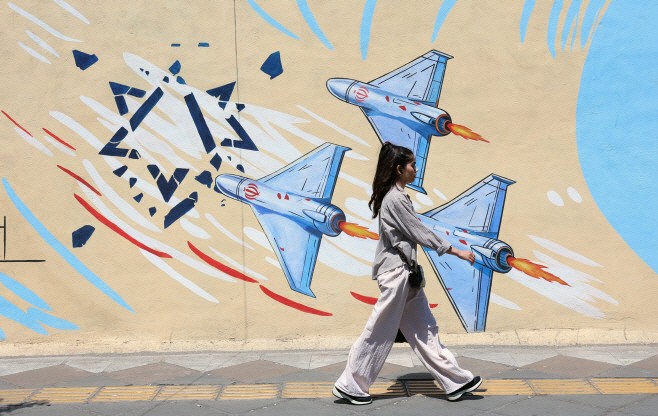 |
| An Iranian girl walks past an anti-Israel mural on a street in Tehran on the 8th (local time). / EPA·Yonhap |
As the United States and Iran hold in-person working-level talks regarding a ceasefire MOU in Bürgenstock, Switzerland, on the 21st (local time), the benefits are highly likely to flow to the Islamic Revolutionary Guard Corps (IRGC) if Washington pursues sanctions relief on the condition of ending the war, Reuters reported on the 20th.
According to Reuters, the IRGC has expanded far beyond a mere military organization to dominate Iran's core industries, including oil, construction, shipping, telecommunications, and ports. Rather than operating as a single enterprise, it has built a massive network and overarching dominance across the Iranian economy through hundreds of subsidiaries and subcontractors.
"The IRGC is uniquely positioned to monopolize a substantial portion of the financial windfalls resulting from sanctions relief, the resumption of oil exports, and foreign investment," four senior Iranian sources stated.
According to the draft MOU unveiled this week, the U.S., alongside regional partners, is set to establish a comprehensive blueprint for Iran's reconstruction and guarantee a funding package worth at least $300 billion.
The IRGC's engineering arm, Khatam al-Anbia, oversees hundreds of subsidiaries and subcontractors, with official announcements and records indicating its deep involvement in telecommunications, automotive manufacturing, tourism, and logistics as well.
Consequently, analysts project that once sanctions are lifted, the IRGC stands to reap the greatest rewards from the resumption of oil exports, the influx of foreign investment, and access to reconstruction funds.
Iran's domestic regulatory framework, specifically the Foreign Investment Promotion and Protection Act, also plays to the IRGC's advantage. Under Iranian law, foreign firms seeking to invest in the country must partner with a local entity, and a vast majority of eligible local businesses are tethered to the IRGC.
Conversely, a critical variable remains: companies doing business with IRGC-linked entities could face legal sanctions under the U.S. Justice Against Sponsors of Terrorism Act (JASTA).
JASTA allows victims of terrorism to file lawsuits against corporations that provide material support to state-sponsored military groups or organizations designated as terrorist entities by the U.S. and the West, such as the IRGC, Al-Qaeda, the Taliban, Hamas, and Hezbollah.
"Even if oil exports are permitted, legal risks still loom large for American corporations because the IRGC is lurking in the background," noted Jeremy Fainer, a former sanctions investigator at the U.S. Department of the Treasury. "The legal ramifications of engaging with the IRGC cannot be ignored."
Park Jin-sook
Most Read
-
1
Trump shares map on social media labeling Strait o..

-
2
Kia Sportage outperforms Mazda CX-5 in German auto..

-
3
Houthis launch successive attacks on Saudi airport..

-
4
U.S. deploys carrier, 10,000 more troops to Middle..

-
5
Trump rejects Iran's offer to open Strait of Hormu..

-
6
N. Korea conducts first swarm attack drill with dr..

-
7
U.S.-China summit falls short on substance as Trum..

PEOPLE






HEADLINE NEWS
- Seoul dismisses Ukraine's claim of 'S. Korean support for Russia' as "inaccurate and inappropriate"
- S. Korea, Japan race to develop nuclear-powered submarines
- Henri Kagan, Kenso Soai win Nobel Prize in Chemistry for uncovering how mol..
- Vance says Alaska LNG cooperation will move forward with Seoul's current or..

-
Address : In-Young Bldg., 34, Uisadang-daero 1-gil, Yeongdeungpo-gu, Seoul
Copyright by ASIATODAY CO., LTD. All rights resereved