



Iran leverages sanctions relief amid economic crisis and Lebanon conflict
Jun 21, 2026, 11:04 am


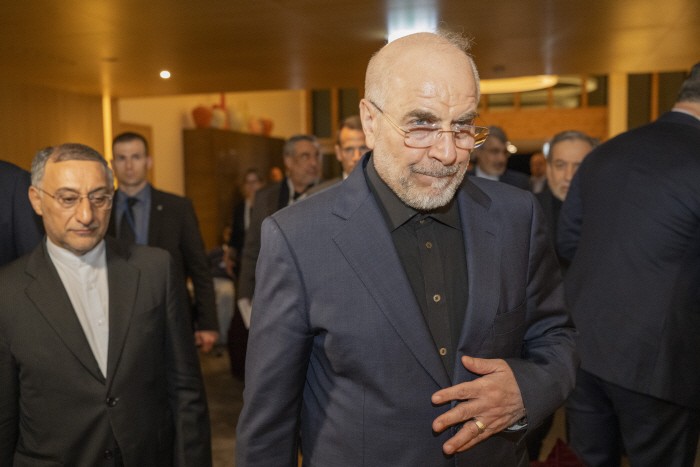 |
| Mohammad Bagher Ghalibaf, Speaker of the Islamic Consultative Assembly of Iran (center), attends a meeting held at the Bürgenstock Resort near Lucerne, Switzerland, on the 21st (local time). / EPA Yonhap |
Following the signing of a memorandum of understanding (MOU) on a wartime ceasefire between the United States and Iran, Iranian state media are framing the development as a resounding defeat for Washington, proclaiming it a diplomatic triumph. With the measure granting partial sanctions relief, the Iranian government is accelerating the resumption of its petroleum exports—already dispatching oil tankers—while maintaining diplomatic pressure to halt Israeli military actions in Lebanon. However, experts point out that behind these tactical gains, Iran remains heavily burdened by a triple whammy: a severe domestic economic crisis, deep-seated disagreements with the U.S. over its nuclear program, and the ongoing conflict in Lebanon, the Associated Press reported on the 20th (local time).
The AP noted that the Iranian leadership is projecting confidence at home and abroad, capitalizing on the fact that the regime survived despite intensive airstrikes by the U.S. and Israel. In particular, Tehran appears intent on leveraging its capability to blockade the Strait of Hormuz to maximize its bargaining chips against Washington.
The tangible effects of the MOU are manifesting first in the oil market. According to maritime data firm Lloyd's List Intelligence, at least three state-owned Iranian oil tankers have already departed as the U.S. lifted its naval blockade on Iranian ports. TankerTrackers.com reported that Iran has exported nearly 18 million barrels of crude over the last five days, which has directly influenced the stabilization of international energy prices, sending benchmark Brent crude—which had once traded above $110 a barrel—plunging down to the $80 range.
For Iran, the agreement serves as an economic springboard, allowing the country to transition away from its previous reliance on selling discounted oil to China via a "shadow fleet" toward securing a broader base of buyers at market prices.
Nevertheless, these economic windfalls are unlikely to resolve Iran's deeply entrenched domestic crises overnight. As a months-long internet shutdown was lifted, the severe hardships facing everyday citizens swiftly surfaced.
The AP reported that the Iranian rial has plummeted past the 1.5 million mark per U.S. dollar, effectively rendering the national currency worthless.
Holly Dagres, a senior fellow at the Atlantic Council's Washington-based think tank, pointed out that the war destroyed at least one million jobs, adding that "the burden has been compounded by chronic government mismanagement, corruption, and hyperinflation."
Compounding this distress is heightened political uncertainty following the deaths of Supreme Leader Ayatollah Ali Khamenei and other top officials in a February 28 airstrike. While Iran's new leader, Mojtava Khamenei, along with regime hard-liners, approved the interim deal with the U.S., they maintain a steadfastly defiant posture.
External variables also threaten the sustainability of the negotiations. Skirmishes between Israel and the Iran-backed militant group Hezbollah continue unabated, and upcoming nuclear talks are anticipated to face severe turbulence.
Given the stark divergence in positions between Washington and Tehran, coupled with domestic political pressures inside Iran, the consensus among experts remains highly skeptical about securing a definitive nuclear accord within the year.
Lee Jung-eun
Most Read
-
1
Trump shares map on social media labeling Strait o..

-
2
Kia Sportage outperforms Mazda CX-5 in German auto..

-
3
Houthis launch successive attacks on Saudi airport..

-
4
U.S. deploys carrier, 10,000 more troops to Middle..

-
5
Trump rejects Iran's offer to open Strait of Hormu..

-
6
N. Korea conducts first swarm attack drill with dr..

-
7
U.S.-China summit falls short on substance as Trum..

PEOPLE






HEADLINE NEWS
- Seoul dismisses Ukraine's claim of 'S. Korean support for Russia' as "inaccurate and inappropriate"
- S. Korea, Japan race to develop nuclear-powered submarines
- Henri Kagan, Kenso Soai win Nobel Prize in Chemistry for uncovering how mol..
- Vance says Alaska LNG cooperation will move forward with Seoul's current or..

-
Address : In-Young Bldg., 34, Uisadang-daero 1-gil, Yeongdeungpo-gu, Seoul
Copyright by ASIATODAY CO., LTD. All rights resereved