



"The MOU is mainly about reopening the Strait of Hormuz," foreign media assess
Jun 18, 2026, 12:01 pm


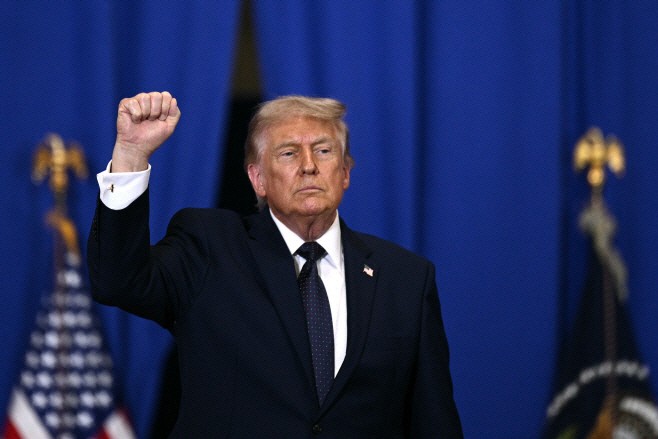 |
| U.S. President Donald Trump pumps his fist as he departs after delivering a speech on the economy at the Rockland Community College Fieldhouse in Suffern, New York, on June 22 (local time). / Photo via AFP, Yonhap |
Foreign media outlets evaluated that the 14 clauses in the draft memorandum of understanding (MOU) to end hostilities agreed upon by the United States and Iran are heavily focused on reopening the Strait of Hormuz.
On June 17 (local time), The Wall Street Journal (WSJ) published an article titled "Clause-by-Clause Interpretation of Trump's Iran Deal," closely analyzing Clauses 4 and 5 of the agreement. The report emphasized that lifting the U.S. naval blockade and ensuring safe navigation for Iran constitute the core of the accord.
Clauses 4 and 5 primarily entail the lifting of the U.S. naval blockade, Iran’s commitment not to interfere with vessel navigation, the withdrawal of U.S. forces from the vicinity of the strait, and mine clearance operations by Iran.
The WSJ added that reopening the strait is not merely about easing military tensions but is essential for normalizing the global flow of crude oil.
Bloomberg News, in its article titled "U.S.-Iran Pact Takes Effect with a Focus on the Strait of Hormuz" on the same day, assessed that the agreement is essentially a "trade-off" between easing military tensions and providing economic compensation.
This highlights that the agreement exchanges de-escalation for an economic deal, with the reopening of the Strait of Hormuz positioned at the center of the arrangement.
Bloomberg pointed out that this exchange is "unbalanced." While the U.S. gains only a return to the pre-war status quo—such as the reopening of the strait and the normalization of crude oil supply—Iran secures fresh economic benefits, including the unfreezing of assets and up to $300 billion in support for reconstruction and economic development.
The Washington Post (WP) explained that reopening the strait is not a simple military measure but is directly linked to the stability of the global energy market.
Highlighting President Trump’s own remarks at the Group of Seven (G7) summit in France, where he stated he pursued the deal "to avoid an economic disaster," the WP analyzed that normalizing the crude oil supply through the reopening of the strait could alleviate global inflationary pressures.
The newspaper also emphasized that Trump chose the practical benefit of "economic stability," risking pushback from hardliners within the Republican Party.
Park Jin-sook
Most Read
-
1
Trump shares map on social media labeling Strait o..

-
2
Kia Sportage outperforms Mazda CX-5 in German auto..

-
3
Houthis launch successive attacks on Saudi airport..

-
4
U.S. deploys carrier, 10,000 more troops to Middle..

-
5
Trump rejects Iran's offer to open Strait of Hormu..

-
6
N. Korea conducts first swarm attack drill with dr..

-
7
U.S.-China summit falls short on substance as Trum..

PEOPLE






HEADLINE NEWS
- Seoul dismisses Ukraine's claim of 'S. Korean support for Russia' as "inaccurate and inappropriate"
- S. Korea, Japan race to develop nuclear-powered submarines
- Henri Kagan, Kenso Soai win Nobel Prize in Chemistry for uncovering how mol..
- Vance says Alaska LNG cooperation will move forward with Seoul's current or..

-
Address : In-Young Bldg., 34, Uisadang-daero 1-gil, Yeongdeungpo-gu, Seoul
Copyright by ASIATODAY CO., LTD. All rights resereved