



Saudi Arabia says long-term verification is key to U.S.-Iran nuclear deal
Jun 18, 2026, 11:45 am


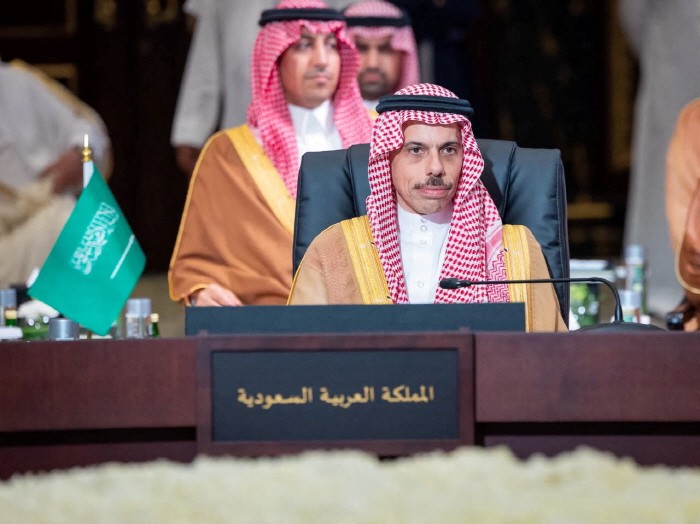 |
| Saudi Arabian Foreign Minister Faisal bin Farhan Al Saud attends the 167th Gulf Cooperation Council (GCC) Ministerial Council meeting held in Manama, Bahrain on June 10 (local time). / Photo via Reuters, Yonhap |
As the resumption of nuclear talks nears following the agreement to end hostilities between the United States and Iran, Saudi Arabia pointed out that the success of the negotiations hinges on how a "monitoring and verification mechanism" for Iran's nuclear program is established.
Saudi Arabian Foreign Minister Faisal bin Farhan Al Saud attended a conference hosted by the European Council on Foreign Relations (ECFR) in Vienna, Austria on June 17 (local time), noting that "the details matter" regarding the upcoming talks between the U.S. and Iran.
Previously, the U.S. and Iranian governments announced they had agreed to end their military conflict and hold subsequent talks covering a broad agenda, including Iran's nuclear program. While a senior U.S. official disclosed the memorandum of understanding (MOU) on ending the conflict, they added that both sides retain the option to walk away until a binding final agreement is reached.
Saudi Arabia is emphasizing the necessity of an effective monitoring system over a simple declaration of compliance. "What is most critical is what verification mechanism is put on the ground," Prince Faisal pointed out, moving beyond mere commitments to limits on uranium enrichment or the removal and downblending of nuclear material.
U.S. President Donald Trump has demanded the removal of Iran's highly enriched uranium, which can be weaponized. A senior Iranian official told Reuters that Tehran has agreed in principle to downblend its highly enriched uranium. The Iranian government maintains the stance that its nuclear program is entirely for peaceful purposes.
The Joint Comprehensive Plan of Action (JCPOA), signed in 2015, strictly restricted Iran's nuclear activities and granted the UN nuclear watchdog authority to conduct snap inspections of undeclared facilities. However, it effectively collapsed after the unilateral withdrawal of the U.S. in 2018, which led Iran to resume expanding its nuclear program.
"Establishing a long-term and sustainable verification system is more important than anything else," Prince Faisal emphasized. "Only when such a framework is in place can the international community and neighboring countries have the confidence to look toward the future."
Lee Jung-eun
Most Read
-
1
Trump shares map on social media labeling Strait o..

-
2
Kia Sportage outperforms Mazda CX-5 in German auto..

-
3
Houthis launch successive attacks on Saudi airport..

-
4
U.S. deploys carrier, 10,000 more troops to Middle..

-
5
Trump rejects Iran's offer to open Strait of Hormu..

-
6
N. Korea conducts first swarm attack drill with dr..

-
7
U.S.-China summit falls short on substance as Trum..

PEOPLE






HEADLINE NEWS
- Seoul dismisses Ukraine's claim of 'S. Korean support for Russia' as "inaccurate and inappropriate"
- S. Korea, Japan race to develop nuclear-powered submarines
- Henri Kagan, Kenso Soai win Nobel Prize in Chemistry for uncovering how mol..
- Vance says Alaska LNG cooperation will move forward with Seoul's current or..

-
Address : In-Young Bldg., 34, Uisadang-daero 1-gil, Yeongdeungpo-gu, Seoul
Copyright by ASIATODAY CO., LTD. All rights resereved