



Behind the U.S.-Iran deal: Qatar secretly mediates, Israel interrupts
Jun 18, 2026, 11:19 am


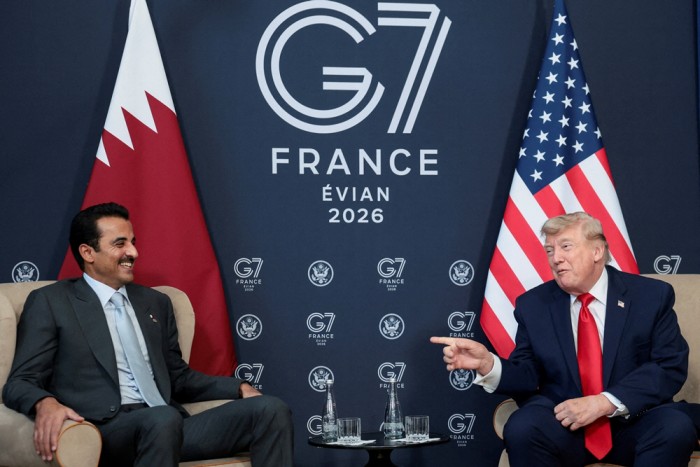 |
| Qatari Amir Sheikh Tamim bin Hamad Al Thani (left) and U.S. President Donald Trump hold a bilateral meeting on June 16 (local time) in Évian-les-Bains, France, where the G7 summit is being held. / Reuters Yonhap |
The secret diplomatic maneuvering of Qatar as a mediator reportedly paved the way for the United States and Iran to sign a memorandum of understanding (MOU) on ending their conflict on June 17 (local time).
Bloomberg News revealed the behind-the-scenes drama of the MOU signing on the same day, reporting that a Qatari mediation team engaged in a grueling 17-hour shuttle diplomacy session in Tehran on June 14, relaying messages between local officials and the U.S. side.
At the request of both countries, Qatar had been secretly mediating the negotiations for the past four weeks. Facing mounting domestic pressure, both the U.S. and Iran were eager to reach an agreement to end the war.
While Qatar has long served as a key mediator in various Middle Eastern conflicts, it was initially just one of several facilitators—alongside Pakistan, Egypt, and Turkey—seeking a solution until mid-last month.
Iran's previous attacks on Middle Eastern nations, including Qatar, had created a burden, prompting Doha to intentionally stay out of the spotlight during the early stages of this issue.
Nevertheless, Qatar stepped in when both the U.S. and Iran requested more direct intervention. The Qatari delegation traveled to Iran via Turkey to carry out the mediation under strict secrecy.
According to sources, the high-level mediators leading the team were Ali Al-Tawadi and Hamad Al-Kubaishi.
The delegation outlined the framework of the agreement in Tehran on May 17. Two days later, without notifying the media, they flew directly to Washington D.C. to meet with Vice President J.D. Vance, Jared Kushner—President Donald Trump's son-in-law—and Steve Witkoff, the special envoy to the Middle East.
Throughout the mediation period, Israel acted as a major obstacle to the negotiations. Immediately after the delegation left the U.S., Qatar and Pakistan received intelligence from two Western nations indicating that Israel was considering a strike on Iran.
Although Israel eventually scrapped the airstrike plan following U.S. intervention, Israeli Prime Minister Benjamin Netanyahu remained steadfast in his stance to continue the war.
The delegation returned to Tehran on May 22. Alongside Pakistan's Chief of Army Staff Asim Munir, they held a closed-door meeting for several hours with Iranian Parliament Speaker Mohammad Bagher Ghalibaf and Iranian Foreign Minister Abbas Araghchi.
To maintain the momentum of the negotiations, the team traveled to Miami two days later to meet with Kushner and Special Envoy Witkoff again, continuing consultations for a full day.
The talks teetered on the brink of collapse during the first week of this month. Although Israel and Lebanon had agreed to a ceasefire, there was no sign of an end to the hostilities between Israel and Hezbollah, the Iranian-backed Lebanese militant group.
Israel launched airstrikes on Beirut, Lebanon, where Hezbollah is headquartered, and began engaging in skirmishes with Iran as well.
In response, President Trump reportedly called Prime Minister Netanyahu and told him to back down.
Netanyahu, who has pushed for a war against Iran for decades, maintains the stance that ensuring Israel's future depends on preserving close ties with President Trump.
For President Trump, however, his relationship with Netanyahu appeared to become a liability ahead of the midterm elections scheduled for November this year.
Kim Hyun-min
Most Read
-
1
Trump shares map on social media labeling Strait o..

-
2
Kia Sportage outperforms Mazda CX-5 in German auto..

-
3
Houthis launch successive attacks on Saudi airport..

-
4
U.S. deploys carrier, 10,000 more troops to Middle..

-
5
Trump rejects Iran's offer to open Strait of Hormu..

-
6
N. Korea conducts first swarm attack drill with dr..

-
7
U.S.-China summit falls short on substance as Trum..

PEOPLE






HEADLINE NEWS
- Seoul dismisses Ukraine's claim of 'S. Korean support for Russia' as "inaccurate and inappropriate"
- S. Korea, Japan race to develop nuclear-powered submarines
- Henri Kagan, Kenso Soai win Nobel Prize in Chemistry for uncovering how mol..
- Vance says Alaska LNG cooperation will move forward with Seoul's current or..

-
Address : In-Young Bldg., 34, Uisadang-daero 1-gil, Yeongdeungpo-gu, Seoul
Copyright by ASIATODAY CO., LTD. All rights resereved