



Trump offers no apology for Indian crew deaths in talks with Modi
Jun 18, 2026, 10:32 am


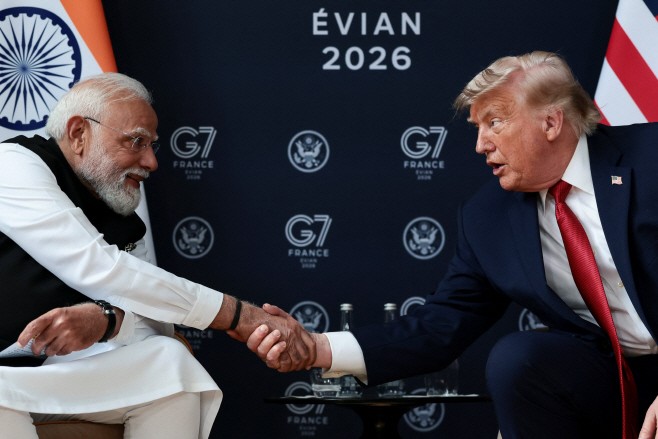 |
| U.S. President Donald Trump and Indian Prime Minister Narendra Modi shake hands during a bilateral meeting on the sidelines of the G7 Summit in Évian-les-Bains, France, on June 17 (local time). / Photo courtesy of Reuters, Yonhap News Agency |
U.S. President Donald Trump sat down with Indian Prime Minister Narendra Modi for the first time in 16 months, yet he ultimately offered neither an apology nor an expression of regret for the three Indian crew members killed by a U.S. military attack. The summit on June 17 (local time), where both nations attempted to patch up relations, instead served only to reaffirm their rifts.
According to Reuters and the South China Morning Post (SCMP), Trump stated after the meeting that both countries continue to "work together" on the issue, but described merchant shipping merely as a "rough business." He said, "I heard about that. These things have always happened, but we work together. We love all of those people, they are fantastic people." He offered neither words of condolence nor an expression of regret. Prime Minister Modi emphasized that the safety of Indian seafarers is a "matter of foremost priority" and stressed his confidence that their safety would be guaranteed during the implementation of the agreement to reopen Hormuz.
This stance from the U.S. is not unprecedented. On June 10, the U.S. military fired missiles at the Palau-flagged tanker MT Settebello in Omani waters, killing three crew members of Indian nationality. On the grounds that it had violated the blockade on Iranian ports, the U.S. also attacked two other merchant vessels carrying Indian sailors under the same pretext.
Immediately after the attack, U.S. Secretary of State Marco Rubio, in a phone call with Indian External Affairs Minister Subrahmanyam Jaishankar, issued a warning instead of offering condolences or an apology, stating that all merchant vessels in the Strait of Hormuz must immediately comply with U.S. military orders and that "U.S. enforcement of the blockade against unlawful transport of Iranian oil will not be compromised." Minister Jaishankar conveyed a "strong protest" during the call and stated on social media that "such lethal actions targeting commercial shipping cannot be justified." However, the U.S. State Department, in a brief one-paragraph statement following the call, merely mentioned that they discussed "recent incidents in the Strait of Hormuz."
Such responses from the U.S. fueled backlash within India. In Delhi, videos spread on social media showing auto-rickshaw drivers tearing off photos of President Trump and U.S. flags attached to their vehicles. These photos had been put up as part of a public relations campaign by the U.S. Embassy. The Indian government summoned Jackson Meeks, the U.S. Chargé d'Affaires, twice within three days, lodging an unusually strong protest. Opposition leader Rahul Gandhi criticized Prime Minister Modi by calling him a "compromised Prime Minister," stating, "No free nation tolerates this language. But our compromised PM stays silent."
Observations suggest that this incident will crack the relationship of trust between the two nations. At one time, President Trump and Prime Minister Modi flaunted a tight-knit camaraderie. In their last meeting in Washington in February of last year, the two countries launched trade agreement negotiations, making India one of the first nations to step up to the negotiating table with the U.S. However, the friendly atmosphere was tarnished by a year of punitive tariffs, sanctions surrounding Russian oil, visa restrictions, and anti-India rhetoric from Trump's MAGA base. Trump's repeated claims in May of last year that he had mediated the India-Pakistan conflict also strained bilateral relations.
Rajeev Ranjan Chaturvedy, a professor of international studies at Nalanda University, pointed out, "The relationship will survive because the U.S. needs India too much, but survival does not equate to trust," adding, "If a U.S. missile kills Indian sailors and Washington cannot even say sorry, what value does this partnership really hold?"
Jung Lee-na
Most Read
-
1
Trump shares map on social media labeling Strait o..

-
2
Kia Sportage outperforms Mazda CX-5 in German auto..

-
3
Houthis launch successive attacks on Saudi airport..

-
4
U.S. deploys carrier, 10,000 more troops to Middle..

-
5
Trump rejects Iran's offer to open Strait of Hormu..

-
6
N. Korea conducts first swarm attack drill with dr..

-
7
U.S.-China summit falls short on substance as Trum..

PEOPLE






HEADLINE NEWS
- Seoul dismisses Ukraine's claim of 'S. Korean support for Russia' as "inaccurate and inappropriate"
- S. Korea, Japan race to develop nuclear-powered submarines
- Henri Kagan, Kenso Soai win Nobel Prize in Chemistry for uncovering how mol..
- Vance says Alaska LNG cooperation will move forward with Seoul's current or..

-
Address : In-Young Bldg., 34, Uisadang-daero 1-gil, Yeongdeungpo-gu, Seoul
Copyright by ASIATODAY CO., LTD. All rights resereved