



Warsh’s first FOMC freezes interest rates, but Fed signals potential hikes this year
Jun 18, 2026, 10:20 am


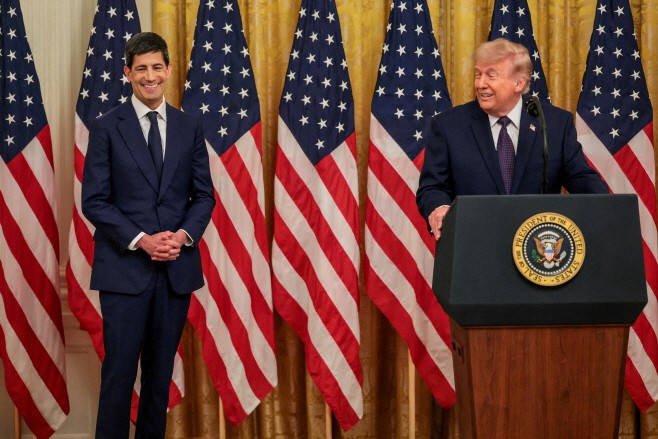 |
U.S. President Donald Trump (right) speaks during the swearing-in ceremony for the new Federal Reserve Chair Kevin Warsh in the East Room of the White House in Washington, D.C., on May 22 (local time). / Photo courtesy of Reuters, Yonhap News Agency
The Federal Reserve, the central bank of the United States, unanimously froze its benchmark interest rate at 3.50% to 3.75% on June 17 (local time) at its first Federal Open Market Committee (FOMC) regular meeting under the leadership of the new Chair Kevin Warsh. With this freeze, the interest rate gap between South Korea (2.50%) and the United States was maintained at 1.25 percentage points based on the upper bound.
While this marked the fourth consecutive freeze following those in January, March, and April of this year, monetary easing expectations weakened as 9 out of 19 policy participants predicted a rate hike within this year in the dot plot released alongside the decision.
Fed freezes rates; New Chair Warsh reaches unanimous decision in first FOMC In its statement, the Fed assessed that economic activity is expanding solidly despite uncertainties stemming from the Middle East conflict, noting, "Productivity growth and capital investment are strong, and employment growth is keeping pace with labor force growth."
Regarding inflation, the Fed diagnosed that it "remains elevated relative to the Committee's 2% objective, partly reflecting supply shocks that have driven up prices in specific areas such as energy." It emphasized, "The Committee is committed to achieving price stability."
Reflecting Chair Warsh's stance, the length of the statement was drastically reduced from 345 words in April to 132 words, and the forward guidance phrasing that guides the future path of interest rates was completely omitted, according to an analysis by the U.S. daily The Wall Street Journal (WSJ).
In a press conference, Chair Warsh said, "The market operates most efficiently when it focuses on real economy data rather than asking how the Fed will react," adding, "Trends unfolding over three or six months are more important than a single individual data point." Regarding the commitment to achieving price stability, he stressed, "It is strong, unanimous, and unambiguous. This is an important message we missed for five years, and we will correct it."
Chair Warsh stated that members generally assessed the labor market as stable, with some viewing it more positively, noting that "employment indicators are moving in a good direction."
9 members forecast hike this year in dot plot; inflation outlook revised upward In the quarterly Summary of Economic Projections dot plot released on the day, the median forecast for the year-end interest rate was revised upward from 3.4% in the March meeting to 3.8%, Reuters reported. Out of the 18 members who submitted their projections (Chair Warsh did not submit one), 9 anticipated at least one rate hike within the year, and among them, 6 projected two or more hikes of 0.25 percentage points (p). Eight expected a freeze, and one predicted a cut. Bloomberg News reported that the outlook for rate cuts in 2027 also disappeared from the dot plot. While no member anticipated a hike during the March meeting, 9 out of the 18 respondents projected an increase within this year this time around.
Chair Warsh revealed that he did not submit a dot plot. He said, "The dot plot does not help me execute policy," adding, "By the end of the year, we will review the overall framework of Fed communications, including press conferences, the dot plot, minutes, and transcripts."
The inflation outlook was also substantially raised. The year-end growth forecast for the Personal Consumption Expenditures (PCE) price index, the Fed's primary gauge for price stability, was raised from the previous 2.7% to 3.6%, and the core PCE forecast, which excludes energy and food, rose to 3.3%. This year's real Gross Domestic Product (GDP) growth forecast was adjusted downward from 2.4% to 2.2%, while the unemployment rate was expected to be 4.3%. The WSJ explained that the energy shock triggered by the Iran war and the surge in infrastructure investment demand driven by the AI boom are the background fueling inflation worries.
Market factors in potential hike; 2-Year yield surges Chair Warsh stated that discussions regarding a rate cut were extremely limited during this meeting. He noted, "One proposal was brought to the table, there was no discussion beyond that, and the discussion on that proposal was also very limited," adding, "After a couple of days of a good internal debate (family fight), we arrived at a better conclusion."
The WSJ pointed out that while U.S. President Donald Trump had demanded deep cuts from former Chair Jerome Powell, and Warsh was also chosen amid expectations of rate cuts, the possibility of a hike conversely emerged during his very first meeting.
President Trump, who was visiting France, reacted to the decision to freeze, saying, "Keeping rates steady is fine," Bloomberg reported.
The market responded immediately. The yield on the short-term 2-year U.S. Treasury note surged by more than 12 basis points (1 bp = 0.01%p). Bloomberg projected that if this upward trend holds until the closing bell, it would mark the largest increase on an FOMC decision day since January 2022, just before the Fed embarked on its most aggressive tightening campaign in decades.
Money markets (short-term interest rate markets including interest rate futures and swaps) 100% priced in the probability of a Fed rate hike by the end of the year, and the U.S. dollar strengthened against all major developed nation currencies.
Warsh initiates Fed overhaul; experts split on next interest rate path Chair Warsh announced the launch of five independent task forces to completely overhaul the way Fed policy is operated. The areas under review include: 1) Communication, 2) Balance sheet, 3) Utilization of existing data sources, 4) Productivity and jobs in transition, and 5) Inflation framework. Experts from both within and outside the field of economics will participate, supported by Fed staff.
He stated, "Work will begin within a few weeks, progress will be shared starting in the autumn, and I expect most to reach conclusions by the end of the year."
Views among experts were divided. William English, a professor at the Yale School of Management and former senior advisor to the Fed, told the WSJ, "The world is more uncertain than usual right now, but it is reasonable for the Fed to maintain current rates for a considerable period and view the next move as potentially a hike."
Conversely, Jeffrey Cleveland, chief economist at the U.S. asset management firm Payden & Rygel, drew a line against the rate hike theory, telling the WSJ, "The next move will eventually be a cut, but not right now, and the current stance of freezing rates is appropriate."
Ha Man-joo |
Most Read
-
1
Trump shares map on social media labeling Strait o..

-
2
Kia Sportage outperforms Mazda CX-5 in German auto..

-
3
Houthis launch successive attacks on Saudi airport..

-
4
U.S. deploys carrier, 10,000 more troops to Middle..

-
5
Trump rejects Iran's offer to open Strait of Hormu..

-
6
N. Korea conducts first swarm attack drill with dr..

-
7
U.S.-China summit falls short on substance as Trum..

PEOPLE





HEADLINE NEWS
- Seoul dismisses Ukraine's claim of 'S. Korean support for Russia' as "inaccurate and inappropriate"
- S. Korea, Japan race to develop nuclear-powered submarines
- Henri Kagan, Kenso Soai win Nobel Prize in Chemistry for uncovering how mol..
- Vance says Alaska LNG cooperation will move forward with Seoul's current or..

-
Address : In-Young Bldg., 34, Uisadang-daero 1-gil, Yeongdeungpo-gu, Seoul
Copyright by ASIATODAY CO., LTD. All rights resereved