



IEA analyzes Iran war hits Southeast Asia energy, triples import burden
Jun 18, 2026, 10:01 am


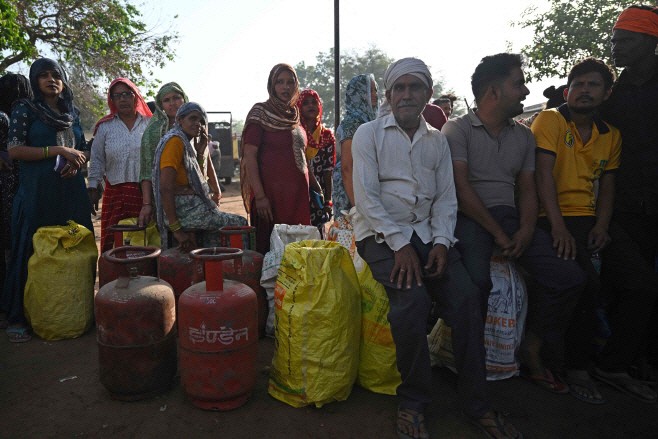 |
| Residents wait to refill their empty LPG (Liquefied Petroleum Gas) cylinders in a village on the outskirts of Jewar district, Uttar Pradesh, India, on April 24 (local time). / Photo courtesy of AFP, Yonhap News Agency |
An analysis from an international organization revealed that the Iran war exposed how vulnerable the energy security of Southeast Asia is, as it relies heavily on the Strait of Hormuz. A warning followed that if the region fails to accelerate the diversification of energy sources, its energy import burden could swell to three times the current level by 2035.
In a report released on June 16 (local time), the International Energy Agency (IEA) diagnosed that Southeast Asia was particularly vulnerable to the shock of the Iran war due to its excessive dependence on oil and gas entering through the Strait of Hormuz. The IEA defined this crisis as a "clear alarm bell" for the region's energy security.
In fact, the energy crisis caused by the Iran war forced Southeast Asian nations into emergency response systems, leading to electricity rate hikes and inflation. The IEA pointed out that, in particular, as the necessity of relying on coal was highlighted once again during the crisis, efforts to transition away from fossil fuels faced setbacks.
Paradoxically, this shock also served as a catalyst to accelerate change. In the Philippines, which declared a national energy emergency, the number of consumers directly installing rooftop solar facilities to cope with skyrocketing electricity bills surged to a record high. Ivan Cano of EcoSolutions, a solar company in Manila, said, "This is the first time I've seen a surge in demand of this scale." As a result, the Philippines became the second-largest export destination for Chinese solar panels in the first quarter of this year, with the import volume reaching about three times that of the same period last year.
The transition to electric vehicles (EVs) also accelerated. The IEA tallied that EV sales in the region more than doubled last year to approximately 500,000 units, meaning one out of every five newly sold cars was an EV. Last month, Laos banned the import of internal combustion engine vehicles for the remainder of this year to reduce oil imports.
The push for nuclear power generation is also gaining momentum again. While Indonesia, Vietnam, and the Philippines are relatively ahead, the IEA viewed that the operation timeline remains uncertain due to construction and licensing procedures that take several years.
The problem is that these movements alone are insufficient. The IEA forecast that without broader reforms, Southeast Asia's energy import spending would swell about threefold from 80 billion dollars (approx. 121 trillion won) in 2024 to 245 billion dollars (approx. 371 trillion won) by 2035. Fatih Birol, Executive Director of the IEA, emphasized, "The diversification of energy sources and supply routes is now a key task."
The IEA stressed that to overcome vulnerability, the overall demand for imported fossil fuels itself must be reduced, and it highlighted the need to improve national power grid efficiency and expand investments in all forms of renewable energy, including solar, wind, hydro, and geothermal power.
Sam Reynolds of the Institute for Energy Economics and Financial Analysis (IEEFA) in the US noted, "Southeast Asia stands at a crossroads," and predicted that despite a tentative agreement to end the Iran war, fossil fuel prices are highly likely to remain elevated, prompting a more aggressive push toward clean energy expansion.
Jung Lee-na
Most Read
-
1
Trump shares map on social media labeling Strait o..

-
2
Kia Sportage outperforms Mazda CX-5 in German auto..

-
3
Houthis launch successive attacks on Saudi airport..

-
4
U.S. deploys carrier, 10,000 more troops to Middle..

-
5
Trump rejects Iran's offer to open Strait of Hormu..

-
6
N. Korea conducts first swarm attack drill with dr..

-
7
U.S.-China summit falls short on substance as Trum..

PEOPLE





HEADLINE NEWS
- Seoul dismisses Ukraine's claim of 'S. Korean support for Russia' as "inaccurate and inappropriate"
- S. Korea, Japan race to develop nuclear-powered submarines
- Henri Kagan, Kenso Soai win Nobel Prize in Chemistry for uncovering how mol..
- Vance says Alaska LNG cooperation will move forward with Seoul's current or..

-
Address : In-Young Bldg., 34, Uisadang-daero 1-gil, Yeongdeungpo-gu, Seoul
Copyright by ASIATODAY CO., LTD. All rights resereved