



Lee ends Europe tour, faces piling domestic challenges
Jun 18, 2026, 09:21 am


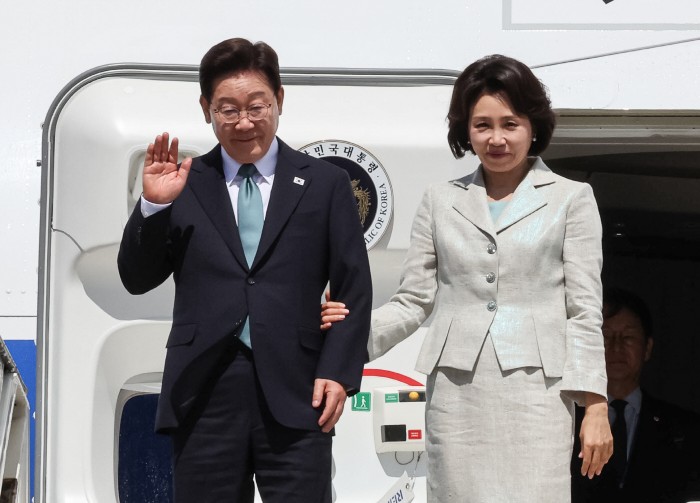 |
| President Lee Jae-myung and First Lady Kim Hye-kyung wave to welcomers as they arrive on Code One at Melsbroek Air Base in Brussels, Belgium, on June 9. / Photo courtesy of Yonhap News Agency |
President Lee Jae-myung departed for South Korea on June 17 after wrapping up his first 10-day tour of Europe. Traveling through Belgium, the European Union, Italy, the Vatican, and the Group of Seven (G7) summit, President Lee focused on economic security, supply chains, and peace diplomacy on the Korean Peninsula. Upon his return, he is expected to address a backlog of domestic issues, including the National Election Commission's mismanagement scandal, structural reforms, real estate measures, a cabinet reshuffle, and managing relations between the ruling party and the presidential office.
After concluding his official schedule at the G7 summit in Évian, France, President Lee boarded Code One at Geneva International Airport in Switzerland at 5:00 p.m. to return home.
During the tour, President Lee held a series of meetings with the leaders of Belgium, the EU, and Italy, as well as Pope Leo XIV, to discuss cooperation in economic, security, and international peace sectors. At the G7 summit, he met with U.S. President Donald Trump and requested an active role from the United States for a peaceful resolution to North Korean issues.
President Lee began his European tour in earnest with a summit meeting with Belgian Prime Minister Bart De Wever. The two nations discussed cooperation in semiconductors, batteries, energy, and small- and medium-sized enterprises (SMEs) and startups, signing related memorandums of understanding.
At the South Korea-EU summit, the sides expanded the institutional foundation for economic security and defense cooperation. The joint South Korea-EU statement included a message refusing to recognize North Korea's status as a nuclear-weapon state and condemning North Korea's support for the Russia-Ukraine war. The presidential office explained that this reaffirmed existing principled positions, while stating that efforts to ease tensions and establish peace on the Korean Peninsula would continue.
During his state visit to Italy, the bilateral relationship was upgraded to a 'Special Strategic Partnership,' and the '2026–2030 South Korea-Italy Strategic Action Plan' was adopted to deepen mutual cooperation. The two nations agreed to widen their cooperation base in advanced technology, defense, space, development cooperation, SMEs, and the social solidarity economy.
At his visit to the Vatican, President Lee reiterated his commitment to peace and coexistence on the Korean Peninsula. In a meeting with Pope Leo XIV, he requested the international community's attention and support for resuming inter-Korean dialogue and establishing peace on the peninsula.
At the G7 summit, President Lee presented key messages on development cooperation, artificial intelligence (AI), and strengthening supply chain resilience. He emphasized that "the AI technology gap must not lead to a growth gap," stressing that the achievements of AI development should not be concentrated in a few countries or social classes.
He also stated, "Based on the experience and capacity of growing from an aid-receiving nation to an aid-giving nation, the South Korean government will fulfill its responsibility and role in building international partnerships." This reflects the view that a new partnership is needed where aid, investment, technology, and institutions move together, considering that development demand is growing while public financial resources remain insufficient.
Bilateral meetings were also held on the sidelines of the G7 summit. President Lee met with leaders from Canada, Germany, and Kenya to discuss expanding cooperation in defense, security, energy, and critical minerals. In particular, ahead of a 60 trillion won submarine project with Canada, he stressed the need for defense cooperation. With Germany, he mentioned that the two countries could move beyond competition to explore cooperation models such as joint research and development and joint entry into third countries.
At the G7 summit, President Lee also approached President Trump, asking him to play a 'peacemaker' role, saying, "Just as you resolved the war in the Middle East, please lead the peaceful resolution of the North Korean issue." President Trump reportedly responded that he would make efforts to resolve the issue.
This is interpreted as an attempt to expand indirect peace diplomacy through the Vatican and the United States at a time when inter-Korean dialogue is stalled. However, since North Korea is protesting against South Korea's principled stance expressed in the joint South Korea-EU statement, observers note that it may take time before any tangible resumption of dialogue occurs.
As President Lee returns to domestic governance after wrapping up his first-half diplomatic schedule, a mountain of domestic issues awaits him.
First, the shortage of ballots and the mismanagement by the National Election Commission during the June 3 local elections stand as major tasks. The government plans to come up with measures to restore public trust in election management through investigations by a joint prosecution-police team, a parliamentary probe, and discussions on institutional improvements.
Various reform tasks are also expected to gain momentum. The administration faces a situation where it must swiftly push forward structural reforms in regulation, finance, public sectors, pensions, and education, while strengthening cooperation with the National Assembly.
Overhauling real estate policies is another imminent task. Along with supply measures, projections suggest that steps to curb speculative demand—encompassing not only multi-homeowners but also non-resident single-homeowners—could align with discussions on tax reform.
A cabinet reshuffle and reorganization of the presidential staff to secure momentum for the second year of governance are drawing attention. Potential replacements for ministers in several departments are being rumored, including the Ministry of SMEs and Startups, which will become vacant following the nomination of Han Seong-sook as Prime Minister. The presidential office is also reportedly considering filling vacancies, such as the Senior Secretary for AI, and replacing some senior-level aides.
The Democratic Party's national convention in August remains a major variable for the ruling bloc. With Representative Jung Cheong-rae leaning toward a bid for the next party leadership and the potential candidacy of Prime Minister Kim Min-suk also being mentioned, the intra-party competition is heating up early. Concerns are rising that the level of factional friction could ultimately affect coordination among the party, the cabinet, and the presidential office.
Park Young-hoon
Most Read
-
1
Trump demands rates fall below 1% as Fed hikes for..

-
2
Celltrion seeks rheumatoid arthritis indication ex..

-
3
Chinese e-commerce giants AliExpress, Temu and She..

-
4
Trump warns countries not helping U.S. must pay re..

-
5
Turkish Airlines named main club partner of Liverp..

-
6
China expels No. 2 military official Zhang Youxia..

-
7
Houthi rebels release video claiming downing of Sa..

PEOPLE






-
Address : In-Young Bldg., 34, Uisadang-daero 1-gil, Yeongdeungpo-gu, Seoul
Copyright by ASIATODAY CO., LTD. All rights resereved