



Japan white paper adds AI, drone warfare chapter, urges allied response to China
Aug 05, 2026, 10:16 am


 |
| Cover of Japan's 2026 defense white paper, released by the Ministry of Defense on the 4th. The illustration depicts citizens of various generations against a futuristic cityscape backdrop. / Japan Ministry of Defense website |
The Japanese government presented, as the core theme of its 2026 defense white paper, plans to restructure its defense posture in line with the AI- and drone-driven nature of modern warfare, while pledging to respond jointly with the U.S. and other allies and partners to China's military activities.
Japan's government approved the 2026 defense white paper at a Cabinet meeting on the morning of the 4th. At 598 pages, it is the longest edition on record. As Japan's government plans to revise its three key security documents — the National Security Strategy, the National Defense Strategy, and the Defense Buildup Program — earlier than initially planned this year, the white paper newly established, for the first time, a dedicated chapter explaining the "new way of fighting" being reshaped by advanced technologies such as AI and drones.
This year's white paper carries the theme "Security Connected to the Future." It covers military trends around Japan and defense policy from April 2025 through March of this year, with some key developments through May of this year also reflected. Japan's government stressed that strengthening security policy and the defense industry is directly linked to the safety and economy of future generations.
The white paper assessed that the war in Ukraine has seen the deployment of "large quantities of cheap, diverse unmanned assets," alongside faster AI-driven decision-making. Judging that expensive, large-scale weapons alone are insufficient to counter mass attacks by cheap drones, it said Japan needs to build a defense capability that integrates unmanned systems, AI, and the space, cyber, and electromagnetic domains.
It also stressed the need to prepare for the possibility that conflicts may not end quickly. The white paper noted that the war in Ukraine has highlighted the importance of maintaining stockpiles and sustained response capacity from peacetime. This means Japan needs not only sufficient reserves of ammunition, parts, and fuel, but also a production base capable of continuously replenishing lost equipment.
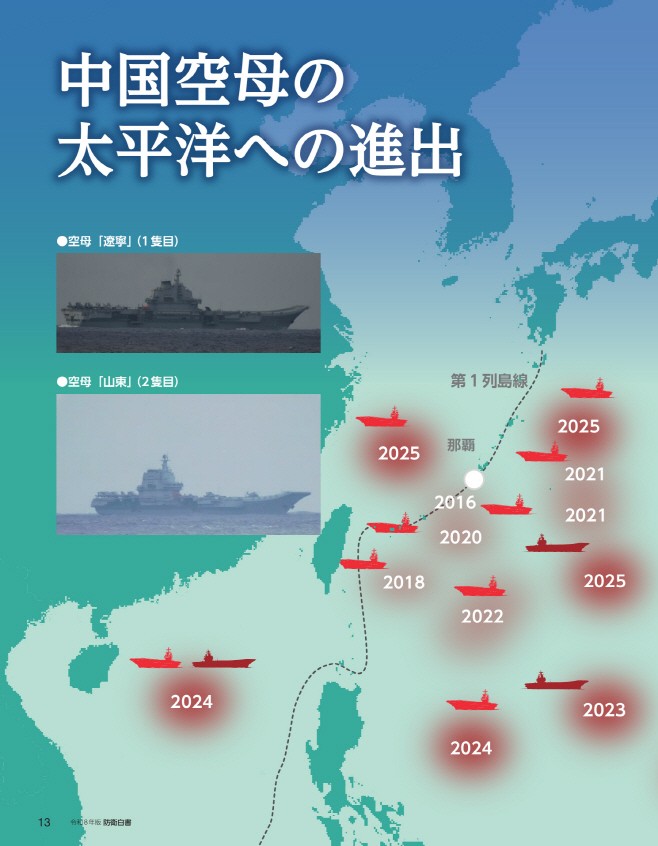 |
| Chinese carrier activity in the Pacific, shown on page 13 of Japan's 2026 defense white paper. Maps and photos mark the areas where the carriers Liaoning and Shandong operated beyond the "first island chain" from 2016 to 2025. / Japan Ministry of Defense website |
The white paper explicitly states that the defense industry "is defense capability itself." Reflecting Japan's revision in April this year of the Three Principles on Transfer of Defense Equipment and Technology and their implementation guidelines — which now allow the export of complete lethal equipment — the government said it would strengthen ties with allies and partners through shared equipment use and technological cooperation. The direction is clear: Japan intends to develop its defense industry not as a domestic-oriented sector but as a tool of diplomacy and security.
The level of vigilance toward China was the highest in the document. The white paper described China's external conduct and military activities as a serious concern for Japan and the international community and the greatest strategic challenge Japan has ever faced. It said Chinese forces are expanding their activities around Japan, in the East and South China Seas, and around Taiwan, and stressed the need to respond through Japan's comprehensive national strength and cooperation with allies and partners.
Regarding North Korea, the white paper cited its nuclear and missile development in describing it as a threat that is "more serious and imminent than ever before." This wording on both China and North Korea is unchanged from last year's edition. It characterized Russia's invasion of Ukraine as a serious violation of international law and the international order, and expressed strong concern over military cooperation between China and Russia as well as closer ties between North Korea and Russia.
The 2026 white paper shows Japan tying together its response to AI- and drone-driven changes in warfare with weapons exports, defense industry development, and joint response with allies as a single strategy. For South Korea, this means the scope of countering North Korea's nuclear program and Korea-U.S.-Japan cooperation is expanding, while at the same time, Japan's expanding military role and the overseas growth of its defense industry are also things to watch closely.
Choi Young-jae
Most Read
-
1
Celltrion’s Omlyclo gains ground in major European..

-
2
Trump demands rates fall below 1% as Fed hikes for..

-
3
Trump makes $1 trillion bet ahead of midterm elect..

-
4
Iran resumes ballistic missile production, assembl..

-
5
Samsung Electronics, Mistral AI to jointly develop..

-
6
Trump warns countries not helping U.S. must pay re..

-
7
Apple launches first foldable, 1 million won prici..

PEOPLE






HEADLINE NEWS
- Trump to roll out ‘unprecedented welcome’ for Xi with B-2 bombers, F-22 fighters
- S. Korea, U.S., and Japan form united front on Taiwan and economic coercion..
- Trump administration moves to impose sweeping sanctions on International Cr..
- Xi to make state visit to U.S. Sept. 23-25, dispelling rumors over his heal..

-
Address : In-Young Bldg., 34, Uisadang-daero 1-gil, Yeongdeungpo-gu, Seoul
Copyright by ASIATODAY CO., LTD. All rights resereved