



Cai Qi secretly briefs Xi on China's economic crisis
Jun 17, 2026, 01:48 pm


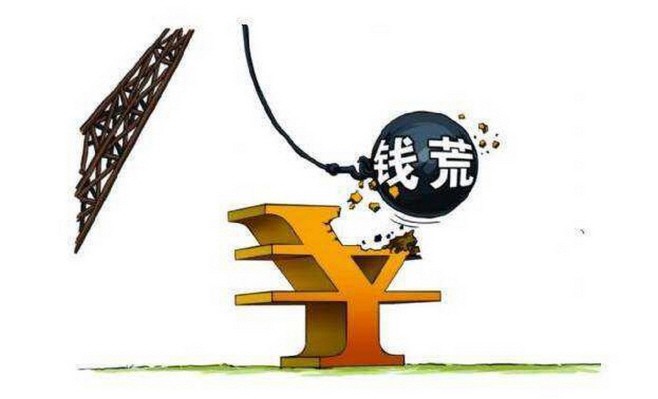 |
| China's economy is analyzed to have entered a phase of severe crisis. As illustrated in a media cartoon, the reality becomes glaringly obvious when the phrase "Qianhuang" (money scarcity) begins circulating in the public sphere. |
The Chinese economy is analyzed to have entered a phase of severe crisis, exhibiting critical warning signs across all key indicators, including investment, exports, and domestic consumption. The reality is so stark that further elaboration is redundant, given the widespread rumors that Cai Qi—a key heavyweight who, as the newly appointed president of the Central Party School, is widely regarded as the second most powerful figure in the party-state apparatus—has delivered a classified, urgent briefing on the situation to Xi Jinping, General Secretary and State President.
According to a synthesis of accounts from Beijing sources well-versed in Chinese economic data on June 17, the crisis in investment appears particularly acute. While official government statistics reported that 4.4 trillion yuan was invested last year, a widely accepted consensus suggests that the actual executed amount was a mere 2.35 trillion yuan. Investments in manufacturing and infrastructure have reportedly plummeted, indicating that the nation's growth engines have grown profoundly weak.
The stagnation in private sector investment is analyzed to be even more devastating. Sources report that while the private sector accounted for 70% of all investments just three to four years ago, that figure collapsed to a mere 40% last year. Foreign direct investment (FDI) attraction paints an equally disappointing picture. Officially, it was announced as 747.69 billion yuan, representing a nearly 10% decline compared to 2024; however, actual figures are estimated to have cratered by 46.5%. Consequently, large-scale projects valued at 100 million dollars or more have also dried up, making up only 26.8% of the total number of investment cases.
Although official statistics put 2025 exports at 3.7719 trillion dollars, a 5.5% increase year-on-year, sources maintain that the ground reality tells a different story, suggesting that the authorities massaged the data. Commenting on the situation, a Beijing-based economic analyst surnamed Qin, who requested anonymity, questioned the credibility of the data, noting, "Under the weight of punitive tariffs, exports to the United States—China's largest single market—plummeted by a staggering 20%. Given this backdrop, an outright increase in overall exports is highly implausible."
The deep slump in domestic consumption is glaringly evident in the popularity of the buzzword "Qianhuang" (money scarcity), which signals a severe systemic credit crunch in the public sphere. It is by no means a coincidence that "stingy consumption" and "beggar-style spending" have become massive trends among Gen Z consumers, who were once notoriously avid buyers of luxury goods. Similarly, the shuttering of high-end restaurants and luxury boutique stores has become a near-daily occurrence over the past few years.
Under such conditions, it would be anomalous for the economy to function smoothly. Incidents of wage arrears have become entirely normalized. In fact, a significant number of local governments are reportedly unable to pay even the basic salaries of their civil servants. It is within this same context that youth unemployment in several economically depressed cities has hovered around 40%.
The economic outlook for this year remains far from recovery. There is a clear rationale behind Chinese economic authorities lowering their growth target to a modest 4.5% to 5%. This deterioration is what prompted Cai Qi, member of the Politburo Standing Committee and Director of the General Office, to submit his emergency report to President Xi. However, he has reportedly failed to devise any clear countermeasure. Amid these compounding challenges, murmurs circulating in the public sphere that a red light has flashed for the political standing of President Xi—who is eyeing prolonged rule beyond a fourth term—appear to be grounded in more than mere rumor.
Hong Soon-do
Most Read
-
1
Trump shares map on social media labeling Strait o..

-
2
Kia Sportage outperforms Mazda CX-5 in German auto..

-
3
Houthis launch successive attacks on Saudi airport..

-
4
U.S. deploys carrier, 10,000 more troops to Middle..

-
5
Trump rejects Iran's offer to open Strait of Hormu..

-
6
N. Korea conducts first swarm attack drill with dr..

-
7
U.S.-China summit falls short on substance as Trum..

PEOPLE




HEADLINE NEWS
- Seoul dismisses Ukraine's claim of 'S. Korean support for Russia' as "inaccurate and inappropriate"
- S. Korea, Japan race to develop nuclear-powered submarines
- Henri Kagan, Kenso Soai win Nobel Prize in Chemistry for uncovering how mol..
- Vance says Alaska LNG cooperation will move forward with Seoul's current or..

-
Address : In-Young Bldg., 34, Uisadang-daero 1-gil, Yeongdeungpo-gu, Seoul
Copyright by ASIATODAY CO., LTD. All rights resereved