



Japan ruling party's plan to slash Lower House seats sparks opposition fury
Jun 17, 2026, 11:16 am


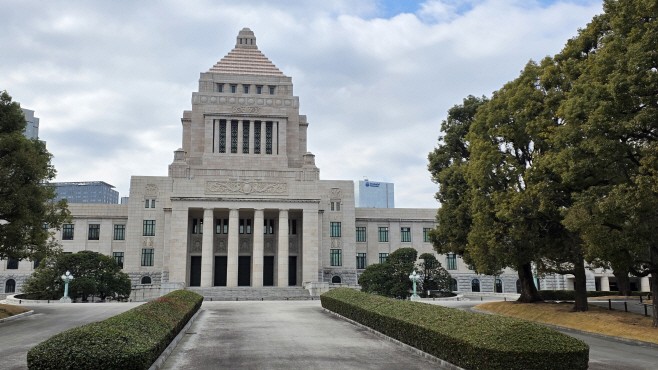 |
| The National Diet Building of Japan in Tokyo. / Photo by Choi Young-jae, Tokyo Correspondent |
The political establishment in Japan has been embroiled in a fierce debate over electoral reform as the ruling Liberal Democratic Party (LDP) and the Nippon Ishin no Kai (Japan Innovation Party) push ahead with a plan to slash 45 seats from the 465-member House of Representatives. With the proposed cuts highly likely to target proportional representation seats rather than single-seat constituencies, opposition parties are hitting back hard, condemning the move as a regressive reform designed to sideline minority voices. The Yomiuri Shimbun reported on June 17 that discussions surrounding a "10 percent reduction in the lower house headcount"—a clause explicitly included in the coalition government agreement signed by the LDP and Nippon Ishin no Kai in October last year—have resurfaced as a major bone of contention. Currently, the House of Representatives has 465 seats, consisting of 289 from single-seat districts and 176 through proportional representation.
Late last year, the LDP and Nippon Ishin no Kai introduced a bill to eliminate 25 single-seat districts and 20 proportional representation seats, but the legislation was scrapped following the dissolution of the lower house in January this year. That bill contained a provision mandating an automatic trigger to slash the seats across both categories if the ruling and opposition camps failed to reach a consensus within one year of the law's enactment. In the current Diet session, however, the coalition is mulling an alternative approach that restricts the entirety of the 45-seat reduction to proportional representation slots.
The opposition's fierce backlash stems from the fact that scaling back proportional representation disproportionately disadvantages smaller and mid-sized parties. According to an analysis by the Yomiuri Shimbun, applying the 45 proportional seat reduction to the results of the lower house election held on February 8 this year would result in a staggering 50% drop in seats for the Japanese Communist Party. The Sanseito party would see a 43% decline, while the Democratic Party for the People would lose 39% of its seats. This indicates that parties with a higher reliance on proportional representation than major establishment parties would bear the brunt of the changes.
Conversely, the ruling bloc is pitching the downsizing as a symbolic gesture of political reform and fiscal prudence aimed at cutting parliamentary expenditures. The monthly salary of a Japanese lawmaker translates to roughly 15.5 million yen annually. On top of this, members receive 1 million yen per month for research, public relations, and accommodation expenses, along with 650,000 yen per month in legislative administrative fees. When factoring in salaries for publicly funded secretaries, total government spending per lower house lawmaker is estimated at around 80 million yen a year. The coalition calculates that trimming 45 lawmakers would yield an annual cost savings of approximately 3.5 billion yen.
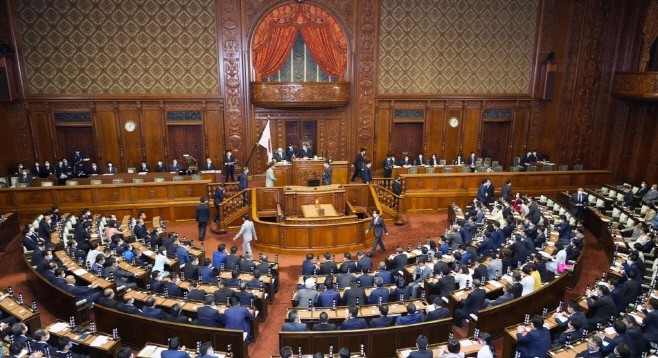 |
| The political establishment in Japan has been embroiled in a fierce debate over electoral reform as the ruling Liberal Democratic Party and the Nippon Ishin no Kai push ahead with a plan to slash 45 seats from the 465-member House of Representatives. / Photo courtesy of Yonhap News Agency |
However, Japan's parliamentary headcount can hardly be considered high by international standards. According to statistics from the Inter-Parliamentary Union (IPU), the number of lawmakers per one million people stands at 5.8 in Japan. While this is higher than the United States at 1.5, it falls well below the United Kingdom at 20.8, France at 13.9, and Canada at 11.2. Among the Group of Seven (G7) nations, the lower house headcounts of the UK (650 seats), Germany (630 seats), and France (577 seats) are all larger than that of Japan's House of Representatives.
The size of the Japanese lower house expanded alongside postwar population growth, peaking at 512 seats in 1986. Following a legal revision in 1994 that introduced the parallel voting system combining single-seat districts and proportional representation, the headcount was set at 500 starting with the 1996 general election. The figure dropped to 480 in 2000 through a reduction of 20 proportional representation seats. It was further scaled down by five single-seat districts in 2013, and by six single-seat districts and four proportional representation seats in 2017, arriving at the current 465-seat system.
The core of the current debate hinges not on whether the total number of lawmakers is excessive, but rather on which specific seats should be eliminated. Single-seat constituencies favor major establishment parties because only the top-voted candidate wins. Conversely, proportional representation allocates seats based on party vote shares, serving as a vehicle to reflect small-to-mid-sized parties and minority opinions in the Diet. Shaving 45 seats exclusively from proportional representation would trim parliamentary spending, but it threatens to shrink political diversity within the legislature.
The political interests at stake are starkly defined. Since its inception, the Nippon Ishin no Kai has championed "reforms that cut into one's own flesh," making seat reductions its signature policy. For Ishin, pushing this downsize through is a critical milestone to showcase to its voter base as a member of the coalition government. The LDP accepted Ishin's demand to preserve the coalition, yet faces significant internal blowback, as a smaller proportional pool impacts not only minor parties but also the LDP’s own lawmakers relying on proportional seats.
For the opposition, this is a matter of sheer survival. Smaller factions like the Japanese Communist Party, Sanseito, and the Democratic Party for the People stand to see their legislative leverage heavily eroded if proportional seats are cut. This underpins the opposition's fierce resistance against what they label an "assault on minority voices." Given that the combined forces of the LDP and Nippon Ishin no Kai fall short of a majority in the House of Councillors (the upper house), clearing the bill without opposition cooperation will be an uphill battle. Consequently, speculation is mounting that the downsize discussions, which stalled without proper deliberation during last year's extraordinary Diet session, may face another setback.
Choi Young-jae
Most Read
-
1
Trump shares map on social media labeling Strait o..

-
2
Kia Sportage outperforms Mazda CX-5 in German auto..

-
3
Houthis launch successive attacks on Saudi airport..

-
4
U.S. deploys carrier, 10,000 more troops to Middle..

-
5
Trump rejects Iran's offer to open Strait of Hormu..

-
6
N. Korea conducts first swarm attack drill with dr..

-
7
U.S.-China summit falls short on substance as Trum..

PEOPLE






HEADLINE NEWS
- Seoul dismisses Ukraine's claim of 'S. Korean support for Russia' as "inaccurate and inappropriate"
- S. Korea, Japan race to develop nuclear-powered submarines
- Henri Kagan, Kenso Soai win Nobel Prize in Chemistry for uncovering how mol..
- Vance says Alaska LNG cooperation will move forward with Seoul's current or..

-
Address : In-Young Bldg., 34, Uisadang-daero 1-gil, Yeongdeungpo-gu, Seoul
Copyright by ASIATODAY CO., LTD. All rights resereved