



Japan is cautious about dispatching minesweepers to Hormuz
Jun 16, 2026, 01:19 pm


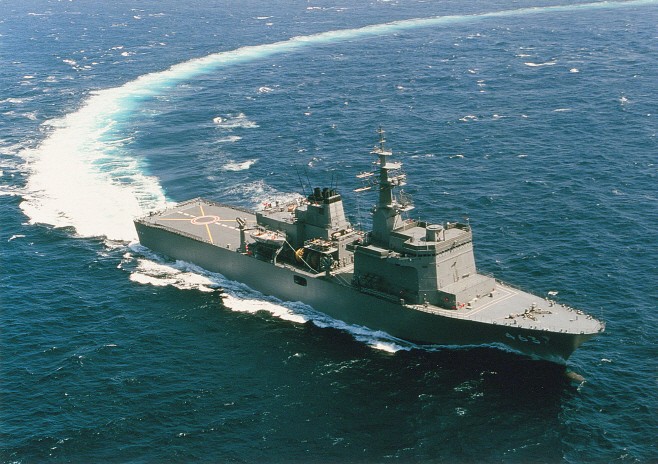 |
| The Uraga-class minesweeper tender of the Japan Maritime Self-Defense Force (JMSDF), featuring a displacement of 5,650 tons and a complement of 160 crew members. / Photo courtesy of the Japan Maritime Self-Defense Force Official Website |
The Japanese government is actively weighing the deployment of a Maritime Self-Defense Force (JMSDF) minesweeping unit to the Strait of Hormuz following a commercial maritime combat cessation agreement between the United States and Iran. Because Japan relies heavily on the Middle East for the vast majority of its crude oil imports, securing the freedom of navigation through the Strait of Hormuz directly correlates with the nation's core energy security. The Mainichi Shimbun reported on June 15 that high-level administrative reviews regarding response frameworks—including the formal dispatch of MSDF assets—have intensified within the ruling administration since the realization of the U.S.-Iran accord.
The Strait of Hormuz serves as a critical geopolitical chokepoint linking the Persian Gulf and the Gulf of Oman, handling a substantial volume of global crude oil and liquefied natural gas (LNG) maritime traffic. If naval mines are deployed within these shipping lanes, commercial merchant vessels and oil tankers cannot resume normal navigation until safety protocols are verified. This operational reality underpins the Japanese government's review of a military dispatch. The JMSDF is widely recognized as possessing world-class capabilities in mine countermeasure and removal operations. This expertise is rooted in post-World War II history, where Japan's naval forces rebuilt their operational foundational strength by clearing residual naval mines laid across Japanese territorial waters during the Pacific War.
There is also historical precedent for such a deployment. During the Korean War, even while Japan was still under Allied occupation, the Special Minesweeping Unit of the Maritime Safety Agency was deployed to the Korean Peninsula between October and December 1950 at the request of the U.S. military. According to Japanese Diet records and Defense Ministry historical documentation, the unit successfully cleared 27 naval mines across key coastal areas, including Wonsan, Incheon, Jinnampo, and Gunsan, incurring casualties and the sinking of a minesweeper in the process. This operation is evaluated as the first instance where Japan’s postwar maritime forces executed real-world operational missions overseas.
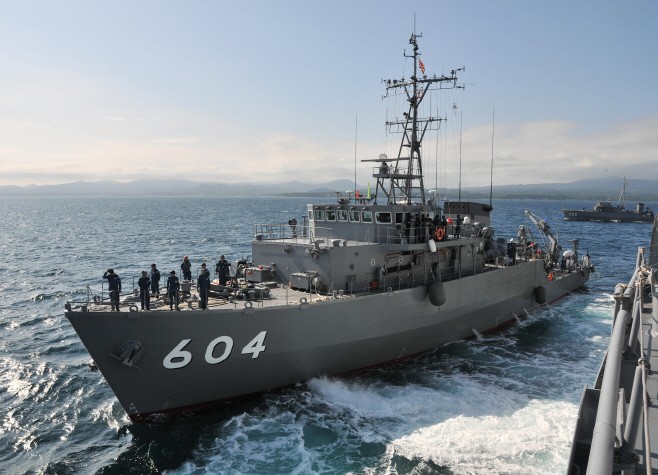 |
| An Enoshima-class coastal minesweeper (MSC) of the Japan Maritime Self-Defense Force (JMSDF), maintaining a displacement of 570 tons and operated by a complement of 45 crew members. / Photo courtesy of the Japan Maritime Self-Defense Force Official Website |
The Japanese government previously deployed a Maritime Self-Defense Force (JMSDF) minesweeping unit to the Persian Gulf in the aftermath of the 1991 Gulf War. At the time, Tokyo dispatched six minesweepers and approximately 510 personnel to participate in clearing naval mines laid by Iraqi forces. Operating under "Operation Gulf Dawn," the JMSDF successfully neutralized 34 naval mines, marking the first official, real-world overseas mission in the history of the Self-Defense Forces.
Similarly, the current dispatch proposal centers strictly on post-combat mine countermeasure operations. According to the Mainichi Shimbun, Prime Minister Sanae Takaichi stated on June 15 from Rome, "We welcome this as a major stride toward resolving the crisis," adding, "What matters now is that the formal signing occurs and is reliably executed." A high-ranking administration official indicated that a final deployment determination would follow an evaluation of the formal U.S.-Iran accord scheduled for signing on June 19, noting that "the recruitment of participating personnel will also commence."
Nevertheless, a profound sense of caution persists within the Japanese government. Should minesweeping operations proceed while the cessation agreement remains volatile or while active hostilities persist, the JMSDF's activities risk being legally interpreted as an unconstitutional use of force. Under Japan's pacifist Constitution and established security legislation, strict legal prohibitions govern the overseas exercise of military force. A senior Foreign Ministry official remarked, "A tentative ceasefire makes a deployment determination highly problematic," while a defense official emphasized, "We must first verify the actual presence of naval mines and confirm that commercial maritime transit is genuinely obstructed."
Ultimately, Tokyo's strategic calculus hinges upon three critical baselines: whether the U.S.-Iran accord is formally ratified and sustained; whether a definitive naval mine hazard is verified within the Strait of Hormuz; and whether the JMSDF's operational framework can be internationally structured as a maritime safety mission rather than a combat engagement. The degree to which Prime Minister Takaichi commits to Japan's operational role during the ongoing G7 summit remains a focal point of geopolitical scrutiny.
Choi Young-jae
Most Read
-
1
Trump shares map on social media labeling Strait o..

-
2
Kia Sportage outperforms Mazda CX-5 in German auto..

-
3
Houthis launch successive attacks on Saudi airport..

-
4
U.S. deploys carrier, 10,000 more troops to Middle..

-
5
Trump rejects Iran's offer to open Strait of Hormu..

-
6
N. Korea conducts first swarm attack drill with dr..

-
7
U.S.-China summit falls short on substance as Trum..

PEOPLE






HEADLINE NEWS
- Seoul dismisses Ukraine's claim of 'S. Korean support for Russia' as "inaccurate and inappropriate"
- S. Korea, Japan race to develop nuclear-powered submarines
- Henri Kagan, Kenso Soai win Nobel Prize in Chemistry for uncovering how mol..
- Vance says Alaska LNG cooperation will move forward with Seoul's current or..

-
Address : In-Young Bldg., 34, Uisadang-daero 1-gil, Yeongdeungpo-gu, Seoul
Copyright by ASIATODAY CO., LTD. All rights resereved