



[Reportage] "Robots weld, AI decides": A glimpse into HD Hyundai's AI shipyard
Jun 15, 2026, 01:49 pm


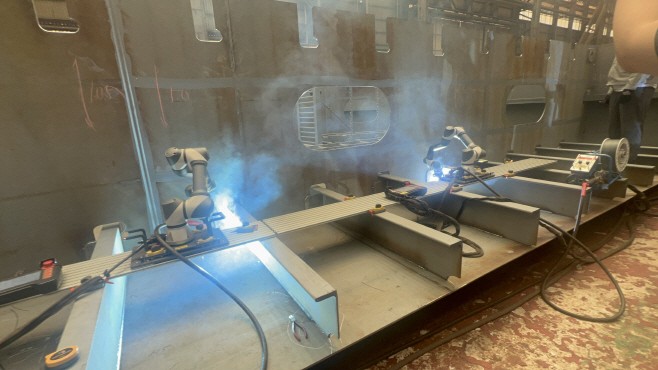 |
| An automated collaborative robot mounted on an electric-tracked autonomous guided vehicle (AGV), introduced by HD Hyundai Heavy Industries, welds steel plate cells to be used for a ship's hull. / Photo by Han Dae-ui |
The Block 2 Assembly Shop at HD Hyundai Heavy Industries in Ulsan was alive with a non-stop shower of sparks, standard for a workspace packed with ship blocks spanning dozens of meters. At first glance, it looked like a typical scene of welders hard at work, but a closer look revealed a completely different picture. Holding the welding torches were robots, not humans.
Operating entirely without manual intervention, these collaborative robots tracked along the welding lines at a steady pace. The moment a weld was completed, the machines transitioned smoothly to the next segment, while nearby, another robot executed a fresh task. Instead of carrying welding rods and moving from one ship block to another, the human workers were focused on managing multiple robots simultaneously through monitors and tablets.
A visit to HD Hyundai Heavy Industries’ production site on June 12 clearly demonstrated that the shipbuilding industry is rapidly pivoting toward an autonomous manufacturing framework powered by AI and robotics.
Shipbuilding has traditionally been classified as a highly non-standardized industry. Unlike car manufacturing, which relies on the repetitive production of identical units, every ship features a unique design and structure, making automation notoriously difficult. Consequently, shipyards have long leaned heavily on the experience and know-how of skilled craftsmen, earning a reputation as one of the toughest sectors to automate across the entire manufacturing spectrum.
However, a shrinking labor pool coupled with fierce competition from Chinese rivals is reshaping the industry's landscape. To lock in both productivity and quality, the deployment of AI-driven autonomous manufacturing technologies is now gaining serious traction.
"Shipbuilding is one of the hardest industries to automate because every single vessel has different structural dimensions and working conditions," explained Yoon Dae-kyu, Senior Vice President at HD Hyundai Heavy Industries. "We concluded that production innovation is absolutely vital to maintain our competitive edge over China."
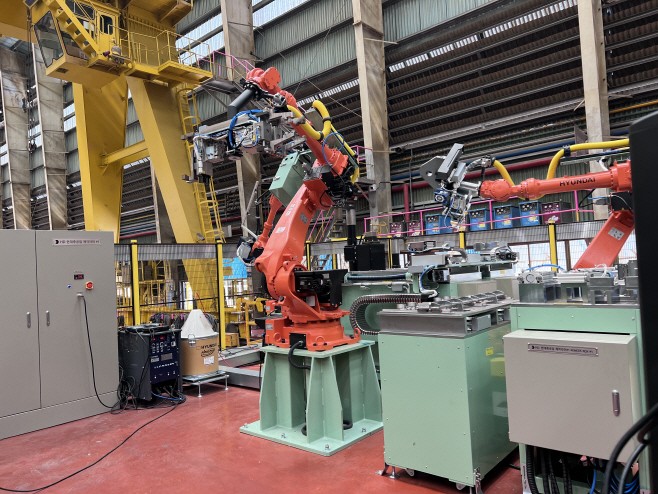 |
| An industrial robot deployed in HD Hyundai Heavy Industries' autonomous lug manufacturing system. / Photo by Han Dae-ui |
The collaborative robots currently deployed on the shop floor are the fruits of an initiative funded by the Ministry of Trade, Industry and Energy, aimed at developing an AI-driven autonomous manufacturing system based on collaborative robots for ship assembly processes. HD Hyundai Heavy Industries, the University of Ulsan, various research institutes, and related supply-chain partners joined forces to pull off the development.
A prime example is the collaborative robot mounted on an electric-tracked autonomous guided vehicle (AGV). While older collaborative robots required operators to physically move them around and manually input welding parameters, the new system automatically detects welding points based on blueprint data. Once a task wraps up, it rolls itself over to the next workspace to keep operations seamless. In areas where multiple veteran welders used to sweat it out, a single operator now oversees several robots at once.
"Previously, this specific process required a team of seven highly skilled workers, but now, a single junior employee can manage multiple robots simultaneously," said Hwang Sang-min, a senior engineer at the Mid-Sized Vessel Automation Innovation Department at HD Hyundai Heavy Industries. "The welding quality has become uniform, and the need for post-processing work has dropped drastically."
The technology is already paying dividends in productivity. According to data from HD Hyundai Heavy Industries, daily production output, which previously hovered around 500 tons under manual labor, has jumped to approximately 750 tons on a daytime shift since the AI welding system went live. When running around the clock on day and night shifts, that output can scale up to as much as 1,000 tons.
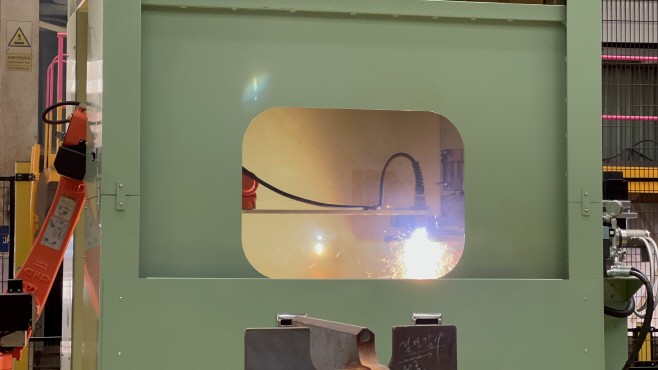 |
| An industrial robot processes a shipping lug at the autonomous lug manufacturing system site inside Assembly Shop 5 of the Medium-Sized Vessel Business Division at HD Hyundai Heavy Industries in Ulsan on June 12. / Photo by Han Dae-ui |
In another corner of the shipyard, a separate automation experiment was underway—the autonomous lug manufacturing system. Lugs are heavy-duty attachment structures used to anchor and lift massive ship blocks with cranes.
Previously, a team of six workers produced roughly 100 units a day, but the shipyard has now automated a significant portion of the cutting, welding, transport, and inspection phases. The setup relies on Autonomous Mobile Robots (AMRs) to shuttle parts around while an AI vision system inspects the welding quality.
All data generated on the shop floor feeds directly into a digital twin platform. From the comfort of their offices, managers can track production progress, equipment health, and quality metrics in real time. Moving forward, the shipyard plans to leverage this accumulated data to enable AI to predict potential quality defects before they occur.
While HD Hyundai Heavy Industries is currently expanding automation primarily around standardized processes like flat-block assembly, it aims to broaden the scope to include non-standardized operations down the road. The blueprint involves utilizing AI vision technology, humanoids, and quadrupedal robots to stretch the boundaries of autonomous manufacturing into dock and yard operations.
The Ministry of Trade, Industry and Energy also intends to propagate these technological breakthroughs down the supply chain to subcontractors rather than letting them remain isolated achievements of a single conglomerate. To support this, HD Hyundai Heavy Industries is standardizing the platform developed through the national project so that small and medium-sized suppliers can easily adopt it.
Han Dae-ui
Most Read
-
1
Kia Sportage outperforms Mazda CX-5 in German auto..

-
2
Houthis launch successive attacks on Saudi airport..

-
3
Saudi Arabia, Iran hold first diplomatic talks to..

-
4
U.S. deploys carrier, 10,000 more troops to Middle..

-
5
Saudi airport in Riyadh struck again, leaving at l..

-
6
Putin's ally visits China on the 8th ahead of APEC..

-
7
Chinese military support and training center opens..

PEOPLE






HEADLINE NEWS

-
Address : In-Young Bldg., 34, Uisadang-daero 1-gil, Yeongdeungpo-gu, Seoul
Copyright by ASIATODAY CO., LTD. All rights resereved