



US strikes Iran after helicopter downing, ceasefire talks stall
Jun 10, 2026, 09:17 am


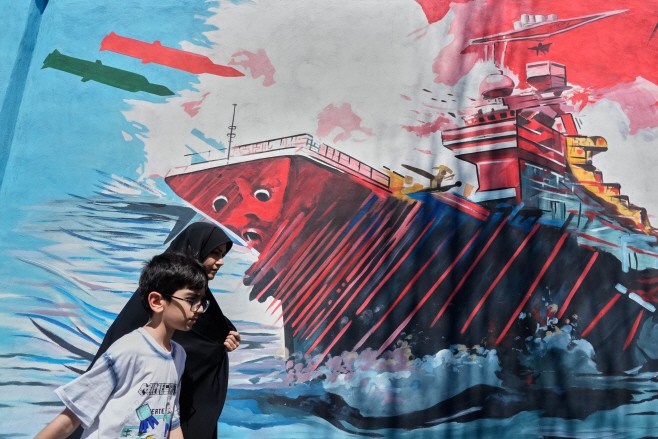 |
| Iranian citizens walk past a mural depicting a U.S. aircraft carrier under missile attack in downtown Tehran on the 8th (local time). / AP-Yonhap News Agency |
The U.S. military launched retaliatory strikes against Iran on the 9th (local time) in response to Iran's downing of a U.S. Apache helicopter that had been patrolling near the Strait of Hormuz.
The U.S. Central Command (CENTCOM) announced via X (formerly Twitter) that, under the direction of President Donald Trump, it began what it described as defensive military operations against Iran at 5:00 p.m. Eastern Time (6:00 a.m. Korea Standard Time on June 10). CENTCOM stated that the operation was conducted in response to the downing of a U.S. Army Apache helicopter the previous day and characterized it as “a proportional response to Iran’s unjustifiable act of aggression.”
Speaking with an ABC News reporter as the operation began, President Trump said, “I believe the response must be very strong and forceful,” adding, “This is exactly that.”
As speculation grows that negotiations aimed at ending the conflict between the United States and Iran are approaching their final stages, renewed military clashes surrounding the Strait of Hormuz have once again emerged as the biggest variable affecting prospects for a ceasefire.
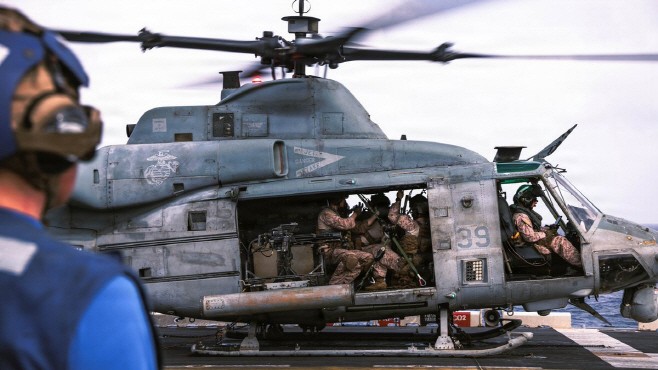 |
| U.S. Marines with the 31st Marine Expeditionary Unit board a UH-1Y Venom helicopter aboard the amphibious assault ship USS Tripoli (LHA 7), operating in regional waters, to conduct aerial sniper and close air support training. / U.S. Central Command (CENTCOM) via X (formerly Twitter) |
CENTCOM launches defensive strikes against Iran, calls action “proportional response” to Apache downing
CENTCOM did not immediately disclose the method, scale, or targets of the operation. However, given its emphasis on a “proportional response,” the strikes may have targeted Iranian military facilities such as drone launch sites or radar installations involved in the downing of the Apache helicopter.
According to CNN, Iran’s semi-official Mehr News Agency reported hearing explosions in the southern coastal city of Sirik and in Bandar Abbas and Qeshm near the Strait of Hormuz. The reports suggest that the U.S. strikes may have been conducted in areas surrounding the strategic waterway.
The United States has consistently characterized its recent military actions against Iran as exercises of self-defense in response to hostile acts. By again describing the operation as a “proportional response,” Washington appears to be signaling that the strikes were limited in scope and not intended to derail ongoing negotiations aimed at ending the conflict.
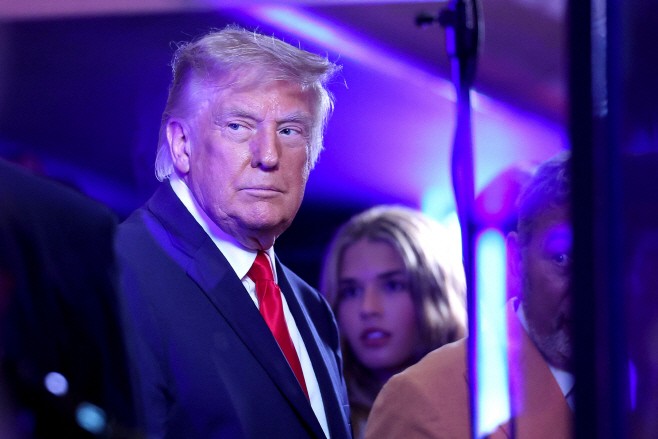 |
| U.S. President Donald Trump watches the action during Game 3 of the 2026 NBA Finals between the San Antonio Spurs and the New York Knicks at Madison Square Garden in New York on the 8th (local time). / AFP-Yonhap News Agency |
Trump signals retaliation on Truth Social, tells ABC peace agreement remains valid
Earlier, President Trump wrote on his social media platform Truth Social that he had “just received reports that a state-of-the-art Apache helicopter patrolling over the Strait of Hormuz last night was shot down by Iran.”
He added that the helicopter had two pilots on board, but that both were safe and had suffered no injuries.
“Nevertheless, the United States has no choice but to respond to this attack,” Trump said, signaling that military retaliation was inevitable. The subsequent U.S. strikes indicate that Trump’s warning was followed by direct military action.
According to Reuters, Trump’s remarks have raised new questions about the prospects for peace negotiations between the United States and Iran.
The Wall Street Journal (WSJ) reported that Trump described the incident during the phone call as “not a big deal,” while also stating that the maritime blockade against Iran would remain in place for as long as necessary. The contrast suggests that while Trump publicly signaled retaliation, he sought in private remarks to downplay the severity of the incident.
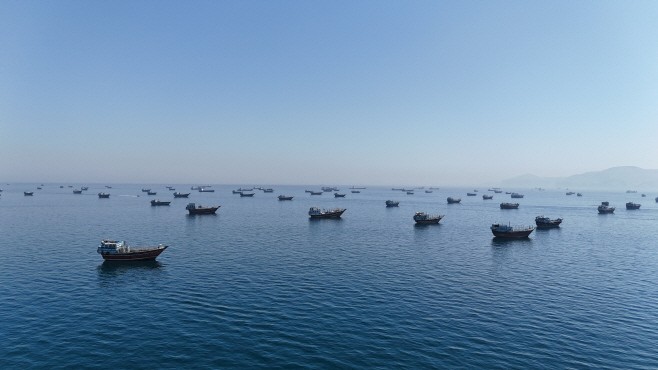 |
| Ships are anchored in the Strait of Hormuz as seen from Musandam, Oman, on the 8th (local time). / Reuters-Yonhap News Agency. |
Drone boat conducts first-ever maritime rescue of two stranded crew members
The New York Times (NYT), citing U.S. officials, reported that an Iranian one-way attack drone—essentially a suicide drone—was responsible for downing the Apache helicopter. Iran, however, has neither confirmed nor denied President Trump's claim that the aircraft was shot down.
Reuters reported that a U.S. Navy surface drone rescued the two crew members about two hours after the crash. According to The Wall Street Journal (WSJ), the operation marked the first maritime rescue mission carried out using a drone boat.
The two crew members remained in the water for roughly two hours while a U.S. MQ-9 Reaper drone and fighter aircraft provided aerial cover, the WSJ reported.
The rescue was conducted by the U.S. Navy's unmanned surface vessel Saronic Corsair. According to the WSJ, the vessel is 24 feet long, has a top speed of 35 knots, a range of more than 1,150 miles, and can carry up to 1,000 pounds of payload.
The unmanned vessel belongs to Task Force 59, the U.S. Navy's first artificial intelligence (AI) and drone operations unit, and was first deployed to the Middle East in late March.
“We had practiced this scenario in training, but we had never actually executed it this way in a real-world situation,” said Tim Hawkins, a spokesperson for U.S. Central Command.
The WSJ also reported that, according to a May report by the Congressional Research Service (CRS), the U.S. military has lost or sustained damage to 42 fixed-wing aircraft, helicopters, and drones since the outbreak of the Iran war on February 28.
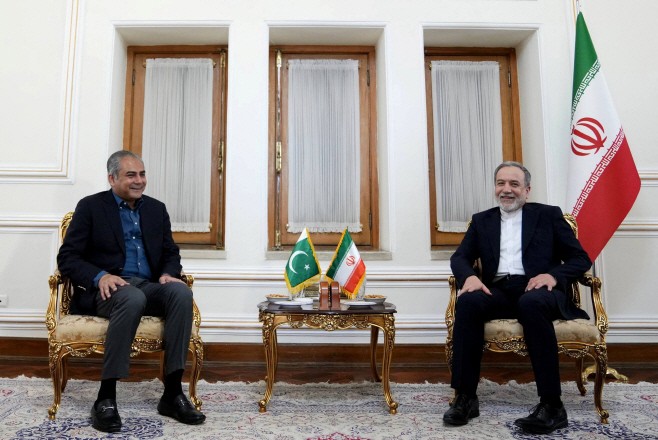 |
| Iranian Foreign Minister Abbas Araghchi (right) meets with Pakistani Interior Minister Mohsin Naqvi in Tehran on the 7th (local time). / Reuters-Yonhap News Agency. |
Iran FM avoids confirming shootdown, says “best solution is for foreign forces to leave”
Iranian Foreign Minister Abbas Araghchi wrote on X (formerly Twitter) that “foreign military forces operating near our territory are constantly exposed to risks arising from human error, accidents, or the possibility of becoming involved in hostilities.”
“The best solution for reducing these risks is for them to leave,” Araghchi said. “We prefer the language of diplomacy, but we know how to speak other languages as well.”
His remarks were widely interpreted as pressure on the U.S. military presence and operations around the Strait of Hormuz, while stopping short of directly acknowledging Iran’s role in the helicopter shootdown.
After President Trump signaled retaliation, Iranian state media, citing Iranian sources, reported that Tehran would respond decisively if the United States resumed hostile actions over the helicopter incident. Any further Iranian military response following the U.S. strikes could once again escalate tensions in the Strait of Hormuz.
Israel’s military operations in Lebanon also remain a variable in ceasefire negotiations. Reuters reported that Israeli airstrikes on the southern Lebanese port city of Tyre killed at least eight people on Monday. The Lebanese front has emerged as a key issue in U.S.-Iran peace talks. While Iran has demanded guarantees for Lebanon’s stability, Israel continues to treat operations against Hezbollah as a separate front.
NYT: Finding a deal both sides can claim as a victory remains the biggest hurdle
According to Bloomberg, the United States and Iran have maintained that the ceasefire remains in effect despite sporadic clashes since the April 8 truce. Pakistan and Qatar have been shuttling between the two sides in an effort to mediate a broader peace agreement.
Before raising the helicopter incident, Trump repeatedly suggested that a deal with Iran was close. In a telephone interview with the BBC, he said, “We are very close to reaching a very strong agreement. It is a very good agreement. There will be no nuclear weapons. Nothing else.”
He later told reporters in New York that negotiations had reached “the final stage of a very good deal,” Bloomberg reported.
The New York Times said the greatest challenge remains crafting an agreement that both Washington and Tehran can present domestically as a victory. According to the report, a provisional agreement could include restoring freedom of navigation through the Strait of Hormuz, ending U.S. restrictions on Iranian shipping, follow-up negotiations over Iran’s highly enriched uranium (HEU) stockpiles, and sanctions relief.
However, significant differences remain over the sequencing of these measures and the release of frozen Iranian assets.
The Financial Times argued that Trump appears increasingly unable to control the direction of the Middle East conflict as events are being driven by both Iran and Israel. The newspaper added that if the perception grows that Trump cannot restrain Israeli Prime Minister Benjamin Netanyahu, Tehran will have little incentive to make major concessions.
U.S. energy chief says Hormuz traffic recovering, but retaliation clouds outlook
There had been signs that shipping activity through the Strait of Hormuz was beginning to recover.
U.S. Energy Secretary Chris Wright said at an Atlantic Council event that vessel traffic through the strait was increasing “very significantly.” He added that it would still take months for global energy flows to return to normal.
Bloomberg reported that Kuwait had offered crude oil cargoes to Asian refiners for the first time since the outbreak of the war, a potential signal that Gulf energy exporters are resuming shipments.
Oil prices had fallen sharply on expectations of easing tensions in the Middle East. August Brent crude futures dropped 2.97% to $91.45 per barrel, while July West Texas Intermediate (WTI) crude fell 3.40% to $88.20 per barrel.
However, losses narrowed later in the trading session after Trump publicly blamed Iran for the helicopter incident and signaled retaliation. With U.S. retaliatory strikes now underway, the recovery of shipping through the Strait of Hormuz and the recent stabilization of oil prices are once again facing uncertainty.
Ha Man-joo
Most Read
-
1
Celltrion’s Omlyclo gains ground in major European..

-
2
Trump demands rates fall below 1% as Fed hikes for..

-
3
Trump makes $1 trillion bet ahead of midterm elect..

-
4
Iran resumes ballistic missile production, assembl..

-
5
Samsung Electronics, Mistral AI to jointly develop..

-
6
Trump warns countries not helping U.S. must pay re..

-
7
Apple launches first foldable, 1 million won prici..

PEOPLE






HEADLINE NEWS
- Trump to roll out ‘unprecedented welcome’ for Xi with B-2 bombers, F-22 fighters
- S. Korea, U.S., and Japan form united front on Taiwan and economic coercion..
- Trump administration moves to impose sweeping sanctions on International Cr..
- Xi to make state visit to U.S. Sept. 23-25, dispelling rumors over his heal..

-
Address : In-Young Bldg., 34, Uisadang-daero 1-gil, Yeongdeungpo-gu, Seoul
Copyright by ASIATODAY CO., LTD. All rights resereved