



[Reporter’s View] Chinese graduates face grave despair as graduation season arrives
Jun 15, 2026, 01:40 pm


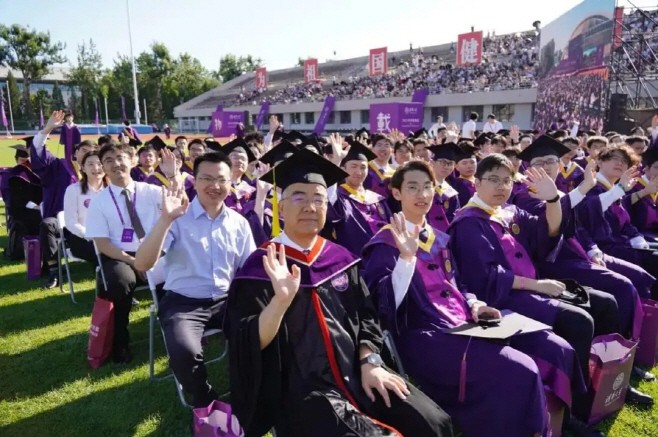 |
A view of Tsinghua University’s graduation ceremony held on June 21 last year. Despite being one of China’s most prestigious institutions, a significant portion of this year's graduates are estimated to remain unemployed. / Photo by Economic Daily
In China, the months of June and July mark the annual college graduation season. This year, a record 12.7 million graduates are stepping out of their campuses to make their first foray into society—a staggering increase of 480,000 compared to last year. Yet, save for a select few, the vast majority of these youths are far from happy. This is because the grim equation of "graduation equals unemployment," which has persisted for several years, remains painfully accurate this year. The graduation season has turned into a season of deep frustration, forcing young graduates onto a grueling march.
The sheer severity of the situation is best illustrated by the employment rate. Synthesizing recent reports from various media outlets, including the Economic Daily, the overall employment rate for graduates is estimated to sit below 50%. Even among those who do find jobs, very few can share the good news of securing a quality position with those around them. Ma Xiangwu, a professor of Chinese literature at Renmin University, recently lamented the bleak reality, saying, "Students who get into Renmin University are considered top talents nationwide. Yet, right now, almost none of the graduates around me have shared news of finding employment. It is truly devastating." His heartbreak is by no means an exaggeration.
When highly educated talents face deep frustration without finding proper work, it inflicts a massive loss on society. It inevitably casts a dark shadow over the entire Chinese economy. Education authorities are not sitting idly by, however. The Ministry of Education is tightening cooperation with local governments and universities to promote "high-quality and sufficient employment" for college graduates. The ministry is also practically begging corporations, desperately urging them to hire as many personnel as possible. With General Secretary and President Xi Jinping himself displaying keen interest in the matter, further explanation on the gravity of the situation is redundant.
Some marginal results are indeed trickling in. For instance, big tech companies based in Hangzhou, Zhejiang Province—widely known as a hub for the ICT industry—have reportedly promised education authorities to recruit an additional 2,000 workers nationwide. Companies located in major cities across neighboring Fujian and Jiangsu provinces are also reportedly striving to answer the government’s call.
The efforts do not stop there. In Guizhou Province, the government is continuing a policy from last year, providing a job-hunting subsidy of 1,500 yuan per person to graduates from vulnerable socioeconomic backgrounds, totaling 200 million yuan. Meanwhile, tier-one megacities like Beijing and Shanghai are encouraging government agencies and state-owned enterprises to maintain or expand their hiring quotas.
Yet, compared to the massive tidal wave of 12.7 million graduates, the fortunate ones who benefit from these government initiatives represent a tiny fraction. The overwhelming majority are forced to lower their sights to food delivery or courier services, settling for life as flexible gig workers. Chen Mingxi, a graduating senior at a university in Beijing, sighed, "I can't help but wonder if this is what I spent four years in college for. I feel incredibly guilty toward my parents." Her lamentation accurately mirrors the harsh reality on the ground.
Simply put, fundamental countermeasures must be put in place. Without them, the employment crisis for Chinese college graduates will likely remain unresolved well beyond this year. Should that happen, China's lofty ambition to surpass the United States and become the world's top superpower (G1) around 2035 will inevitably remain nothing more than wishful thinking.
Hong Soon-do |
Most Read
-
1
Trump shares map on social media labeling Strait o..

-
2
Kia Sportage outperforms Mazda CX-5 in German auto..

-
3
Houthis launch successive attacks on Saudi airport..

-
4
U.S. deploys carrier, 10,000 more troops to Middle..

-
5
Trump rejects Iran's offer to open Strait of Hormu..

-
6
N. Korea conducts first swarm attack drill with dr..

-
7
U.S.-China summit falls short on substance as Trum..

PEOPLE





HEADLINE NEWS
- Seoul dismisses Ukraine's claim of 'S. Korean support for Russia' as "inaccurate and inappropriate"
- S. Korea, Japan race to develop nuclear-powered submarines
- Henri Kagan, Kenso Soai win Nobel Prize in Chemistry for uncovering how mol..
- Vance says Alaska LNG cooperation will move forward with Seoul's current or..

-
Address : In-Young Bldg., 34, Uisadang-daero 1-gil, Yeongdeungpo-gu, Seoul
Copyright by ASIATODAY CO., LTD. All rights resereved