



Despite US-Iran peace pact, energy supply normalization remains a long way off
Jun 15, 2026, 01:29 pm


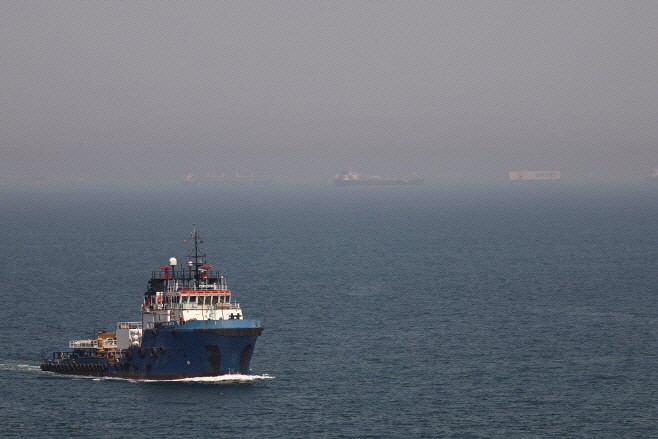 |
| The offshore supply vessel "Zakher Duty" sits anchored at the Port of Fujairah in the United Arab Emirates (UAE) on June 6 (local time), amid restricted maritime traffic in the Strait of Hormuz driven by ongoing conflicts between Iran, the United States, and Israel. / Photo by Reuters, Yonhap News |
With the United States and Iran agreeing to a peace pact on June 14 (local time), the Strait of Hormuz—which has been blockaded for 108 days—is on the verge of reopening. However, projections suggest it will take considerable time for the global energy and logistics markets to bounce back to pre-war levels.
The Islamic Revolutionary Guard Corps (IRGC) blockaded the critical waterway back on February 28 following joint US and Israeli strikes on Iran. Once the blockade lifts under this new peace agreement, East Asian nations heavily reliant on crude imports—including South Korea, Japan, and China—are expected to be the primary beneficiaries.
Yet the shipping and insurance sectors warn against expecting an overnight recovery, pointing to lingering challenges like high freight rates, soaring insurance premiums, and the need for safety verifications like sea mine clearance. While maritime insurance rates and freight costs that spiked during the conflict are expected to ease gradually, the remaining risk premiums mean a short-term recovery is unlikely.
Global crude prices dipped immediately following the announcement, but analysts forecast that it will take at least several months for the supply chain to genuinely stabilize.
"For the strait to become fully operational, the vessels currently stranded there must leave first before new tankers can enter, which requires establishing a secure window of time," Daniel Evans, head of global fuel and refining research at S&P Global Commodity Insights, told the AP. "Getting operations back up and running on the ground inherently takes longer, particularly when you consider the fundamentally slow pace of crude oil transportation."
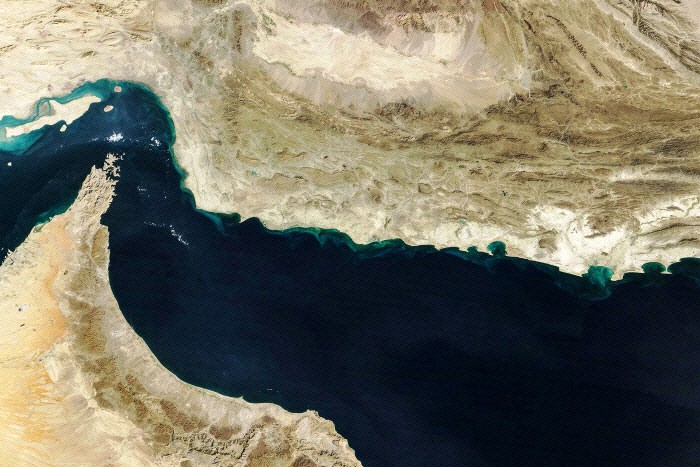 |
| This satellite image, captured on March 5 (local time) by the Moderate Resolution Imaging Spectroradiometer (MODIS) sensor aboard NASA’s Terra satellite, shows the Gulf of Oman and the Makran region located across southern Iran and southwestern Pakistan (center), the Strait of Hormuz (left), and the northern coast of Oman. / Photo by AFP, Yonhap News |
An official from the International Chamber of Shipping also noted, "Even as vessels return to the shipping lanes, it will take at least several months for operational costs to slide back to pre-war levels. Insurance premiums, in particular, are weighed down by risk premiums, making them highly resistant to dropping in the short term."
In fact, Iran is sticking to its stance on maintaining control over the strait, without ruling out the possibility of imposing transit fees. While the United States demands unconditional freedom of navigation, Iran asserts its domestic administrative authority, leaving a gap in interpretation that remains a potential flashpoint for future conflict.
The shipping industry similarly maintains that it has no choice but to approach the normalization of operations with caution until sea mine clearance and safety verifications are fully wrapped up, viewing the burdens of high insurance premiums and freight rates as hurdles that cannot be cleared overnight.
"Even if a peace pact is implemented, there is no guarantee that another crisis won't boil over," Rodolphe Saadé, CEO of French shipping giant CMA CGM, recently warned during a parliamentary hearing. "It is dangerous to assume that just because the Strait of Hormuz has opened, everything will seamlessly snap back to how it was before."
Varying recovery speeds among different oil-producing nations also add layers of complexity to global energy normalization.
"Saudi Arabia and the UAE have alternative pipelines in place, allowing them to ramp production back up relatively quickly," pointed out Alan Gelder, Vice President of Refining, Chemicals, and Oil Markets at Wood Mackenzie. "However, Iraq deals with far more complex oil fields, meaning its recovery could drag on for nearly a year."
Park Jin-sook
Most Read
-
1
Trump shares map on social media labeling Strait o..

-
2
Kia Sportage outperforms Mazda CX-5 in German auto..

-
3
Houthis launch successive attacks on Saudi airport..

-
4
U.S. deploys carrier, 10,000 more troops to Middle..

-
5
Trump rejects Iran's offer to open Strait of Hormu..

-
6
N. Korea conducts first swarm attack drill with dr..

-
7
U.S.-China summit falls short on substance as Trum..

PEOPLE






HEADLINE NEWS
- Seoul dismisses Ukraine's claim of 'S. Korean support for Russia' as "inaccurate and inappropriate"
- S. Korea, Japan race to develop nuclear-powered submarines
- Henri Kagan, Kenso Soai win Nobel Prize in Chemistry for uncovering how mol..
- Vance says Alaska LNG cooperation will move forward with Seoul's current or..

-
Address : In-Young Bldg., 34, Uisadang-daero 1-gil, Yeongdeungpo-gu, Seoul
Copyright by ASIATODAY CO., LTD. All rights resereved