



War and surging US rates drag down Asian currencies amid AI boom
Jun 15, 2026, 11:13 am


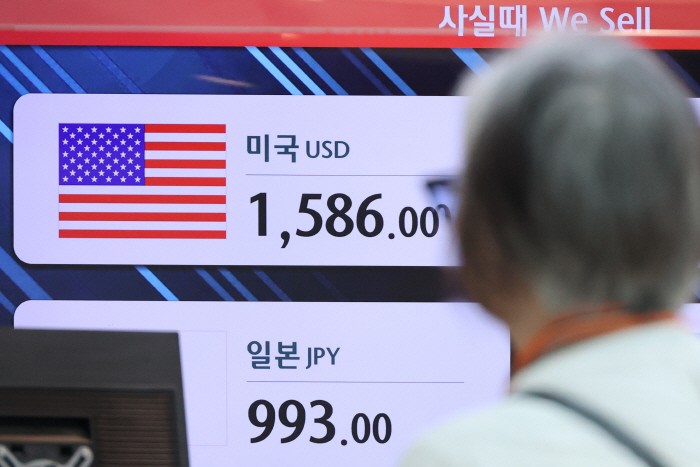 |
| Real-time Won/Dollar exchange rates are displayed at a bank currency exchange booth inside Incheon International Airport on June 9. / Yonhap News |
Despite a boom in artificial intelligence (AI)-related exports across Asian economies like Taiwan, Japan, and South Korea, their respective currencies continue to weaken against the greenback, The Wall Street Journal (WSJ) reported on June 13 (local time).
According to the WSJ, the Indonesian rupiah has tumbled 7 percent against the U.S. dollar this year, while the South Korean won shed around 5 percent, the Thai baht dropped about 4 percent, and the Philippine peso slid roughly 3 percent.
A confluence of factors is driving this downward pressure on Asian currencies, heavily led by surging energy prices triggered by the blockade of the Strait of Hormuz.
Asian economies—including Japan, South Korea, and Taiwan—are deeply vulnerable to energy shocks, relying on imports for 80 to 90 percent of their energy needs.
Because oil is globally priced in U.S. dollars, escalating energy import bills inevitably drive down the currency value of major importing nations.
Mounting inflationary pressures also stand out as a critical culprit. Rising energy costs strain government fiscal balances and fuel inflation, which ultimately pushes the domestic currency into a deeper slump.
Compounding the issue is the relentless rise in U.S. interest rates. As U.S. Treasury yields climbed, global capital fled to the United States in pursuit of higher returns, amplifying the depreciation of Asian currencies, the WSJ explained.
Typically, an export boom—such as the one South Korea, Taiwan, and Japan are currently riding on the back of AI demand—bolsters domestic currency strength. However, Asia is now wrestling with a highly unusual anomaly where a surging export sector coexists with currency weakness.
Deconstructing this paradox, the WSJ pointed to South Korea as a prime example, noting that local investors, swept up in the AI craze, have aggressively moved capital out of the country to invest in U.S. tech stocks, further exacerbating the currency's decline.
"In my career as an economist, I have rarely seen a configuration quite like this," remarked Frederic Neumann, Chief Asia Economist at HSBC.
Park Jin-sook
Most Read
-
1
Trump shares map on social media labeling Strait o..

-
2
Kia Sportage outperforms Mazda CX-5 in German auto..

-
3
Houthis launch successive attacks on Saudi airport..

-
4
U.S. deploys carrier, 10,000 more troops to Middle..

-
5
Trump rejects Iran's offer to open Strait of Hormu..

-
6
N. Korea conducts first swarm attack drill with dr..

-
7
U.S.-China summit falls short on substance as Trum..

PEOPLE






HEADLINE NEWS
- Seoul dismisses Ukraine's claim of 'S. Korean support for Russia' as "inaccurate and inappropriate"
- S. Korea, Japan race to develop nuclear-powered submarines
- Henri Kagan, Kenso Soai win Nobel Prize in Chemistry for uncovering how mol..
- Vance says Alaska LNG cooperation will move forward with Seoul's current or..

-
Address : In-Young Bldg., 34, Uisadang-daero 1-gil, Yeongdeungpo-gu, Seoul
Copyright by ASIATODAY CO., LTD. All rights resereved