



Philippines earthquake raises seabed, devastating marine life
Jun 15, 2026, 11:04 am


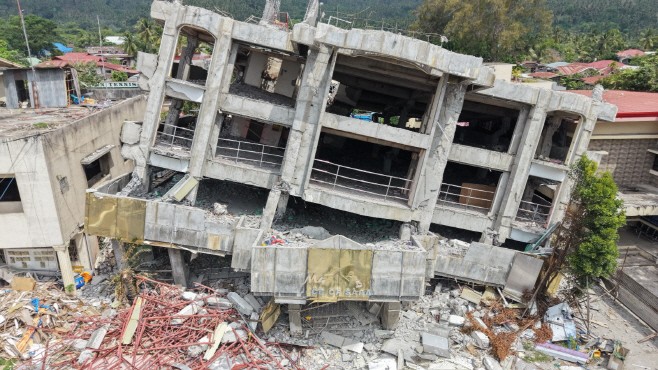 |
| An aerial drone view of the earthquake damage in Glan, Sarangani Province, Philippines, captured on June 11 (local time). / Xinhua Yonhap News |
A powerful magnitude 7.8 earthquake that struck the southern Philippines last week raised the seabed by up to 2 meters, exposing submerged coral reefs above the water and causing the mass die-off of fish and other marine life.
The Philippine Department of Environment and Natural Resources (DENR) announced that the earthquake, which occurred on June 8, left corals exposed and severely damaged the marine ecosystem, AFP reported on June 15 (local time). Local disaster authorities reported that the powerful tremor on the southern island of Mindanao has left at least 61 people dead and 40 others missing so far.
As the human toll was being tallied, a series of anomalies were reported in the ocean. This phenomenon, known as "coastal uplift," first came to light when residents reported it on June 10, two days after the earthquake. The DENR stated that the shoreline in some areas had extended outward into the sea by up to 200 meters.
This dramatic shift in the coastline was caused by movement along the Cotabato Trench. The Philippine Institute of Volcanology and Seismology (PHIVOLCS) explained that displacement in the Cotabato Trench pushed parts of the coastlines in Sarangani and Davao Occidental provinces upward, exposing the seabed that was previously underwater. The institute noted that the measured vertical uplift was approximately 2 meters.
The Cotabato Trench is located as close as 50 kilometers off the coast of southern Mindanao and is a seismically active region. In January of this year, an earthquake swarm involving thousands of mostly minor tremors was recorded in the area.
Authorities dispatched an investigation team to the site to determine the full extent of the exposed seabed. The DENR stated that the investigation confirmed long stretches of shoreline, coral reefs, and seagrass beds had been pushed above the water. However, an official told AFP that it is still difficult to pinpoint the exact scale of the damage due to the vast area that needs to be surveyed.
Photographs released by a regional DENR office showed dead fish and marine organisms scattered across wide expanses of exposed coral reefs. Residents initially reported the changes out of concern that they might be affected by the foul odor of decaying marine life. The DENR stated, "The exposed corals and seagrass beds, along with the reef fish, eels, and shellfish that inhabited them, have begun to die off."
Jung Ri-na
Most Read
-
1
Trump shares map on social media labeling Strait o..

-
2
Kia Sportage outperforms Mazda CX-5 in German auto..

-
3
Houthis launch successive attacks on Saudi airport..

-
4
U.S. deploys carrier, 10,000 more troops to Middle..

-
5
Trump rejects Iran's offer to open Strait of Hormu..

-
6
N. Korea conducts first swarm attack drill with dr..

-
7
U.S.-China summit falls short on substance as Trum..

PEOPLE






HEADLINE NEWS
- Seoul dismisses Ukraine's claim of 'S. Korean support for Russia' as "inaccurate and inappropriate"
- S. Korea, Japan race to develop nuclear-powered submarines
- Henri Kagan, Kenso Soai win Nobel Prize in Chemistry for uncovering how mol..
- Vance says Alaska LNG cooperation will move forward with Seoul's current or..

-
Address : In-Young Bldg., 34, Uisadang-daero 1-gil, Yeongdeungpo-gu, Seoul
Copyright by ASIATODAY CO., LTD. All rights resereved