



Japan’s nationwide accommodation tax expansion hits Korean tourists’ wallets
Jun 15, 2026, 10:26 am


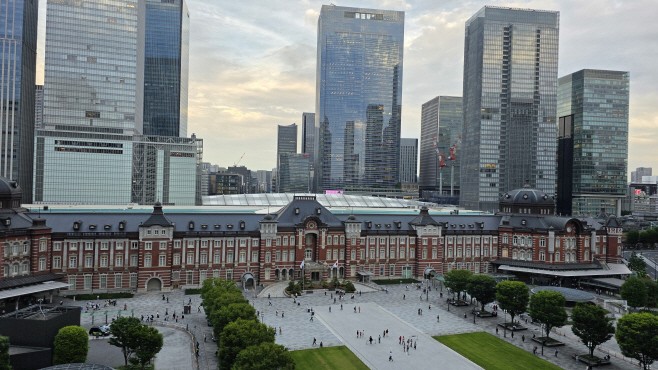 |
| Tokyo Station crowded with foreign tourists. / By Tokyo Correspondent Choi Young-jae |
Korean tourists planning trips to Japan are expected to face a heavier financial burden as the "accommodation tax"—a separate levy imposed on hotel and ryokan (traditional inn) guests—spreads across the country. Local governments in Japan cite the need to upgrade tourism infrastructure and counter overtourism driven by the influx of international visitors as justification. However, since this is a supplemental tax added to the baseline room rates, South Korean travelers bound for Japan will feel the direct impact.
The Yomiuri Shimbun reported on June 13, citing Japan’s Ministry of Internal Affairs and Communications, that 45 local governments have already implemented the accommodation tax, with another 10 municipalities scheduled to follow suit this year. The accommodation tax is a local tax levied on patrons of lodging facilities. In simple terms, it is a "tourism-focused surtax" collected separately by local authorities to secure municipal tourism funds, completely apart from standard room charges and the consumption tax.
For Korean travelers, calculating these expenses in Korean won (KRW) is essential. Assuming a current exchange rate of approximately 950 KRW per 100 JPY, a tax of 100 JPY per night translates to around 950 KRW, 200 JPY is about 1,900 KRW, 300 JPY equals roughly 2,850 KRW, and 500 JPY comes to nearly 4,750 KRW. For instance, if two people stay for three nights and owe an accommodation tax of 300 JPY per person per night, a total of 1,800 JPY—roughly 17,000 KRW—will be tacked onto the bill outside of the room rate.
Hot spring destinations are no exception. Yugawara-machi in Kanagawa Prefecture introduced the accommodation tax this past April, becoming the first municipality within the prefecture to do so. Guests pay 300 JPY if the nightly room rate per person is under 50,000 JPY, and 500 JPY if it meets or exceeds 50,000 JPY. This adds roughly 2,850 to 4,750 KRW per person per night. For a couple staying two nights, that means an extra charge of at least 11,000 KRW, or around 19,000 KRW if they book a high-end ryokan.
The financial hit is even steeper in Kyoto. Kyoto City raised its accommodation tax rates in March to tackle overtourism. The city expanded its tax brackets from three tiers to five and raised the maximum daily cap per person from 1,000 JPY to 10,000 JPY. Travelers staying at luxury hotels or ryokans priced at 100,000 JPY or more per night must now pay up to roughly 95,000 KRW per night just in accommodation taxes. Kyoto City projects its accommodation tax revenue for this year to more than double to 13.2 billion JPY.
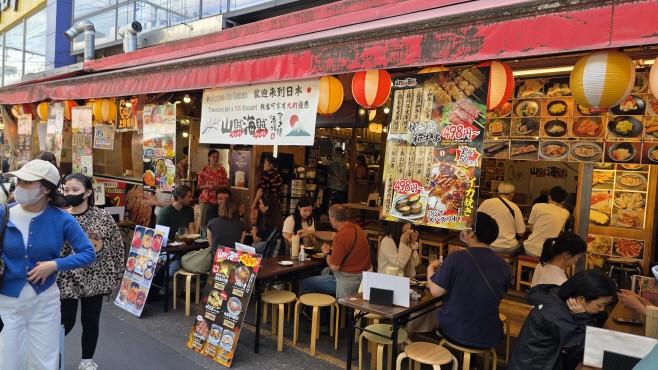 |
| Japanese pubs (izakayas) in Tokyo crowded with foreign tourists. / By Tokyo Correspondent Choi Young-jae |
Tokyo, a popular destination for Korean tourists, is also preparing to revamp its system. Starting in fiscal year 2027, the Tokyo Metropolitan Government plans to transition from its current flat-rate system—which charges 100 JPY or 200 JPY per person per night—to a fixed-percentage rate of 3% on the room charge. Under this framework, the tax scales up in proportion to the cost of the lodging. For instance, a stay at a accommodation priced at 20,000 JPY per night would incur a tax of 600 JPY (roughly 5,700 KRW). If the rate is 30,000 JPY, the tax rises to 900 JPY (about 8,500 KRW), and for a 50,000 JPY room, it reaches 1,500 JPY (around 14,000 KRW). For family travelers or those on a three-to-four-night itinerary, the perceived financial burden will be even greater.
The reason Japanese local governments are pushing to introduce accommodation taxes is a combination of surging tourist numbers and deteriorating municipal finances. Officials in Yugawara-machi maintain that to sustain itself as a tourist destination amid a shrinking population and declining tax revenue, securing dedicated funds for tourism is vital. The revenue generated from the accommodation tax is utilized for issuing local lodging vouchers and gift certificates, upgrading hospitality infrastructure for visitors, and expanding tourism resources.
However, the policy is facing pushback. The hospitality industry expresses concern that increased costs for guests could trigger a drop in bookings. In fact, Akita City shelved its implementation plans last year after a survey of lodging operators highlighted anxieties over a decline in visitors and the administrative burden of tax collection. The lack of a concrete plan on how exactly to allocate the collected funds for tourism promotion also contributed to the suspension.
Controversy also surrounds the scope of the taxation. Biei-cho in Hokkaido considered exempting local residents when it introduced an accommodation tax alongside a parking fee at the famous tourist spot "Blue Pond," but the Ministry of Internal Affairs and Communications pointed out that this raised equity concerns regarding taxation. The situation now demands coordination between the central government and local authorities over how far municipalities can go in placing the financial burden exclusively on tourists.
The accommodation tax is not a standard tax officially designated by name in Japan’s Local Tax Act, but rather an "extra-legal earmarked tax" created by local governments via municipal ordinances for specific objectives. It can only be collected after obtaining consent from the Minister of Internal Affairs and Communications. While the stated goal is tourism promotion, for South Korean tourists, an era has arrived where accommodation taxes must be factored into the travel budget alongside airfare, lodging, and dining expenses.
Choi Young-jae
Most Read
-
1
Trump shares map on social media labeling Strait o..

-
2
Kia Sportage outperforms Mazda CX-5 in German auto..

-
3
Houthis launch successive attacks on Saudi airport..

-
4
U.S. deploys carrier, 10,000 more troops to Middle..

-
5
Trump rejects Iran's offer to open Strait of Hormu..

-
6
N. Korea conducts first swarm attack drill with dr..

-
7
U.S.-China summit falls short on substance as Trum..

PEOPLE






HEADLINE NEWS
- Seoul dismisses Ukraine's claim of 'S. Korean support for Russia' as "inaccurate and inappropriate"
- S. Korea, Japan race to develop nuclear-powered submarines
- Henri Kagan, Kenso Soai win Nobel Prize in Chemistry for uncovering how mol..
- Vance says Alaska LNG cooperation will move forward with Seoul's current or..

-
Address : In-Young Bldg., 34, Uisadang-daero 1-gil, Yeongdeungpo-gu, Seoul
Copyright by ASIATODAY CO., LTD. All rights resereved