



NIS targets overseas drug hubs, exposing supply chains
Jun 12, 2026, 11:19 am


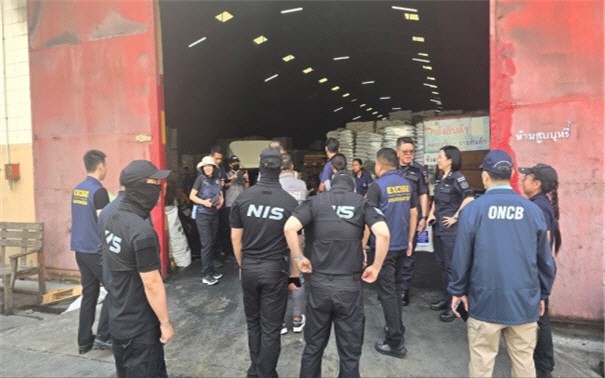 |
| The scene of a crackdown on a drug precursor supply base in Thailand. / National Intelligence Service |
The National Intelligence Service (NIS) is accelerating its "precision strike at the core" strategy, directly targeting overseas drug manufacturing bases. Despite repeated intensive crackdowns domestically, thousands of kilograms of illicit drugs continue to flood into the country from abroad each year, rendering domestic enforcement efforts akin to pouring water into a leaking bucket. Experts analyze that interrupting these supply lines by neutralizing foreign hubs beyond national borders will serve as a critical watershed in shifting the landscape of domestic drug crimes.
The NIS announced on the 10th that, in cooperation with the Office of the Narcotics Control Board (ONCB) of Thailand, it seized 49.98 tons of drug precursors and chemicals—including acetone, hydrochloric acid, and sulfuric acid intended for drug manufacturing—from 10 storage warehouses located across Bangkok and other regions in Thailand. This marks the first time a South Korean agency has directly struck an overseas drug supply source. The seized chemicals are sufficient to manufacture either 21 tons of methamphetamine or 1.1 billion Yaba tablets, equivalent to roughly 700 million doses at once, with an estimated street value of 8.4 trillion won.
Thailand is regarded as the largest source of drugs smuggled into South Korea. According to domestic drug seizure statistics (2021–2024) provided by the NIS, Southeast Asia accounted for the largest volume of incoming narcotics by region, with Thailand ranking first. Drugs produced in the Golden Triangle—the notorious border region of Thailand, Myanmar, and Laos—and particularly in Myanmar's Shan State, flow into Thailand before being distributed globally.
In addition, Southeast Asian nations such as Vietnam, Laos, and Malaysia are classified as primary transit hubs for narcotics entering South Korea. In fact, from 2021 to June of last year, the volume of seized narcotics smuggled into the country from Southeast Asia surpassed 1,300 kilograms.
Afghanistan, the world's largest opium producer, is also emerging as a new supply hub for methamphetamine. In response to surging global demand, Afghanistan began producing methamphetamine in 2014, expanding its distribution networks abroad via Iran and Pakistan. Although the Taliban issued a decree banning poppy cultivation after taking power in 2021 to signal a crackdown, they are currently turning a blind eye to the production of opium and methamphetamine. Local political instability and geopolitical conditions that resist oversight are identified as primary drivers fueling this drug production.
The NIS is reportedly monitoring the potential influx of Afghan-made methamphetamine into Northeast Asia, including South Korea. An expert well-versed in global drug trends noted, "The possibility that Afghanistan could eventually replace Southeast Asia as a primary drug supplier cannot be ruled out. The continuous influx of workers from Southwest Asia into South Korea also poses a potential risk factor."
An NIS official stated, "Striking overseas production hubs is highly significant as it dismantled the source of narcotics distributed across Asia. We will continue to strengthen cooperation with major drug-producing nations to cripple international supply chains."
Choi Min-jun
Most Read
-
1
Celltrion’s Omlyclo gains ground in major European..

-
2
Trump demands rates fall below 1% as Fed hikes for..

-
3
Hyundai Motor Group breaks ground on integrated st..

-
4
U.S. strikes 3 Iranian oil tankers, Iran vows reta..

-
5
Trump makes $1 trillion bet ahead of midterm elect..

-
6
Iran resumes ballistic missile production, assembl..

-
7
Samsung Electronics, Mistral AI to jointly develop..

PEOPLE







-
Address : In-Young Bldg., 34, Uisadang-daero 1-gil, Yeongdeungpo-gu, Seoul
Copyright by ASIATODAY CO., LTD. All rights resereved