



Lee, EU leaders reject NK nuclear status, denounce NK‑Russia ties
Jun 11, 2026, 09:25 am


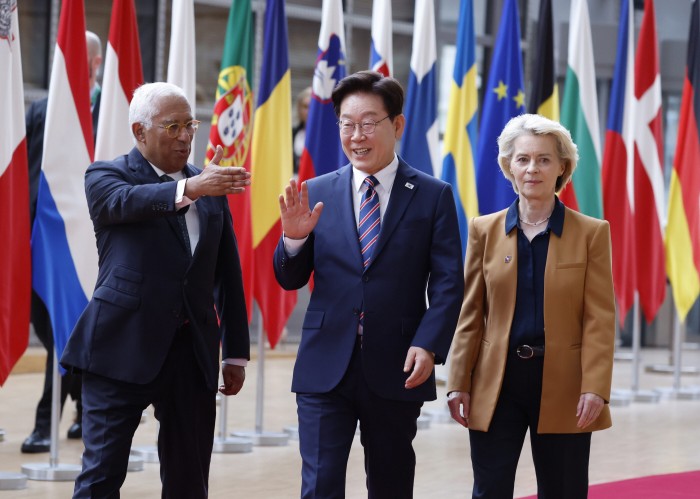 |
| South Korean President Lee Jae-myung walks with António Costa and Ursula von der Leyen during a welcome ceremony at the European Council headquarters in Brussels, Belgium, on the 10th (local time). / Yonhap News Agency |
On June 10, President Lee Jae‑myung held a summit with European Union (EU) leaders and adopted a joint statement consisting of 36 clauses. The Korea‑EU leaders confirmed the strengthening of their strategic partnership, including the establishment of a high‑level economic dialogue, while strongly condemning North Korea for supporting Russia’s invasion of Ukraine and making clear that they cannot recognize North Korea’s status as a nuclear state.
That afternoon in Brussels, Belgium, President Lee met with António Costa, President of the European Council, and Ursula von der Leyen, President of the European Commission, and announced the joint statement.
In the statement, both sides declared: “Our strategic partnership has been steadily strengthened across all areas, contributing to the prosperity and security of our peoples.”
They added: “We welcome the progress made since the last summit and reaffirm our commitment to further develop our partnership in all aspects.”
The joint statement included comprehensive cooperation measures in economic security, digital, energy, information protection, and public safety. Both sides agreed to establish a Korea‑EU high‑level economic dialogue, sign a Korea‑EU digital trade agreement, and pursue the creation of a Korea‑EU competitiveness partnership.
It also included the launch of negotiations on a Korea‑EU classified information protection agreement, the signing of an AI cooperation document, and the start of a high‑level energy dialogue. They also agreed to expedite the entry into force of the Passenger Name Record (PNR) transfer agreement to combat terrorism and serious crime.
On North Korea, the statement was assessed as the strongest joint message issued under the Lee administration. Both sides condemned Russia’s invasion of Ukraine and strongly criticized third‑party support that enables the war to continue, particularly North Korea’s assistance.
The Korea‑EU leaders stated: “We condemn third‑party support that enables Russia’s war of aggression against Ukraine to continue, particularly North Korea’s support. We strongly condemn the illegal military cooperation between Russia and North Korea.” They urged: “Immediately cease all related activities and comply with the UN Charter and relevant UN Security Council resolutions.”
They also expressed serious concern over North Korea’s nuclear and ballistic missile programs, reaffirming their commitment to the complete denuclearization of the Korean Peninsula in line with UN Security Council resolutions.
In particular, they explicitly stated that North Korea’s status as a nuclear state cannot be recognized. The leaders declared that North Korea must fully comply with its obligations as a non‑nuclear weapon state under the Nuclear Non‑Proliferation Treaty (NPT), implement the Comprehensive Safeguards Agreement with the International Atomic Energy Agency (IAEA), and bring the Additional Protocol into force.
They emphasized: “North Korea will never be recognized as a nuclear weapon state under the NPT, nor will it be granted any special status related to it.”
At the same time, the statement included support for engagement and dialogue with North Korea. Both sides reaffirmed their commitment to peace and stability on the Korean Peninsula and expressed support for the South Korean government’s efforts to resume inter‑Korean dialogue through tension‑reduction and confidence‑building measures aimed at expanding exchanges, normalizing relations, and achieving denuclearization.
The joint statement also addressed North Korean human rights. The leaders stressed that substantial improvement in North Korea’s human rights situation is essential and urged Pyongyang to allow access to international and humanitarian organizations.
Positions were also expressed on Middle East affairs and maritime security. Both sides discussed recent developments in the Middle East and their global implications, calling for de‑escalation and restraint.
Regarding the Strait of Hormuz, they emphasized the need to respect international law, including the UN Convention on the Law of the Sea, and highlighted freedom of navigation, safe passage, and protection of civilians and civilian infrastructure.
On the South China Sea and Taiwan Strait, they reaffirmed their existing stance: “We support freedom of navigation and overflight in areas including the South China Sea, and stress the importance of maintaining peace and stability in the Taiwan Strait.” They also opposed unilateral attempts to change the status quo in the Indo‑Pacific region.
However, on the much‑watched issue of EU steel industry regulations, the statement remained at a principled level. Both sides agreed to continue joint efforts to address global steel overcapacity through forums such as the Global Forum on Steel Excess Capacity.
Park Young‑hoon
Most Read
-
1
Trump demands rates fall below 1% as Fed hikes for..

-
2
Celltrion seeks rheumatoid arthritis indication ex..

-
3
Chinese e-commerce giants AliExpress, Temu and She..

-
4
Trump warns countries not helping U.S. must pay re..

-
5
Turkish Airlines named main club partner of Liverp..

-
6
China expels No. 2 military official Zhang Youxia..

-
7
Houthi rebels release video claiming downing of Sa..

PEOPLE





-
Address : In-Young Bldg., 34, Uisadang-daero 1-gil, Yeongdeungpo-gu, Seoul
Copyright by ASIATODAY CO., LTD. All rights resereved