



Deputy PM says recovery continues, summit diplomacy to create growth engines
Jun 10, 2026, 11:08 am


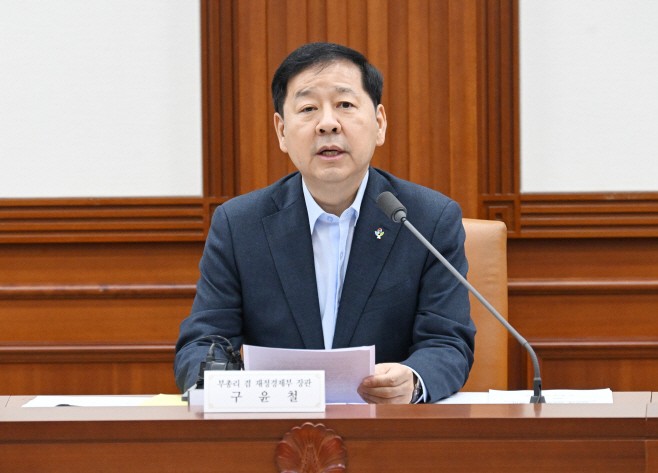 |
| Koo Yun-cheol, Deputy Prime Minister and Minister of Economy and Finance, delivers opening remarks during the 269th External Economic Ministers' Meeting at the Government Complex Seoul in Jongno-gu, Seoul, on June 10. / Courtesy of the Ministry of Economy and Finance. |
Koo Yun-cheol, South Korea’s Deputy Prime Minister and Minister of Economy and Finance, said that the Korean economy continues to show a solid recovery despite the prolonged conflict in the Middle East, adding that the government intends to turn the post-war reconstruction process into an opportunity for economic growth.
Speaking at the 269th External Economic Ministers’ Meeting held at the Government Complex Seoul on June 10, Koo stated, “Although external uncertainties remain, including the prolonged tensions in the Middle East, the Korean economy has maintained a solid recovery thanks to the combined efforts of our people, businesses, and government.”
He added, “We will actively utilize summit diplomacy and economic cooperation so that this recovery momentum can lead to sustained expansion of overseas business opportunities and the creation of new growth engines for Korean companies.”
During the meeting, ministers reviewed the implementation status of economic cooperation initiatives agreed upon through recent summit diplomacy and discussed follow-up measures. They confirmed that exports of new agricultural and fisheries products have expanded through enhanced quarantine and sanitary cooperation, while follow-up consultative bodies and cooperation plans in science and technology have been proceeding smoothly.
The government also agreed to continue operating a joint interagency monitoring system to ensure that summit agreements translate into tangible economic outcomes. Any difficulties arising during implementation will be addressed through close cooperation among relevant ministries.
Koo emphasized, “The government will continue working with all relevant ministries to ensure that the cooperative foundations established through summit diplomacy result in concrete achievements, including expanded overseas opportunities for Korean businesses and stronger economic cooperation.”
The meeting also discussed country-specific cooperation strategies in response to economic and industrial restructuring across the Middle East. As major regional economies pursue industrial diversification and broader economic reforms beyond post-war reconstruction, demand for advanced infrastructure is expected to grow, creating new opportunities for Korean firms.
Accordingly, the government plans to identify cooperation projects tailored to each country's needs in areas such as plant construction and energy, transportation and logistics, urban development, and digital infrastructure. It will actively support Korean companies seeking participation in these projects.
As part of these efforts, the government will use overseas diplomatic missions and related institutions to identify local projects, establish a Middle East Infrastructure Strategic Fund, and provide customized financial support packages, including up to $6 billion in advance financing for major Middle Eastern project owners.
Koo concluded, “Although uncertainties in the global economy persist, crises can also create new opportunities for cooperation and growth. We will carefully manage this process so that cooperation and economic achievements reinforce one another, while providing strong support for Korean companies to secure greater opportunities in global markets.”
Seo Byung-joo
Most Read
-
1
Celltrion’s Omlyclo gains ground in major European..

-
2
Trump demands rates fall below 1% as Fed hikes for..

-
3
Trump makes $1 trillion bet ahead of midterm elect..

-
4
Iran resumes ballistic missile production, assembl..

-
5
Samsung Electronics, Mistral AI to jointly develop..

-
6
Trump warns countries not helping U.S. must pay re..

-
7
Apple launches first foldable, 1 million won prici..

PEOPLE





HEADLINE NEWS
- Trump to roll out ‘unprecedented welcome’ for Xi with B-2 bombers, F-22 fighters
- S. Korea, U.S., and Japan form united front on Taiwan and economic coercion..
- Trump administration moves to impose sweeping sanctions on International Cr..
- Xi to make state visit to U.S. Sept. 23-25, dispelling rumors over his heal..

-
Address : In-Young Bldg., 34, Uisadang-daero 1-gil, Yeongdeungpo-gu, Seoul
Copyright by ASIATODAY CO., LTD. All rights resereved