



Iran warns UK it will become legitimate target if it supports US military operations
Jul 27, 2026, 10:20 am


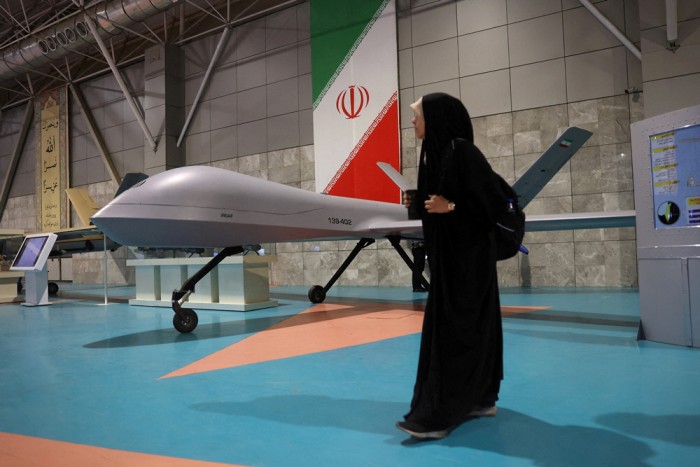 |
| A drone developed by Iran is on display at the Islamic Revolutionary Guard Corps (IRGC) Aerospace Force Museum in Tehran, Iran, on November 12 last year. / Reuters, Yonhap News |
Iran warned on July 25 (local time) that it could strike countries supporting U.S. military operations against it.
A spokesperson for Iran's Islamic Revolutionary Guard Corps (IRGC) said on state broadcaster IRIB that day that "If the UK supports U.S. military action against Iran, the UK will become a clear and legitimate target of attack."
He added that not only the UK, but any country, including those in the Gulf region, participating in a war against Iran alongside the U.S. will be considered a target for strikes.
The spokesperson claimed that U.S. bombers recently used British air bases, but provided no specific evidence to support the claim.
The IRGC stipulated that, under a previous memorandum of understanding (MOU), vessels passing through the Strait of Hormuz must navigate according to the operational rules published by Iran.
It then pointed out that the U.S. violated the MOU by establishing a separate sea lane for ships passing through the Strait of Hormuz.
On the same day, The Telegraph expressed concern that the British government is overlooking the IRGC's "asymmetric terrorist force," rather than its regular military, which could operate within the UK.
The IRGC has consistently conducted intelligence activities in the UK, building networks through legitimate entities such as mosques, charities, and universities to exert influence.
Through these channels, it has promoted radicalization of Islamic extremism, terrorism, and violence in the UK, while the Iranian regime denies responsibility.
These radical Islamist organizations, expanding their influence in the UK with the support of the Iranian regime, are reportedly already carrying out threats, vandalism, and violence against Jewish people and Iranian dissidents in the UK.
Kim Hyun-min
Most Read
-
1
Celltrion’s Omlyclo gains ground in major European..

-
2
Trump demands rates fall below 1% as Fed hikes for..

-
3
Trump makes $1 trillion bet ahead of midterm elect..

-
4
Iran resumes ballistic missile production, assembl..

-
5
Samsung Electronics, Mistral AI to jointly develop..

-
6
Trump warns countries not helping U.S. must pay re..

-
7
Apple launches first foldable, 1 million won prici..

PEOPLE






HEADLINE NEWS
- Trump to roll out ‘unprecedented welcome’ for Xi with B-2 bombers, F-22 fighters
- S. Korea, U.S., and Japan form united front on Taiwan and economic coercion..
- Trump administration moves to impose sweeping sanctions on International Cr..
- Xi to make state visit to U.S. Sept. 23-25, dispelling rumors over his heal..

-
Address : In-Young Bldg., 34, Uisadang-daero 1-gil, Yeongdeungpo-gu, Seoul
Copyright by ASIATODAY CO., LTD. All rights resereved