



NASA unveils Artemis III crew, first European to join
Jun 10, 2026, 11:02 am


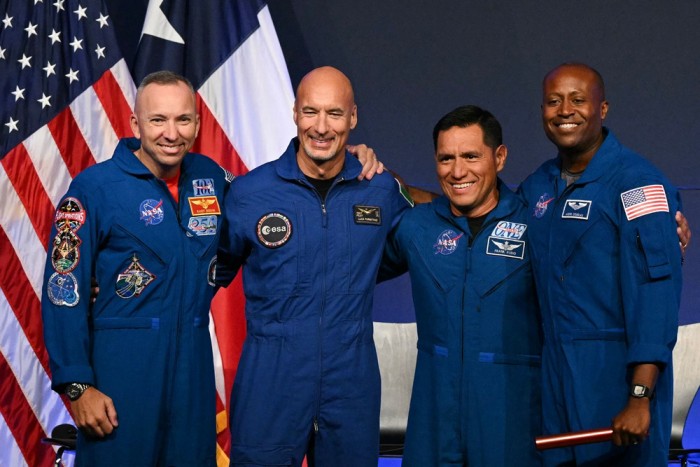 |
| At a press conference announcing the crew for the Artemis III mission held at NASA's Johnson Space Center in Houston, Texas, on June 9 (local time), astronauts Randy Bresnik (from left), Luca Parmitano, Frank Rubio, and Andre Douglas pose for a commemorative photo. / AFP-Yonhap News. |
NASA announced on June 9 (local time) the four astronauts selected for the Artemis III mission, part of its effort to return humans to the Moon. The crew list includes the first European astronaut to participate in the Artemis program.
At a press conference held at Johnson Space Center in Houston, Texas, NASA introduced the four crew members: Randy Bresnik, Luca Parmitano, Andre Douglas, and Frank Rubio, according to reports from USA Today and other media outlets.
NASA also named Bob Hines, a former U.S. Air Force pilot and astronaut with prior spaceflight experience, as the backup crew member.
Particular attention has focused on Parmitano, an Italian astronaut representing European Space Agency. Born in 1976 and a former Air Force pilot, he was selected as an ESA astronaut in May 2009 and has completed multiple missions. He previously spent extended periods aboard the International Space Station from May to November 2013 and again from July 2019 to February 2020.
Scheduled for 2027 and expected to last approximately two weeks, Artemis III differs from the earlier Artemis II mission, which placed a crewed spacecraft into lunar orbit. The primary objective of Artemis III is to test spacecraft and equipment intended for future lunar landing operations.
During the mission, the astronauts aboard NASA's Orion spacecraft will rendezvous and dock in low Earth orbit with two commercial lunar landers currently being developed by SpaceX and Blue Origin.
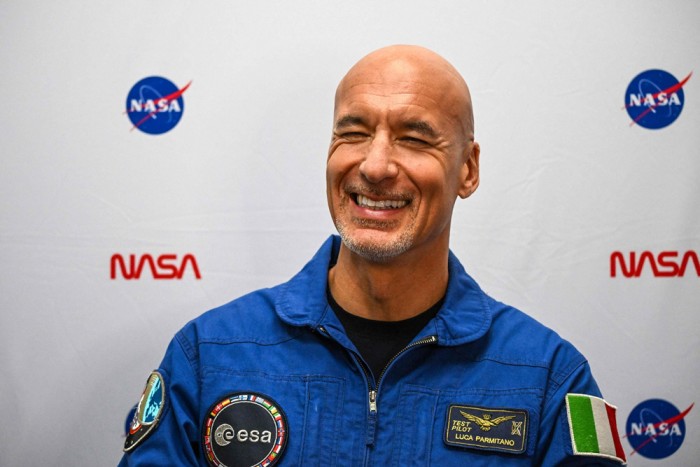 |
Luca Parmitano, an astronaut with the European Space Agency, speaks during an interview following a press conference announcing the crew for the Artemis III at Johnson Space Center in Houston, Texas, on June 9 (local time). / AFP-Yonhap News.
The Orion spacecraft will be launched from Kennedy Space Center aboard NASA's super-heavy-lift Space Launch System rocket.
The commercial lunar landers—Starship Human Landing System developed by SpaceX and Blue Moon Mark 2 developed by Blue Origin—will be launched separately and placed into orbit.
SpaceX plans to use its Starship Super Heavy booster, while Blue Origin will use the New Glenn rocket.
One of the key questions addressed during the announcement was whether astronauts would board the lunar landers after docking. According to Jeremy Parsons, two crew members are expected to enter the Blue Moon lander through its hatch following the docking maneuver.
Two days later, the Orion spacecraft will separate and dock with the Starship Human Landing System. Whether astronauts will transfer aboard the HLS at that stage has not yet been decided. The mission will ultimately conclude with a splashdown in the Pacific Ocean off the coast of California.
If Artemis III is successfully completed as planned, Artemis IV could begin transporting astronauts from lunar orbit to the Moon's surface using lunar landers from SpaceX and Blue Origin as early as 2028.
Jared Isaacman said, “Artemis III will demonstrate the power of American innovation and international cooperation as we test complex spacecraft rendezvous and docking operations and advance technologies that may one day take us deeper into the solar system. This mission will require one of the most remarkable large-scale launch collaborations in history, drawing on the talent and capabilities of teams across government and the spaceflight industry.”
Kim Hyun-min |
Most Read
-
1
Trump shares map on social media labeling Strait o..

-
2
Kia Sportage outperforms Mazda CX-5 in German auto..

-
3
Houthis launch successive attacks on Saudi airport..

-
4
U.S. deploys carrier, 10,000 more troops to Middle..

-
5
Trump rejects Iran's offer to open Strait of Hormu..

-
6
N. Korea conducts first swarm attack drill with dr..

-
7
U.S.-China summit falls short on substance as Trum..

PEOPLE






HEADLINE NEWS
- Seoul dismisses Ukraine's claim of 'S. Korean support for Russia' as "inaccurate and inappropriate"
- S. Korea, Japan race to develop nuclear-powered submarines
- Henri Kagan, Kenso Soai win Nobel Prize in Chemistry for uncovering how mol..
- Vance says Alaska LNG cooperation will move forward with Seoul's current or..

-
Address : In-Young Bldg., 34, Uisadang-daero 1-gil, Yeongdeungpo-gu, Seoul
Copyright by ASIATODAY CO., LTD. All rights resereved