



China to build massive data centers for AI dominance, pressing Nvidia
Jun 10, 2026, 10:27 am


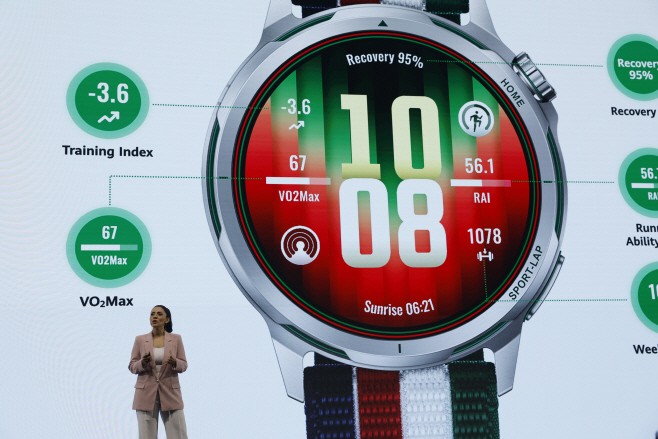 |
| Farangis Sultonzoda, a senior product expert at Huawei, introduces the new flagship Huawei Watch GT Runner 2 Racing Legend Edition during the company's product launch event in Bangkok, Thailand, on May 7. / EPA-Yonhap News Agency |
The Chinese government is preparing a state-led initiative that would spend approximately 2 trillion yuan (about $280 billion) over the next five years to build data centers nationwide as part of its push to develop artificial intelligence (AI) capabilities and surpass the United States in the sector, Bloomberg reported on Aug. 9.
Separately, Reuters reported that booming global investment in AI, combined with China's manufacturing strength, is fueling export growth in the technology sector. Exports of integrated circuits (semiconductors) surged 111% in May.
China plans nationwide computing network with 2 trillion yuan investment
According to Bloomberg, citing people familiar with the matter, key government agencies including the National Development and Reform Commission are designing a blueprint for a nationwide network of interconnected computing hubs.
State-owned telecom operators such as China Mobile and China Telecom would be responsible for operating and connecting most of the data centers. The goal is to link currently dispersed computing facilities across the country into a unified network by 2028.
Bloomberg said the project is intended to provide the infrastructure foundation for broader AI deployment across public-sector fields including healthcare, transportation, and urban management. It is also a key component of China's recently announced "Six Networks" program, which encompasses the construction of essential infrastructure in areas such as water resources, power, and computing.
Funding is expected to come primarily from ultra-long-term special government bonds with maturities exceeding 10 years and state-backed strategic industry investment funds, supplemented by bank loans and private capital.
However, the plan remains in the early stages of discussion, and details could still change.
Following Bloomberg's report, shares of Chinese data-center operators rose sharply in U.S. premarket trading. GDS Holdings gained as much as 12%, while Vnet Group jumped 17%.
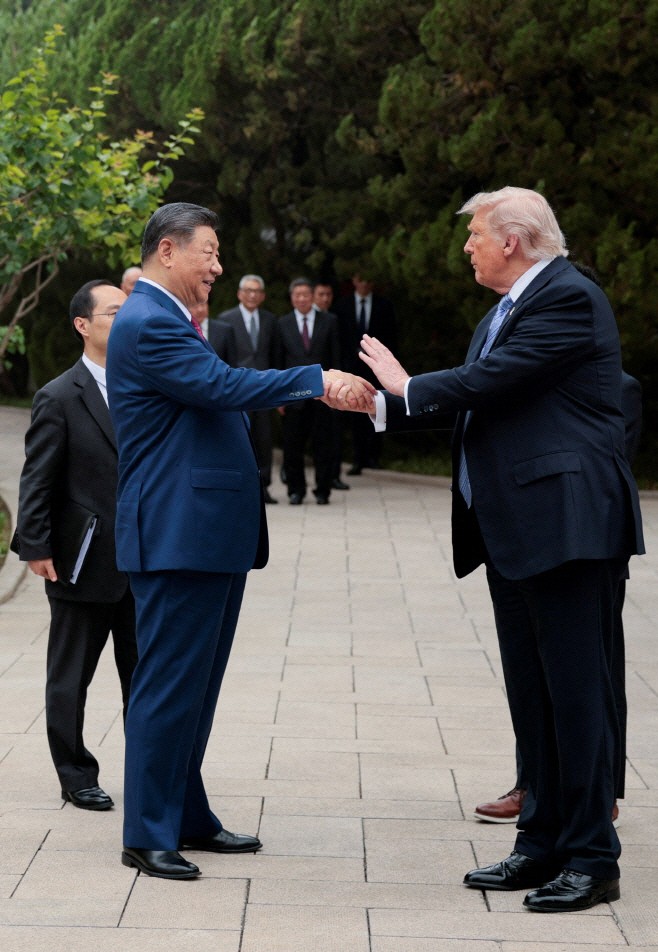 |
| Donald Trump (right), President of the United States, shakes hands with Xi Jinping after visiting the gardens of Zhongnanhai in Beijing, China, on Nov. 15. / Reuters-Yonhap News Agency. |
China plans to mandate 80% domestic technology use, sidelining Nvidia and AMD
A central objective of the initiative is to reduce reliance on U.S. technology and strengthen China's domestic supply chain.
According to sources cited by Bloomberg, Chinese authorities are considering requirements that at least 80% of AI-related technologies used in the new computing network—including AI chips—come from domestic suppliers such as Huawei. The plan would effectively push U.S. chipmakers NVIDIA and AMD out of much of China's data-center market.
Bloomberg noted that the strategy mirrors China's earlier efforts to support Huawei by mobilizing national resources to replace U.S. technology with domestic alternatives.
In May, nine Chinese-made AI chips produced by companies including Huawei, Alibaba Group, Biren Technology, and Moore Threads passed security reviews conducted by Chinese cybersecurity authorities. The approvals opened the door for wider adoption in sectors with stringent security requirements.
Although the U.S. government has agreed to allow Nvidia to sell its previous-generation H200 AI chips in China, the model remains one generation behind Nvidia's latest Blackwell architecture, and shipments have yet to begin.
 |
| Jensen Huang (left), Chief Executive Officer of NVIDIA, embraces Lee Hae-jin during a visit to NAVER's 1784 headquarters in Seongnam, Gyeonggi Province, on Aug. 8. / Yonhap News Agency. |
U.S. Big Tech to spend $725 billion this year; China plans 2 trillion yuan over five years
China's proposed 2 trillion yuan investment plan is smaller in headline terms than the $725 billion (about 1.1 quadrillion won) that major U.S. technology companies such as Meta Platforms and Microsoft are expected to spend on AI in 2026 alone.
However, Bloomberg noted that direct comparisons are difficult because data-center construction costs in China are lower due to cheaper labor, components, and building expenses, as well as incentives offered by local governments. In addition, spending by private-sector firms such as Alibaba Group and Tencent is not included in the 2 trillion yuan figure, meaning China's total AI infrastructure investment could ultimately be much larger.
Sources also said that if power-grid projects are integrated with data centers and high-speed communications infrastructure, total investment could rise to at least 5 trillion yuan (about 1.12 quadrillion won).
Bloomberg added that it remains unclear how the proposed national computing network would operate alongside privately owned data-center networks run by companies such as Alibaba and Tencent.
Robert Lea of Bloomberg Intelligence said the infrastructure buildout would support China's "AI Plus" strategy, but monetization remains a significant challenge.
He added that domestic infrastructure suppliers, particularly Huawei, are likely to be the biggest beneficiaries of the initiative, rather than internet giants such as Tencent, Alibaba Group, or Baidu.
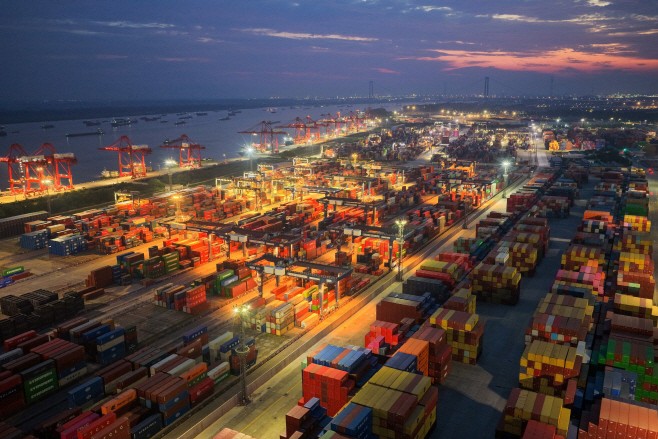 |
| Containers are stacked at a logistics facility in Nanjing, Jiangsu Province, eastern China, on Aug. 9. / AFP-Yonhap News Agency. |
Global AI boom drives China's exports: May exports up 19.4%, chip exports surge 111%
The planned national AI infrastructure initiative comes as the global AI investment boom is reshaping China's export landscape.
According to Reuters, China's exports rose 19.4% year-on-year in May, surpassing both April's 14.1% growth and market expectations of 15%. Imports also increased 27.4%, exceeding forecasts of 25%.
Integrated-circuit (semiconductor) exports surged 111%, leading the growth. Other strong performers included automated data-processing equipment (+66.1%), high-tech products (+50.9%), and automobiles (+39%).
China's trade surplus reached $105.43 billion, surpassing April's $84.8 billion and market expectations of $92.1 billion.
Xing Zhaopeng of ANZ Group said memory-chip prices rose 20% month-on-month, helping drive integrated-circuit export growth to 111%.
He said, "AI demand is far from over, and semiconductors are rewriting China's trade landscape."
Sian Fenner Yu of Oxford Economics said China's scale advantages, deep supply chains, and industrial capabilities provide sufficient competitive strength to absorb trade friction with Western countries.
She projected that advanced technology and green products would remain key drivers of China's economic growth this year despite geopolitical headwinds.
However, questions remain about the sustainability of the export boom. New export orders in May manufacturing surveys fell sharply after reaching a two-year high in April. Furniture exports rose only 1.9%, while toy exports declined 7% and footwear exports fell 10.4%.
Meanwhile, China's crude oil imports dropped 29% in May, the lowest level in eight years, reflecting the impact of energy-market disruptions linked to the Iran conflict.
Concerns over trade imbalances are also growing. The Organisation for Economic Co-operation and Development has argued that roughly 60% of Chinese companies' market-share gains can be explained by government subsidies. The Federal Reserve System has also noted that China's trade surplus now exceeds 1% of global GDP, surpassing the peak levels reached by Japan and Germany in the late 20th century.
Ha Man-joo
Most Read
-
1
Celltrion’s Omlyclo gains ground in major European..

-
2
Trump demands rates fall below 1% as Fed hikes for..

-
3
Trump makes $1 trillion bet ahead of midterm elect..

-
4
Iran resumes ballistic missile production, assembl..

-
5
Samsung Electronics, Mistral AI to jointly develop..

-
6
Trump warns countries not helping U.S. must pay re..

-
7
Apple launches first foldable, 1 million won prici..

PEOPLE






HEADLINE NEWS
- Trump to roll out ‘unprecedented welcome’ for Xi with B-2 bombers, F-22 fighters
- S. Korea, U.S., and Japan form united front on Taiwan and economic coercion..
- Trump administration moves to impose sweeping sanctions on International Cr..
- Xi to make state visit to U.S. Sept. 23-25, dispelling rumors over his heal..

-
Address : In-Young Bldg., 34, Uisadang-daero 1-gil, Yeongdeungpo-gu, Seoul
Copyright by ASIATODAY CO., LTD. All rights resereved