



Siloed air defenses can't stop AI, drone swarms, KR-US experts warn
Jun 09, 2026, 03:49 pm


Under modern and future battlefields where an advanced asymmetric threat combining drone swarms and ballistic and cruise missiles is becoming a reality, military, industry, academia, and research experts have issued sharp recommendations stressing that South Korea urgently needs to establish an Integrated Air and Missile Defense (IAMD) system that links fragmented, standalone air defense assets into a single network for national survival.
The conference titled “The Future of Integrated Air and Missile Defense (IAMD),” hosted by the Korea Association of Defense Industry Studies (KADIS, Chairman Kim Jin-gi), organized by the Missile Defense Forum (MDF), and sponsored by global defense company Northrop Grumman, was held on the 9th at Exhibition Hall 2 of the Daejeon Convention Center.
The event was held in conjunction with the defense industry exhibition “InLEX KOREA 2026” taking place over the same period, drawing strong attention from participants including U.S. Forces Korea, foreign military attachés in Korea, and domestic and international defense industry officials.
In his remarks, KADIS Chairman Kim Jin-gi emphasized that building an integrated air defense network is an urgent task directly tied to national survival in modern and future warfare, calling for close governance cooperation among the military, industry, academia, and research sectors.
Rep. Yoo Yong-won of the National Assembly’s Defense Committee, who delivered congratulatory remarks, stressed the need to accelerate the advancement of Korea’s missile defense capabilities and future air defense forces, noting the growing global interest in the Cheongung-II, South Korea’s missile interception system.
Lessons from Ukraine and the Middle East: “Beyond increasing interceptors, we must build an intelligent neural network”
In his keynote speech, Kim Ki-won, senior research fellow at the Korea Institute for Defense Analyses (KIDA), called for a paradigm shift in future air defense by analyzing conflicts such as the Israel-Iran confrontation and the Russia-Ukraine war.
He stated that simply increasing interceptor assets to counter saturation attacks such as drone swarms has clear limitations, and proposed as a solution the establishment of AI-based “intelligent engagement control” and an integrated neural network linking multiple sensors into a unified system.
Presentations in the thematic sessions also delivered dense proposals aligned with global defense technology trends.
Sean McLay, Asia-Pacific Business Development Director at Northrop Grumman, highlighted patterns of complex saturation attacks combining ballistic and cruise missiles with drones, and suggested transitioning from platform-centered air defense systems to a “network-centric integrated architecture” combining sensors, command and control, and engagement systems.
Northrop Grumman is a key defense company that developed the Integrated Battle Command System (IBCS), currently operated by the United States and Poland, based on the concept of an integrated architecture summarized as “Any Sensor, Best Shooter,” which matches any sensor with the optimal strike asset.
Calls to break military “silo structure” and establish resilient multi-layer survival systems
Sharp critiques were also raised from an operational perspective regarding the need to break entrenched barriers within the military.
Former Air Force 3rd Missile Defense Brigade Commander Moon Oh-sun noted that while South Korea’s individual air defense systems have already reached world-class performance, maximizing operational effectiveness requires dismantling the closed and isolated “silo” structure across services and achieving full integration of information sharing and command decision-making systems.
Kim Dae-young, military affairs research fellow at the Korea Institute for National Strategy, proposed a strategy grounded in a realistic assessment, emphasizing the importance of building a multi-layered survival structure.
Assuming that “perfect interception does not exist,” he argued that even if missile defense systems fail to intercept incoming missiles, the country must be able to maintain national functions through civil defense infrastructure such as shelters, establishing a system designed to “absorb and withstand” attacks.
Meanwhile, Korea’s strong domestic defense technology capabilities were also showcased.
Jung Won-woo, head of the Air Defense Control Development Division at LIG D&A, presented the company’s integrated fire control (IFC) network technology based on DDS middleware under the theme “From Engagement Control to Integrated Fire Control,” drawing significant attention.
The event concluded with a panel discussion chaired by retired Army Brig. Gen. Joo Kwang-seop, visiting researcher at the Sejong Institute, which explored optimal IAMD implementation strategies for future security environments.
Han Kwon-hee, planning director of KADIS, stated that the insights and recommendations from the conference will be used to strengthen Korea’s integrated air defense capabilities and enhance the global competitiveness of K-defense, pledging to serve as a policy bridge moving forward.
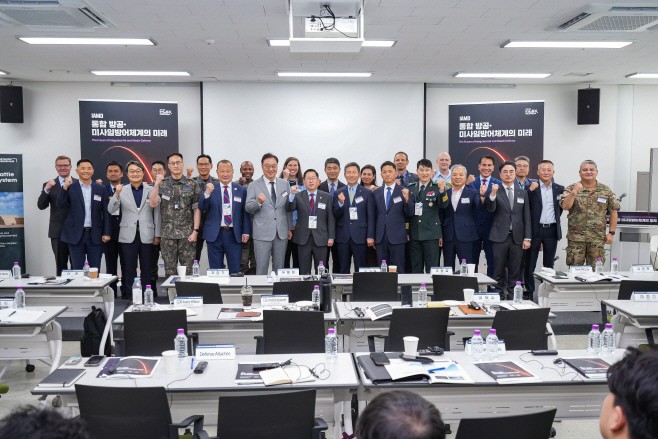 |
| (From the fourth person in the front row) Lee Kwan, Country Manager of Northrop Grumman Korea; Kim Jin-gi, Chairman of the Korea Association of Defense Industry Studies (KADIS); Rep. Yoo Yong-won; Kim Ki-won, Senior Research Fellow at the Korea Institute for Defense Analyses (KIDA); Joo Kwang-seop, Visiting Research Fellow at the Sejong Institute; Lee Man-hee, Commandant of the Army Air Defense School / Photo provided by the Korea Association of Defense Industry Studies (KADIS) |
Goo Pil-hyun
#Air defense #Security #AI #Drone
Copyright by Asiatoday
Most Read
-
1
Trump demands rates fall below 1% as Fed hikes for..

-
2
Celltrion seeks rheumatoid arthritis indication ex..

-
3
Chinese e-commerce giants AliExpress, Temu and She..

-
4
Trump warns countries not helping U.S. must pay re..

-
5
Turkish Airlines named main club partner of Liverp..

-
6
China expels No. 2 military official Zhang Youxia..

-
7
Houthi rebels release video claiming downing of Sa..

PEOPLE







-
Address : In-Young Bldg., 34, Uisadang-daero 1-gil, Yeongdeungpo-gu, Seoul
Copyright by ASIATODAY CO., LTD. All rights resereved