



China's 5,000-year-old Fangxian Huangjiu arrives in Korea
Jun 09, 2026, 09:48 am


Zhonghe Fangxian Huangjiu, a traditional Chinese rice wine produced in Fangxian County, Hubei Province, is set to make its full-scale entry into the South Korean market. Given its reputation and quality in China, the brand is expected to exert considerable influence on Korea's Chinese alcoholic beverage market in the years ahead.
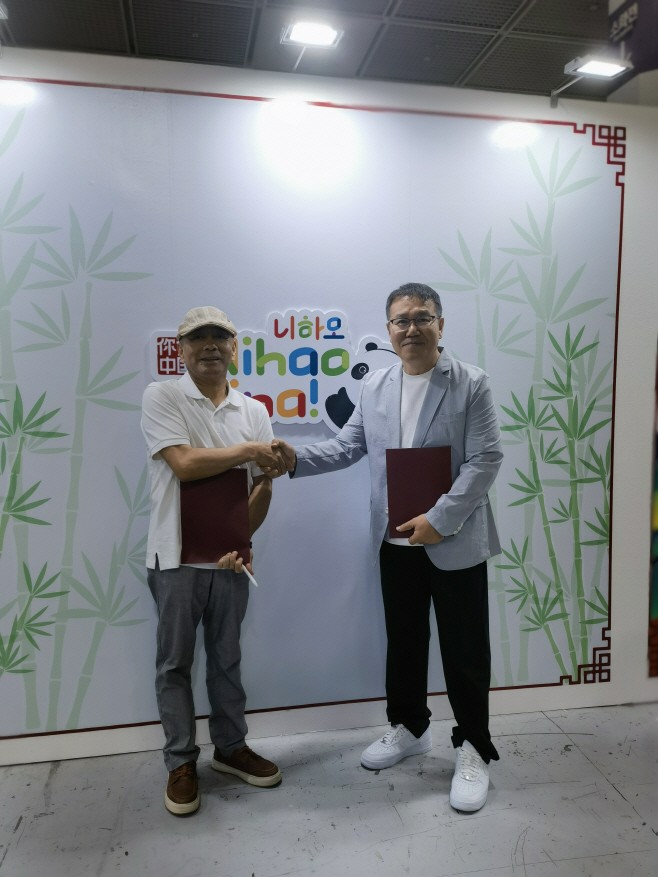 |
| Kim Sung-hoon (left), CEO of Beijing-based law firm Kookyeon Consulting, and an official from Zhonghe Fangxian Huangjiu shake hands after signing a memorandum of understanding (MOU) on business cooperation. / Kookyeon Consulting |
According to Beijing-based sources familiar with the Chinese alcoholic beverage industry, Kookyeon Consulting, a Beijing law and consulting firm, signed a strategic memorandum of understanding (MOU) with Zhonghe Fangxian Huangjiu during the Seoul International Travel Fair held in Seoul on June 4.
The agreement is said to mark the first attempt to introduce Fangxian Huangjiu to the Korean market through a "brand, culture and system" approach. The cooperation covers product imports, distribution channel development, brand marketing and cultural experience programs.
Fangxian, often referred to in China as a "special zone for world-renowned liquor," is widely regarded as one of the birthplaces of Chinese Huangjiu culture. Drawing on brewing traditions that date back to the Neolithic era, Fangxian Huangjiu was reportedly presented to imperial courts during both the Zhou and Tang dynasties.
The product has undergone significant technological upgrades in recent years through industry-academia collaboration led by Sun Baoguo and his research team. Innovations in low-temperature brewing, storage and aseptic filling have helped transform the traditional beverage into a modern premium product.
The wine is made using premium glutinous rice from the Qinba mountain region south of Wudang Mountains, deep-rock spring water from the Qingfeng fault zone, wild herbs from Shennongjia, and traditional fermentation starters. The company emphasizes that no caramel coloring, artificial flavoring or preservatives are added.
With an alcohol content below 15%, Fangxian Huangjiu is marketed as a naturally amber-colored, low-alcohol beverage. Its blend of rice, honey and fruit aromas, combined with relatively mild aftereffects compared with stronger spirits, has helped it align with growing global demand for lower-alcohol drinks.
The brand has received China's prestigious Qingzhuo Award and was selected as the official beverage for a diplomatic cultural event promoting Chinese culture. According to company representatives, the product has gained recognition among diplomatic missions from more than 170 countries.
Fangxian Huangjiu has also attracted attention at major trade exhibitions, including the China International Consumer Products Expo, where it was featured as a nationally promoted new product.
The production project is also viewed as a symbolic achievement of economic cooperation between Beijing's Fangshan District and Fangxian County in Hubei Province. Since Zhonghe established operations in Fangxian in 2014, it has built an industrial complex covering roughly 330,000 square meters and equipped with 12 smart production lines. Annual production capacity has reportedly reached 100,000 metric tons.
According to recent reports by People's Daily, annual sales of Fangxian Huangjiu are estimated at 4.5 billion yuan (approximately $630 million), while the regional brand value has reached 16.65 billion yuan.
Industry sources say export conditions for Hubei specialty products have improved significantly following the expansion of international flights between the Wudangshan area and Seoul. Against this backdrop, Fangxian Huangjiu recently completed trademark registration for all product categories in South Korea.
Under the agreement, Kookyeon Consulting and Zhonghe plan to jointly develop products tailored to Korean consumers, including low-alcohol Huangjiu designed for food pairing and small carbonated alcoholic beverages. They also intend to launch gift sets themed around Zhonghe and Wudang wellness culture.
Distribution plans include entry into major Korean e-commerce platforms, premium Korean dining chains and overseas Chinese community networks, with the long-term goal of expanding across Northeast Asia.
A Zhonghe representative said the company would continue refining recipes for Korean consumers by leveraging the expertise of Sun Baoguo's research team and its experience developing the "4,600 Herbal" product series.
"We hope this premium liquor, which embodies the culture of the Book of Songs and the wellness philosophy of Wudang, will serve as an ambassador for cultural exchange between China and Korea," the representative said.
Industry experts also welcomed the market entry, saying it demonstrates how Chinese Huangjiu exports have evolved beyond simple product sales into exports of brand value, culture, health philosophy and lifestyle concepts.
Fangxian Huangjiu is already exported to Europe, Brazil, Japan and Southeast Asia. The company also signed export agreements worth $10 million at Expo 2025 Osaka.
Following the MOU signing, Kim Sung-hoon, CEO of Kookyeon Consulting, said the company aims to combine China's 4,600-year brewing heritage with Korea's strengths in distribution and cultural content.
"Our goal is to develop Fangxian Huangjiu into a premium low-alcohol brand that Korean consumers can trust and enjoy," he said.
Hong Soon-do
Most Read
-
1
Trump shares map on social media labeling Strait o..

-
2
Kia Sportage outperforms Mazda CX-5 in German auto..

-
3
Houthis launch successive attacks on Saudi airport..

-
4
U.S. deploys carrier, 10,000 more troops to Middle..

-
5
Trump rejects Iran's offer to open Strait of Hormu..

-
6
N. Korea conducts first swarm attack drill with dr..

-
7
U.S.-China summit falls short on substance as Trum..

PEOPLE





HEADLINE NEWS
- Seoul dismisses Ukraine's claim of 'S. Korean support for Russia' as "inaccurate and inappropriate"
- S. Korea, Japan race to develop nuclear-powered submarines
- Henri Kagan, Kenso Soai win Nobel Prize in Chemistry for uncovering how mol..
- Vance says Alaska LNG cooperation will move forward with Seoul's current or..

-
Address : In-Young Bldg., 34, Uisadang-daero 1-gil, Yeongdeungpo-gu, Seoul
Copyright by ASIATODAY CO., LTD. All rights resereved