



SKT joins EU quantum cryptography project, first Asian company to participate
Jun 09, 2026, 09:33 am


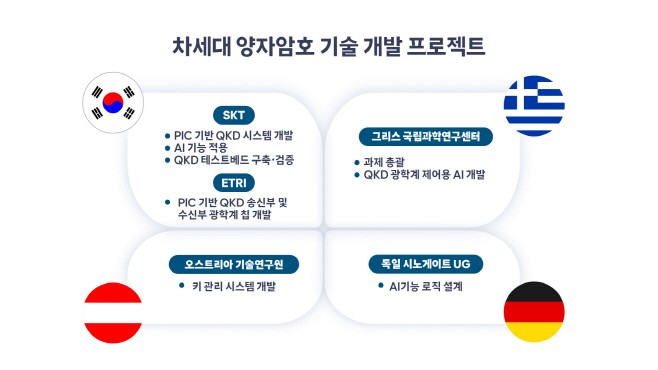 |
| Infographic illustrating SK Telecom's next-generation quantum cryptography technology project. / SK Telecom |
SK Telecom said Monday it has been selected to participate in Horizon Europe, the European Union's flagship research and development program, to develop next-generation quantum cryptography technologies.
The company is the first private-sector firm in Asia to receive Horizon Europe research funding and will conduct joint research with European institutions.
The three-year project aims to develop and demonstrate a quantum key distribution (QKD) system based on "QPIC-AI," which combines photonic integrated circuits (PICs) with artificial intelligence (AI).
QKD is a cybersecurity technology that uses the principles of quantum mechanics to generate and distribute encryption keys. Because any attempt by a third party to intercept communications alters the quantum state of the transmitted information, the technology is widely regarded as virtually immune to hacking.
SK Telecom's QPIC-AI technology is designed to address two major obstacles to the commercialization of quantum cryptography systems: large equipment size and high deployment costs.
The system integrates multiple optical components onto a single semiconductor chip using photonic integrated circuit technology, significantly reducing hardware size. Embedded AI functions continuously compensate for changes in optical conditions caused by environmental factors such as temperature fluctuations and vibration, improving system stability.
The company expects the technology to facilitate mass production, improve power efficiency and accelerate broader adoption of quantum cryptography solutions.
Project participants include the National Center for Scientific Research Demokritos (NCSRD) in Greece, the Austrian Institute of Technology (AIT) and German semiconductor startup Sinogate UG.
SK Telecom will be responsible for developing the PIC-based QKD system, integrating AI capabilities, and building and validating testbeds. The Electronics and Telecommunications Research Institute (ETRI) will develop optical transmitter and receiver chips for the project.
The company also expects the joint research initiative to contribute to the international standardization of quantum cryptography technologies.
Currently, South Korea and Europe operate under different certification standards for quantum cryptography systems, limiting interoperability. Through the project, participating organizations plan to compare and analyze national certification frameworks and lay the groundwork for future discussions on unified international standards.
SK Telecom has been conducting quantum cryptography research and development since 2011. Its ongoing efforts include extending wired QKD technologies to wireless and satellite communications, as well as developing advanced quantum random number generators (QRNGs) and post-quantum cryptography (PQC) solutions.
"Winning this Horizon Europe project demonstrates SKT's research and development capabilities in quantum cryptography," said Ryu Tak-ki, head of network technology at SK Telecom. "By combining PIC and AI technologies to develop next-generation QKD systems, we will strengthen our leadership position in the global quantum-secure communications market."
He added that the experience and achievements gained through multinational cooperation are expected to contribute significantly to the advancement of South Korea's quantum technology ecosystem.
Lee Ji-sun
Most Read
-
1
Kia Sportage outperforms Mazda CX-5 in German auto..

-
2
Houthis launch successive attacks on Saudi airport..

-
3
Saudi Arabia, Iran hold first diplomatic talks to..

-
4
U.S. deploys carrier, 10,000 more troops to Middle..

-
5
Saudi airport in Riyadh struck again, leaving at l..

-
6
Putin's ally visits China on the 8th ahead of APEC..

-
7
Chinese military support and training center opens..

PEOPLE






HEADLINE NEWS

-
Address : In-Young Bldg., 34, Uisadang-daero 1-gil, Yeongdeungpo-gu, Seoul
Copyright by ASIATODAY CO., LTD. All rights resereved