



China dominates green tech while US loses momentum
Jun 08, 2026, 03:36 pm


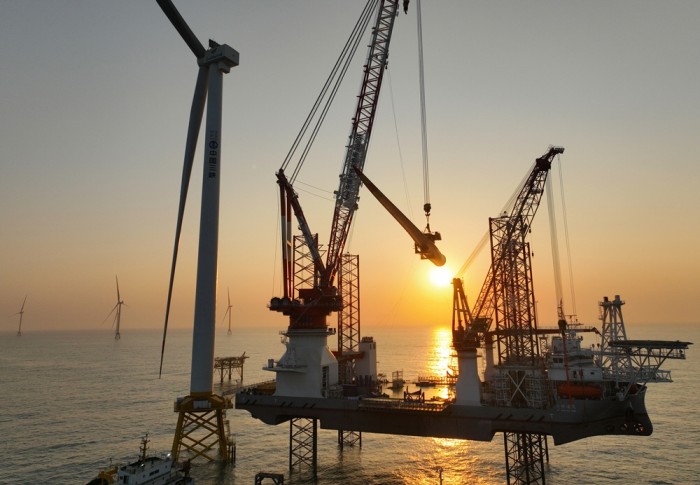 |
A wind turbine blade is hoisted by a crane at an offshore wind farm construction site off the coast of Fujian Province in southeastern China on January 13. / Photo via Xinhua News Agency, Yonhap News
An analysis released on June 8 (local time) found that China is solidifying its dominance in attracting and investing in global low-carbon industrial projects, while the United States is experiencing a relative slowdown, causing the gap between the two countries to widen.
According to Reuters, the non-profit international decarbonization coalition Mission Possible Partnership (MPP) stated in a report released that day that 19 low-carbon industrial projects worldwide successfully secured financing between November of last year and April of this year, representing a total investment of $43 billion (approximately KRW 66.2 trillion).
The number of financed projects more than doubled from eight during the same period a year earlier, and most of these projects were concentrated in China. Investment in green industries accelerated during a period when fossil fuel prices surged following military strikes launched by the United States and Israel against Iran in late February.
Of the 19 projects, 13 reached the Final Investment Decision (FID) stage, and all 13 are being carried out in China. The United States accounted for only one project.
Globally, there are currently 969 low-carbon industrial projects under development across a wide range of sectors, including chemicals, aviation, cement, and metals.
Among them, China is responsible for 170 projects, while the so-called “Sun Belt” countries, including India and Brazil, account for 318 projects. Europe has 211 projects, and the United States has 72.
MPP noted that although the United States still maintains a sizable project pipeline, it is losing relative growth momentum. The organization pointed out that the number of projects announced in the U.S. has declined by 20 over the past year, from 92 to 72.
Faustine Delasalle, CEO of MPP, said that the increasingly fragmented and unstable international environment continues to demonstrate that dependence on fossil fuels exposes countries to price shocks, supply disruptions, and economic crises.
MPP works to accelerate the growth of low-carbon industries and receives support from the Bezos Earth Fund (BEF), founded by Jeff Bezos, as well as the World Economic Forum (WEF).
Kim Hyun-min |
Most Read
-
1
Trump shares map on social media labeling Strait o..

-
2
Kia Sportage outperforms Mazda CX-5 in German auto..

-
3
Houthis launch successive attacks on Saudi airport..

-
4
U.S. deploys carrier, 10,000 more troops to Middle..

-
5
Trump rejects Iran's offer to open Strait of Hormu..

-
6
N. Korea conducts first swarm attack drill with dr..

-
7
U.S.-China summit falls short on substance as Trum..

PEOPLE






HEADLINE NEWS
- Seoul dismisses Ukraine's claim of 'S. Korean support for Russia' as "inaccurate and inappropriate"
- S. Korea, Japan race to develop nuclear-powered submarines
- Henri Kagan, Kenso Soai win Nobel Prize in Chemistry for uncovering how mol..
- Vance says Alaska LNG cooperation will move forward with Seoul's current or..

-
Address : In-Young Bldg., 34, Uisadang-daero 1-gil, Yeongdeungpo-gu, Seoul
Copyright by ASIATODAY CO., LTD. All rights resereved