



War wreaks havoc on Iranian citizens, cripples economy and hope
Jun 08, 2026, 10:24 am


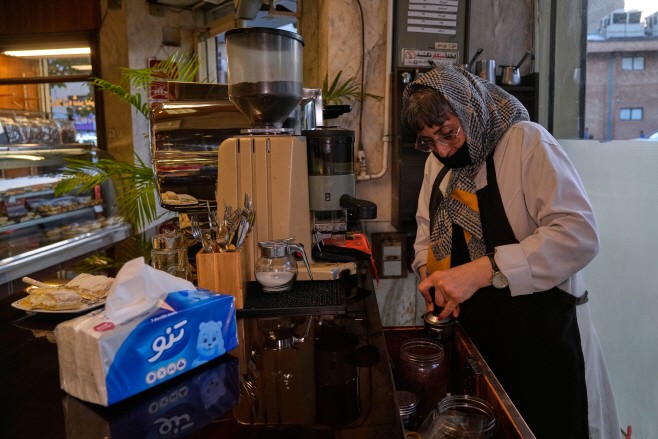 |
| A barista prepares coffee at a bakery and cafe in downtown Tehran, Iran, on the 6th (local time). / Photo via AP, Yonhap News |
Airstrikes by Israel and the United States, coupled with economic collapse, are plunging both supporters and opponents of the Iranian government into despair, The New York Times (NYT) reported on the 7th (local time).
Skyrocketing prices of daily necessities and shortages of medicine have disrupted daily life, while anti-government factions who had hoped for regime change expressed disillusionment over reports that the return of former President Mahmoud Ahmadinejad is being considered. Amid an unstable ceasefire and deadlocked negotiations, Iranians are demanding stability through diplomatic talks rather than war.
Iranian prices skyrocket: Cooking oil surges 430%, Medicine shortages spread
According to data released by the Statistical Center of Iran last week, compared to the same period last year, the price of cooking oil surged 430%, eggs 345%, rice 287%, and milk 139%, the NYT reported.
A manager at a plastic bottle factory near Mashhad stated that production has completely ground to a halt as the supply of raw materials was cut off following Israeli airstrikes on Iran's petrochemical industry, leaving the entire staff on unpaid leave.
A doctor in Isfahan noted that pharmacies are rationing medical supplies and the Ministry of Health has advised prescribing only essential medicines. Amin Afshar, head of the Iranian Hemophilia Society, recently told Iranian media that there is zero inventory of medicines required for hemophilia patients and that importing them has become extremely difficult.
Following the initial attacks by the US and Israel in June 2025, Iran was hit by airstrikes again starting February 28 of this year, which destroyed factories, airports, ports, bridges, universities, and residential areas, leaving 1,700 civilians reported dead, according to the NYT.
From the beginning of the war until late May, the Iranian government blocked public internet access, citing national security. Since the internet was restored, grievances from Iranians regarding their suffering have been spreading rapidly via social media (SNS). The story of Hamed Mirzaei, who lost 12 family members in an airstrike on Tehran's Resalat Square, is also rapidly circulating on Iranian social media.
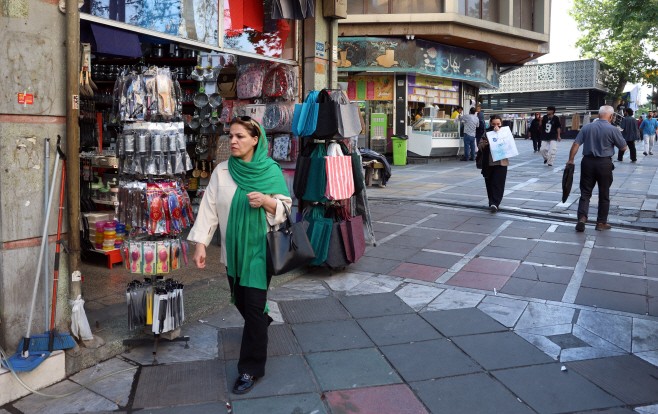 |
| An Iranian woman walks past shops on a street in Tehran on the 6th (local time). / Photo via EPA, Yonhap News |
Anti-government Iranians disillusioned by potential installation of Ahmadinejad
Anti-regime Iranians who desired regime change expressed deep despair after learning of an NYT report stating that Israel and the US had sought to install Ahmadinejad, a hardline conservative former president, as the new leader, the NYT reported.
Amirali, 62, an engineer in Tehran, criticized, "Was the purpose of bombing and destroying our country, airports, roads, and factories under the pretext of regime change just to bring back Ahmadinejad?" He added, "This proves that the goal was never to make Iran a freer or better nation."
Kimia, 25, a designer living in Tehran, noted, "I feel angry and isolated." She pointed out, "The world only views us as tools for war and negotiations, failing to recognize the fact that we are human beings."
The NYT interviewed around 20 Iranians living in Tehran, Isfahan, Ahvaz, and Mashhad via voice applications, noting that all of them withheld their full names due to fears of retaliation.
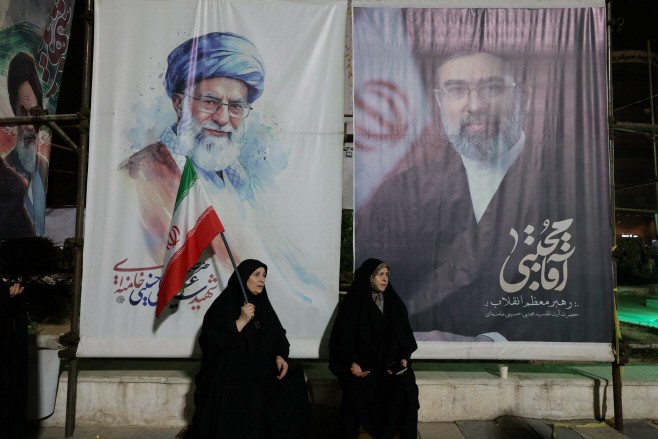 |
| An Iranian woman waves an Iranian national flag during a pro-government rally held in Tehran on the 7th (local time). Hanging behind her are photos of Iran's Supreme Leader Ayatollah Ali Khamenei (left), who was killed in an Israeli airstrike on February 28, and his son and successor, Mojtaba Khamenei. / Photo via AFP, Yonhap News |
Pro-government Iranians also complain of hardship: "Prices do not discriminate
between supporters and opponents"
Complaints over economic suffering are growing even among Iranians who have supported the government, the NYT reported. Hamed, a pro-government conservative, said, "Skyrocketing prices affect everyone, without discriminating between government supporters and opponents."
Mehdi, 52, a government employee who has regularly attended pro-government rallies with his family, stated that his salary runs out in the middle of the month, leaving him unable to buy beef or chicken. He bought groceries on credit at a local store, but when he went to pay them off after receiving his salary, the prices had risen, doubling the amount he owed on credit. He warned, "If the economic issues are not resolved, there will be trouble."
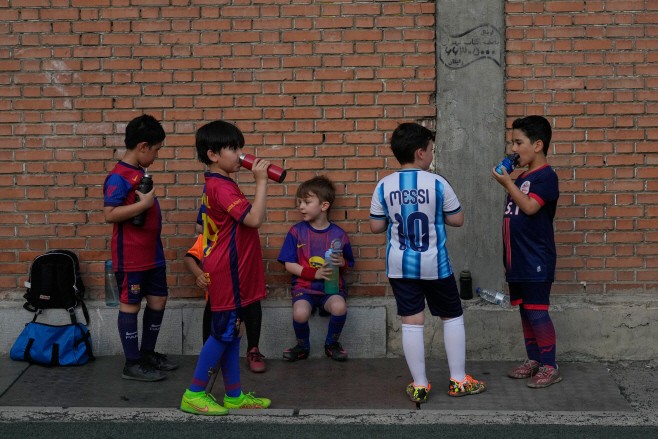 |
| Iranian children take a break during training at a soccer academy in Tehran on the 3rd (local time). / Photo via AP, Yonhap News |
Iranians demand stability through negotiations over war amid unstable ceasefire
The unstable ceasefire was further shaken as Iran launched approximately 10 ballistic missiles toward Israel on this day, raising the possibility of Israeli retaliation, the NYT reported. Iran stated that the launch was in response to Israeli attacks on Lebanon.
One of the key sticking points in the negotiations is the blockade of the Strait of Hormuz, which has effectively cut off the trade route for oil, Iran’s primary export. The NYT noted that analysts said the massive airstrikes changed the minds of Iranians who had initially supported the war.
Rida, 44, an anti-government environmental specialist in Tehran, stated that she now favors negotiations, adding, "We have lost too many lives, infrastructure, and human resources."
Analysts and interviewees pointed out that US President Donald Trump fueled confusion and anger among Iranians through contradictory remarks, such as promising support for Iranian protesters, threatening to destroy Iran's ancient civilization, and later stating it would be an "honor" to meet the new supreme leader if a deal were reached, the NYT reported.
These remarks instantly became a hot topic in Iran, triggering a wave of mockery on social media (SNS) that alluded to the fact that Supreme Leader Mojtaba Khamenei has not appeared in public since the war.
Ellie Geranmayeh, a senior policy fellow at the European Council on Foreign Relations (ECFR), assessed that "accepting the resilience of the regime despite all hopes is a very bitter moment for dissidents," diagnosing that the war has ultimately left the Iranian regime stronger than before.
Sanam Vakil, director of the Middle East and North Africa programme at the British think tank Chatham House, noted that her contacts inside Iran are constantly asking what will happen to them, commenting, "They are simply victims of this conflict, which is beyond their control and sphere of influence."
Ha Man-joo
Most Read
-
1
Trump shares map on social media labeling Strait o..

-
2
Kia Sportage outperforms Mazda CX-5 in German auto..

-
3
Houthis launch successive attacks on Saudi airport..

-
4
U.S. deploys carrier, 10,000 more troops to Middle..

-
5
Trump rejects Iran's offer to open Strait of Hormu..

-
6
N. Korea conducts first swarm attack drill with dr..

-
7
U.S.-China summit falls short on substance as Trum..

PEOPLE






HEADLINE NEWS
- Seoul dismisses Ukraine's claim of 'S. Korean support for Russia' as "inaccurate and inappropriate"
- S. Korea, Japan race to develop nuclear-powered submarines
- Henri Kagan, Kenso Soai win Nobel Prize in Chemistry for uncovering how mol..
- Vance says Alaska LNG cooperation will move forward with Seoul's current or..

-
Address : In-Young Bldg., 34, Uisadang-daero 1-gil, Yeongdeungpo-gu, Seoul
Copyright by ASIATODAY CO., LTD. All rights resereved