



HD Hyundai expands SMR-powered ship development
Jun 05, 2026, 10:29 am


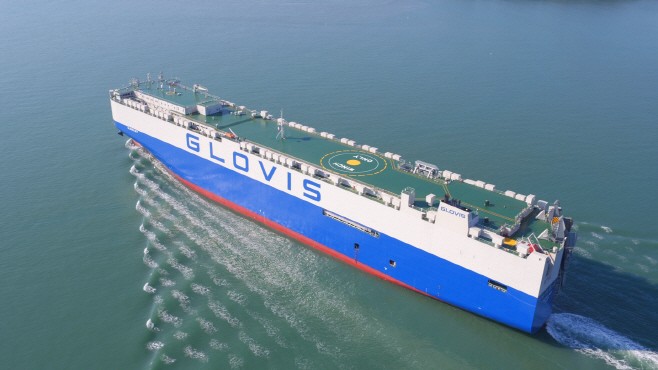 |
| A 7,500‑unit class pure car and truck carrier (PCTC) built by HD Hyundai Samho. / HD Hyundai |
HD Hyundai is accelerating efforts to secure next‑generation ship technology by expanding the development of small modular reactor (SMR)–powered vessels to include pure car and truck carriers (PCTCs). The company is simultaneously advancing eco‑friendly ship technology, autonomous navigation, and defense cooperation to strengthen competitiveness in the future maritime industry.
On June 5, industry sources reported that HD Hyundai, through its shipbuilding affiliates HD Hyundai Heavy Industries and HD Korea Shipbuilding & Offshore Engineering, received Approval in Principle (AIP) from Lloyd’s Register (UK) for the basic concept design of a large PCTC applying molten salt reactor (MSR) technology at the Posidonia 2026 exhibition, one of the world’s three largest maritime trade fairs.
An HD Hyundai representative stated, “We are showcasing leading eco‑friendly ship technologies in cooperation with major shipping companies and classification societies. We will continue to drive the era of carbon‑neutral ships through ongoing R&D and investment.”
The project was jointly pursued with Hyundai Glovis, G‑Marine Service, and the Korea Atomic Energy Research Institute. HD Hyundai handled concept design and technical review, Hyundai Glovis contributed operational plans based on its car carrier experience, G‑Marine Service reviewed ship management aspects, and the Korea Atomic Energy Research Institute verified MSR technology.
MSR, a type of SMR that uses molten salt mixed with nuclear fuel and coolant, is considered a next‑generation technology for maritime nuclear applications due to its high safety and efficiency. HD Hyundai, which had focused on container ships, is now extending MSR application to car carriers.
SMR‑powered car carriers are seen as promising eco‑friendly ships because they can maintain stable output during long voyages while reducing carbon emissions.
At Posidonia 2026, HD Hyundai also secured global classification approvals for other eco‑friendly ship technologies, including LPG dual‑fuel container ships under development and LPG carriers with Type‑B tanks.
Defense cooperation is expanding as well. HD Hyundai Heavy Industries signed a comprehensive MOU with Greece’s largest shipyard, Skaramangas, to jointly participate in projects for the Hellenic Navy and Coast Guard, including manned‑unmanned integrated systems and unmanned surface vessels (USVs).
In autonomous navigation, Avikus, HD Hyundai’s specialized subsidiary, signed an agreement with HJ Shipbuilding & Construction to apply its “HiNAS Control” autonomous navigation solution as a standard specification on HJ‑built commercial vessels.
Posidonia 2026, alongside Nor‑Shipping (Norway) and SMM (Germany), is considered one of the world’s top three maritime exhibitions. This year’s event featured over 2,000 companies from 130 countries. HD Hyundai showcased eco‑friendly ships and energy‑efficient equipment through five affiliates: HD Hyundai Heavy Industries, HD Hyundai Samho, HD Hyundai Marine Solution, Avikus, and HD Hyundai Electric.
Han Dae‑ui
Most Read
-
1
Kia Sportage outperforms Mazda CX-5 in German auto..

-
2
Houthis launch successive attacks on Saudi airport..

-
3
Saudi Arabia, Iran hold first diplomatic talks to..

-
4
U.S. deploys carrier, 10,000 more troops to Middle..

-
5
Saudi airport in Riyadh struck again, leaving at l..

-
6
Putin's ally visits China on the 8th ahead of APEC..

-
7
Chinese military support and training center opens..

PEOPLE






HEADLINE NEWS

-
Address : In-Young Bldg., 34, Uisadang-daero 1-gil, Yeongdeungpo-gu, Seoul
Copyright by ASIATODAY CO., LTD. All rights resereved